Original vs Reissue

Hey, Maybe Rudy Van Gelder IS as Bad a Mastering Engineer as Some Say

Hot Stamper Pressings of Recordings by Rudy Van Gelder Available Now

It’s certainly a proposition worth considering, mostly because so many audiophiles seem to believe it. Or maybe in spite of their believing it, skeptics such as myself being the troublemakers they always are.

So let’s dig down into the dirt of a record that Rudy both recorded and mastered.

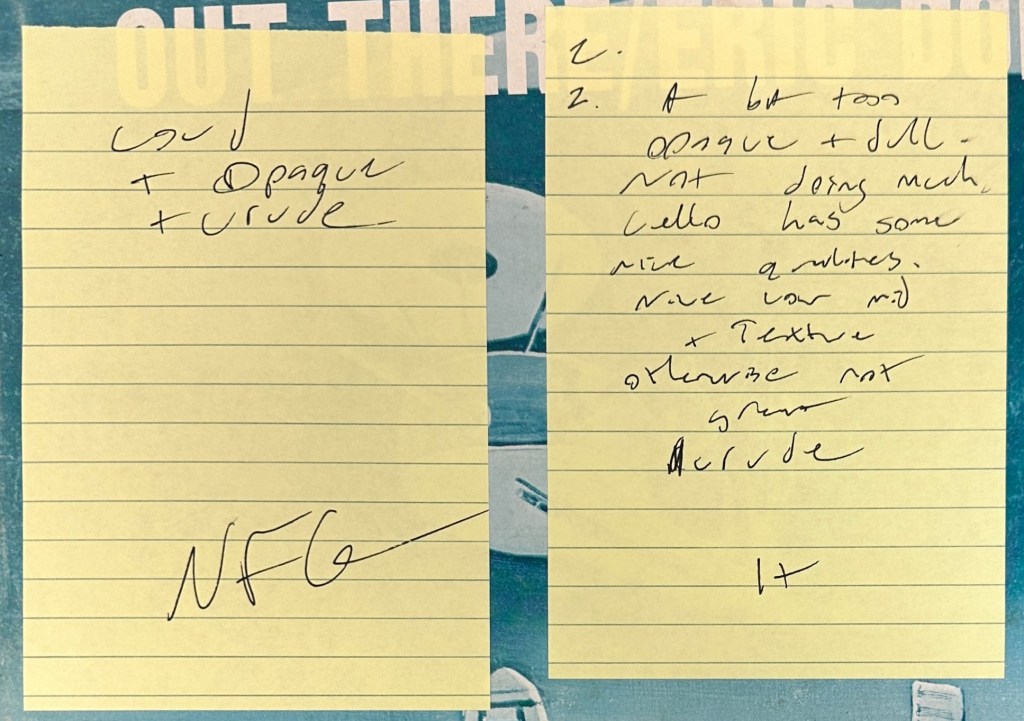
None of the Rudy Van Gelder cuttings we played of Eric Dolphy’s 1961 release of Out There were better than passable, and some had sides that were downright awful sounding, as you can plainly see from our notes.

The copies that won our most recent shootout were mastered by George Horn, and the best of them sound amazing. Here are some comments we made for the album years back as well as the Allmusic review:

Insanely good sound throughout with both sides earning Shootout Winning Triple Plus (A+++) grades. This copy was doing it all right: rich, full-bodied and Tubey Magical yet still super open and spacious.

“A somber and unusual album by the standards of any style of music, Out There explores Dolphy’s vision in approaching the concept of tonality in a way few others — before, concurrent, or after — have ever envisioned.” – 5 stars

As you will see from our notes, we played some very disappointing early pressings. All the early pressings we had on hand were expensive to acquire, the vintage jazz pressing market being what it is: expensive and full of optimistic record graders of questionable skill. (For these kinds of vintage pressings we probably return 70-80% of what comes our way.)
We have to pay top dollar to get copies that are clean, even on the 60s and 70s reissue labels. Noisy old jazz records are simply not saleable to audiophiles no matter how good they sound.

None of the early copies we played earned grades good enough to bother pursuing, not when there are wonderful sounding vintage reissues from the 80s available. On a more positive note, this being our first shootout for the album in many years, we certainly learned a lot, so let’s just chalk up the losses to the cost of doing business. Our newfound knowledge of the best pressings will continue to pay dividends for years to come now that we know what the right stampers tend to be.


(more…)

Coltrane’s Sound – Forget the 70s Reissues

Hot Stamper Pressings of the Music of John Coltrane Available Now

This is yet another superb Tom Dowd recording of Coltrane in his prime, with support from the brilliant McCoy Tyner and Elvin Jones.

Just don’t bother with the later Red and Green Atlantic pressings.

Every one we’ve ever played was flat, dry, and thin. They sound like most of the cheap reissues that Atlantic churned out in the ’70s.

Don’t get me wrong; there are some good sounding records on the Red and Green label, but you really have to know what you are doing — or be really lucky — to find them.

We’ve played them by the score, and found relatively few winners among a slough of losers. If you want to take your chances on some, knock yourself out, more power to you, but expect to come up with nothing to show for your time and money almost every time. That’s been our experience anyway.

And be very thankful if you happen to run into one of these early Atlantic stereo pressings, especially if it plays quietly. Few Classic Coltrane albums survived the jazz lovers of the day and their awful turntables.

(more…)

You Say Your Shaded Dog Just Sounds Like an Old Record?

Hot Stamper Pressings of the Music of Tchaikovsky Available Now

The better pressings of LSC 2328 have some of the best sound we have ever heard for The Nutcracker. We’ve played recordings of the work by the dozens, on the greatest Golden Age labels of all time, including the likes of Mercury, RCA and London. (Our current favorites of both the suites and the complete ballet are those conducted by Ansermet for Decca.)

The CSO, as one might expect, plays this work with more precision and control than most others. They also bring more excitement and dynamic contrasts to their performance, adding greatly to our enjoyment of the music.

Some may find the performances a bit rushed. That was our experience during our most recent shootout.

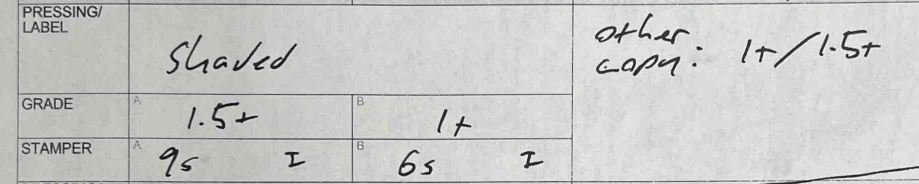
But skip 9s/6s. We had two copies and both of them sounded too much like an old record.

Pressings with those stampers might be passable, even to some degree enjoyable, especially when played on an old school system, but they would not be worth bothering with on the high quality modern equipment we use.

There are quite a number of other records that we’ve run into over the years with a catalog of obvious shortcomings — obvious to us but not necessarily to others — and we’ve broken them down into the three major labels that account for most of the best classical and orchestral titles we’ve had the pleasure to play.

(more…)

Always wanted to have a Plum and Orange pressing? Here’s your chance!

Hot Stamper Pressings of the Music of Led Zeppelin Available Now

We should have titled this one “here was your chance” since this pressing sold very quickly.

Over the years most Plum and Orange pressings were disposed of by us on ebay for the benefit of collectors and those audiophiles who might be ill-informed enough to think that early British pressings would have the best sound for Led Zeppelin III.

They do not. They can, however, sound reasonably good in some cases with the proper cleaning.

However, they are not even Double Plus (A++) good, which sounds like something from the novel 1984 but is in fact a Very Good grade and guaranteed to trounce any and all copies of the album you have ever heard.

No, the best Zeppelin album we have played to date with the early label in this case earned a grade of Single Plus to Double Plus, which we describe as “[a] wonderful sounding side with many impressive qualities, notably better than a Single Plus copy. A big step up from the typical pressing.”


UPDATE:

We do not even offer Single Plus copies on the site anymore. Although their faults would be less obvious to anyone who went through the shootout process with the album, such faults are much too bothersome to us precisely because we did go through that process.

Once you know what is right, it’s very easy to spot what is wrong.

This is the foundational principle of Hot Stampers.

(more…)

In 2008 We Discovered the Best Sound for this Album

Hot Stamper Pressings of Top Quality Jazz Albums Available Now

In the early 2000’s we auditioned an amazing sounding cheap reissue pressing of this album. By 2008 we finally had enough copies to do a shootout.

The fact that we were not able to find a copy with two killer sides tells me a few different things about what may or may not have been true at the time. (2008 was early days in the world of Hot Stamper shootouts.)

One, that we may not have had a big enough pile of copies to play. This is before Discogs made it easy to find a record like this, so chancing upon copies locally was very much a hit or miss deal, or

Two, we couldn’t clean them as well as we can now, or

Three, we couldn’t play them as well as we can now, or

Four, some or all of the above, to one degree or another. (This is of course how audio works, which, for those of us who have been in it for a long time, is best described as mysteriously.)

(more…)

Letter of the Week – “Any new audiophile pressing I have sounds flat when comparing it to a pressing you’ve sold”

Hot Stamper Pressings of the Music of The Beatles Available Now

One of our good customers had this to say about a Hot Stamper pressing of Sgt. Peppers he purchased from us a while ago:

Hey Tom,   

Wish I found your blog earlier. I do not have a huge collection but any new audiophile pressing I have sounds flat when comparing it to a pressing you’ve sold – i.e., Sgt Pepper.

Even my wife, who enjoys music but is not into it for the best sound, picked the 80s Pepper pressing I played her over the recent stereo remix and the mono from the box set everyone seems to love. Not close.

Dear Ryan,

It is indeed disheartening when collectors and audiophiles rave about mediocre records such as the two you mention. More proof, as if any were needed, that the audiophile record collecting world has lost its mind.

As for the copy you got from us having been pressed in the 80s, yes, we do sell some of those later pressings as Hot Stampers. The best of them can sometimes earn Super Hot (2+) stamper grades on one or both sides.

We always put a number of them in our shootouts to keep our grading honest by making sure that our best copies are a big step up over anything pressed in that decade. For The Beatles, a good rule of thumb is that the 60s can be rough and the 80s can be rough, but the 70s are where you will find the sweet spot for many of their titles.

For a big shootout we did in 2024, we actually had an early label pressing (stampers: -1/-2) that earned grades of 1.5+/2+ — not bad by any means, but a long ways from the best.

This early pressing would be the one that would set the standard for most audiophiles.

However, without a proper cleaning — good typically for a half-plus improvement or more — practically any of the Hot Stamper pressings we would sell would be better in almost every way, and a whole lot quieter to boot, at a fraction of the price a collector would be likely to pay for a clean first label pressing in stereo.

Glad to hear your wife had no trouble hearing the difference, they usually do.

Thanks for writing,

Best, TP

(more…)

An Overview of the Reissues of Teaser & The Firecat

Hot Stamper Pressings of the Music of Cat Stevens Available Now

It is my contention that there is no audiophile pressing on the face of the Earth that can compete with the best sounding originals of Teaser and the Firecat. 

Of ANY music. From ANY era.

The best copies of Teaser have a sound I have never experienced with any modern remastered record. There is a magic in its grooves that may simply be impossible to capture with the cutting equipment currently in use. Perhaps one day I’ll be proven wrong, but that day is clearly not yet upon us.

Island 25th Anniversary LP

I remember fifteen years ago when Acoustic Sounds was selling the then in-print 25th Anniversary Island pressing (10U, as I recall) for $15, claiming that it was a TAS list record. If you’ve ever heard that pressing, you know it has no business going anywhere near a Super Disc List. It’s mediocre at best and has virtually none of the magic of the good original pressings. I refused to sell it back in those days, for no other reason than it’s far from a Better Record. I don’t like misrepresenting records and I don’t like ripping off my customers. That pressing was a fraud and I was having none of it.

The Anadisq

In case you don’t already know, one of the worst sounding, if not the worst sounding version of all time, is the Mobile Fidelity Anadisq pressing that came out in the ’90s. If you own that record, you really owe it to yourself to pull it out and play it. It’s just a mess and it should sound like a mess, whether you have anything else to compare it to or not.

It’s also on the TAS Super Disc list, which is sad. Really, really sad. (more…)

How Do the The Mastering Lab Pressings of Sticky Fingers Sound?

Hot Stamper Pressing of the Music of The Rolling Stones Available Now

A listing for an early domestic Hot Stamper pressing for Sticky Fingers will typically be introduced like this:

If you have never heard one of our Hot Stamper pressings of the album, you (probably) cannot begin to appreciate just how amazing the sound is.

A landmark Glyn Johns / Andy Johns recording, our favorite by the Stones, a Top 100 Title (of course) and 5 stars on Allmusic (ditto).

After hearing so much buzz about it, we finally broke down and ordered a German TML pressing about a year ago. Having played scores of phenomenally good sounding copies of the album over the past fifteen or so years, we were very skeptical that anyone could cut the record better than the mastering engineers who inscribed Rolling Stones Records into the dead wax on the early pressings. (I could find no mastering engineers credited.)

Well, the results were not good. As we suspected would be the case, we were not impressed in the least with what The Mastering Lab — one of the greatest independent cutting houses of all time, mind you — had wrought.

Their version is not really even good enough to charge money for. It might have earned a grade of One Plus, just under the threshold for a Hot Stamper that we would put on the site these days. Decent, but not much more than that.

Wait, There’s More

We subsequently learned that it is the British TML pressings that are supposed to be the best.

So we got one of those in, an A3/B4 copy.

Better, but good enough? Barely.

Here are the notes for the copy we played. For those who have trouble reading our writing, I have transcribed the notes as follows:

Side One

Track one:

Weighty, a bit veiled or smeary. Backing vox kinda lost.

Track three:

Very full, rockin’ but not the sparkle/space.

Kinda compressed.

Not as huge.

Side Two

Track two:

Not as rich, clear.

A bit pushy/dry vox.

No real space.

Thick drums

Track one:

This works better.

A bit hard, but full and lively.

This Sound?

Is this the sound audiophiles are raving about?

(more…)

Why Are the Earliest Stampers on 461 Ocean Boulevard So Bad Sounding on Side Two?

Hot Stamper Pressings of the Music of Eric Clapton Available Now

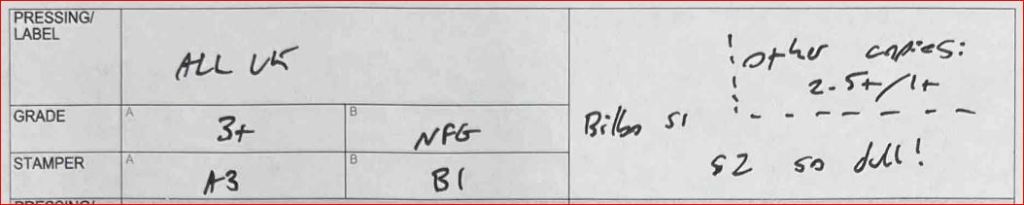
The UK pressings with the side two stampers shown below have not done well in our shootouts for a number of years now. If you own a copy with B-1 stampers on side two, the good news is that we can get you a much better sounding copy of 461 Ocean Boulevard than you have ever heard.

Stamper numbers are not the be-all and end-all in the world of records, a subject we discuss below, but after hearing too many copies with these stampers and substandard sound, from now on we are going to focus our attention on the stampers that do well and avoid copies with the B-1 marking on side two.

Bilbo cut the A-3 side one and did a great job; his side one won our most recent shootout.

Whoever cut side two really screwed it up, as you can see from our notes for our last two shootouts.

When it comes to stampers, labels, mastering credits, country of origin and the like, we make a point of revealing very little of this information on the site, for a number of good reasons we discuss here.

The idea that the stampers are entirely responsible for the quality of any given record’s sound is a mistaken one, and a rather convenient one when you stop to think about it. Audiophiles, like most everybody else on this planet, want answers.

In the world of records, there aren’t many, but B-1 for side two of this album is a clear exception to the rule that the stamper numbers are one part of a multi-faceted puzzle. In this case, B-1 is awful and is best avoided at all costs.

The Biz

Being in the shootout business means we have no way to avoid such realities, which is why it is so easy for us to accept them.

The amateurs and professionals alike who review records for audiophiles want there to be clear-cut answers for every album they write about. Uncertainty and trade-offs upset them no end.

We recognized twenty years ago that the empirical pursuit of record knowledge, practiced scientifically, must be understood as incomplete, imperfect, and provisional.

That is not going to change no matter how upsetting anyone may find it.

(more…)