
Hot Stamper Pressings on Decca & London Available Now
Sonic Grade: F
More vinyl dreck from Speakers Corner.
Pure mud. What piano ever sounded like this?
Hot Stamper Pressings on Decca & London Available Now
Sonic Grade: F
More vinyl dreck from Speakers Corner.
Pure mud. What piano ever sounded like this?

More of the music of Sergei Rachmaninoff (1873-1943)
Sonic Grade: Unknown
In the late ’90s, we described the sound of this pressing this way:
“Outstanding Rachmaninoff, dark and rich. Highly recommended.”
Since we have not played a copy of the album in over ten years [now 20], we have taken down our previous Sonic Grade of B as we have no idea how the record would fare today on our much-improved system.
For all we know it may have been recut, which is another problem with our older reviews of records we used to like: the new version could have very different sound from the one we played (and that’s not even taking into account the pressing variability, which we all know is sometimes huge).
 Decca and London Hot Stamper Pressings Available Now
The average copy of this 1976 recording has that dry, multi-miked modern sound that the 70s ushered in for many of the major labels, notably London and RCA.
How many Solti records are not ridiculously thick and opaque? One out of ten? If that. We’re extremely wary of records produced in the 70s; we’ve been burned too many times.
And to tell you the truth, we are not all that thrilled with most of what passes for good sound on Mehta‘s London output either, especially those recorded in Royce Hall. If you have a high-resolution system, these recordings, like those on Classic Records Heavy Vinyl that we constantly criticize, leave a lot to be desired.
Opacity is a real dealbreaker for us. Most of the classical records we play from later eras simply do not have the transparency essential to transporting us from our listening room into the concert hall.
One thing you can say about live classical music, it is never opaque. (It can be dry though. Some concert halls have that sound.)
No recording in our experience — our experience having been informed by playing thousands upon thousand of them — can ever be remotely as transparent as live music.
If you have any doubts, next time you come home from the concert hall, take a moment to put on a favorite recording of the same music. You may be in for quite a shock.
Other Deccas and Londons that we’d cleaned and played and found to be disappointing can be seen here.
For more on the subject of opacity on record, click here.
Here are some of the other records we’ve discovered that are good for testing string tone and texture.

Hot Stamper Classical and Orchestral Imports on Decca & London
Sonic Grade: B
One of the better Speakers Corner Deccas.
We haven’t played a copy of this record in years, but back in the day we liked it, so let’s call it a “B” with the caveat that the older the review, the more likely we are to have changed our minds.
This is a very early stereo recording, which means it is spacious and open, with little spotlighting.
But what is especially memorable is the choice of material, with a few of the more obscure overtures really brought to life here, such as the opening piece by Adam on side one: Si j’etais roi.
Although not long, every second is packed with color and energy, exactly what a good overture needs.
And it even has a glockenspiel! How can you go wrong?

Hot Stamper Pressings of the Music of Igor Stravinsky Available Now
For our shootout years ago of The Firebird we had three minty, potentially hot copies of the Mercury with Dorati, as well as our noisy ref. (We have a noisy reference copy for just about every major title now. We have been doing these shootouts for a very long time. After thirty years in the record business we have accumulated a World Class collection of great sounding records that are just too noisy to sell.)
UPDATE 2024
This is no longer true. Our customers seem to be able to put up with surface noise on the records we offer if the price is low enough. Not actually low, just low enough. We have a section for records with condition issues, and there are 175 entries in it as of today, which turns out to be more than a quarter of all the Hot Stamper pressings on the site as a matter of fact.
We had one FR pressing and two of the later pressings with the lighter label, the ones that most often come with Philips M2 stampers. This is how we described the winner:
So clear and ALIVE. Transparent, with huge hall space extending wall to wall and floor to ceiling. Zero compression.
Lifelike, immediate, front row center sound like few records you have ever heard.
Rich, sweet strings, especially for a Mercury. This side really gets quiet in places, a sure sign that all the dynamics of the master tape were protected in the mastering of this copy.
What we didn’t say — and what we never say in the listings — is what the second tier copies didn’t do as well as the shootout winner.
We used to. When you read the older entries, most of the time they mention the shortcomings that caused one side or another to be downgraded by some amount, usually something like a half to a full plus.
Not all the top end, not all the bass, not as present, slightly smeary, slightly congested — the list of potential faults for any given pressing is long indeed. These are all the problems we listen for and it’s the rare copy that doesn’t suffer from one or more of them.
We decided years ago that it was better just to let you hear the two sides of the record for yourself and make your own judgments about the sound, rather than make clear to you what areas we felt needed improvement.
Consider this example. If on our system the bass was lacking compared to the very best, perhaps on your system the bass was fine, not an issue, good enough. Without the top copy to compare yours to, how would you know how much better the bass could possibly be?
A classic case of “compared to what?”
Shootouts are the only way to answer that question, which, as we never tire of saying, is THE most important question in all of audio. This is why we do shootouts, and why you must do them too, if owning the highest quality pressings is important to you.
Click on the following link to see more records for which we’ve detailed the strengths and weaknesses of a specific copy.
What We Heard on The Firebird
With all that in mind, only the Triple Plus (A+++) copy, as described above, did everything right.
There were two Double Plus (A++) copies, and each of them fell short in different ways.
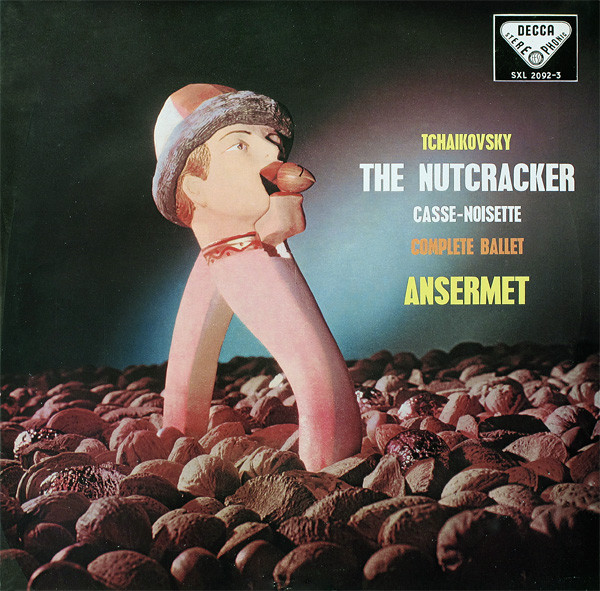
Hot Stamper Pressings of the Music of Tchaikovsky Available Now
Sonic Grade: B?
Not sure if we would still agree with what we wrote back in the ’90s when this record came out, but here it is anyway.
Superb! New records just don’t sound any better! This is the complete Nutcracker Ballet as conducted by Ansermet for Decca, a record that sets a standard of performance and sound that is unlikely ever to be equaled, and almost certainly not to be surpassed.
For those of you on a budget, if you can get your hands on one of these for a reasonable price, the Heavy Vinyl reissue would not be a bad way to go.
That’s assuming the copy you buy sounds at least good, similar to the one I played all those years ago, something that cannot be assumed.
But it would make for a good jumping off point.
A Must Own Classical Record (on Vintage Vinyl)
Ansermet breathes life into this ballet as only he can, and the Decca engineering team led by Kenneth Wilkinson do him proud.
It’s an Orchestral Spectacular that should have a place of honor in any audiophile’s collection.
Others that belong in that category can be found here.

Hot Stamper Pressings of Living Stereo Titles Available Now
Way back in 1994, long before we had anything like the system we do now, we were finding fault with the “Classic Records Sound.”
With each passing year — 28 32 and counting — we like that sound less. Some Classic Records pressings may be on Harry’s TAS list — disgraceful but true — but that certainly has no bearing on whether or not they are very good records.
I had a chance to play LSC 1806 (pictured above) not long ago and I was dumbfounded at how bright, shrill and aggressive it was.
I still remember playing my first Classic Records title, their first release, which would probably have been in 1994. The deep bass of the organ at the start of Also Sprach Zarathustra, the horns and the tympani blasting out from a dead silent background, put a lump in my throat. Had they actually managed to remaster these old recordings so well that the vintage pressings I was selling for such high prices would soon be worthless? I really do remember having that thought race through my mind.
But then the strings came in, shrieking and as bright as the worst Angel or DG pressing I’d ever heard. It was as if somebody had turned the treble control up on my preamp two or three clicks, into ear-bleeding territory. All my equipment at the time was vintage and tube, and even though my system erred on the dark side tonally, the first Classic release was clearly off the charts too bright and transistory, with none of the lovely texture and sheen that RCA was famous for in the early days of Living Stereo.
I knew right then that my vintage record business was safe.
 Hot Stamper Mercury Pressings Available Now
These notes are taken from the first shootout we did many years ago.
These are THE BEST HAYDN SYMPHONIES I have ever heard on disc. Folks, until I heard Dorati and the Festival Chamber Orchestra perform these pieces I never knew there could be this much FIRE in Haydn’s music. (Please excuse the pun; the 59th Symphony is entitled “Fire”.)
The producers and engineers for Mercury bring the kind of recording energy and presence to this music that I have frankly never heard before. Credit must go to both Dorati and his players.
His tempi are fast and sprightly throughout, and the smaller orchestra allows the players to zig and zag with the musical changes much more quickly than would be the case with a larger and more inertia-bound group.
The FCO are so technically proficient and so light on their feet that Dorati was able to push them to dizzying heights of performance. For the first time I can honestly say that Haydn’s music really works — it’s wonderful!
(If you’ve ever heard Previn conducting Prokofiev’s Classical Symphony with the L.A. Phil from 1990 you will know what I mean. In his (their) hands the work is so lively it’s hard to hear it performed by anyone else. Bad digital sound but it’s worth it to hear the piece played with such gusto.)

Hot Stamper Pressings of Classical and Orchestral Music Available Now
We review yet another mediocre Speakers Corner Heavy Vinyl reissue.
We recently gave the Heavy Vinyl pressing from Speakers Corner, the same one that we had previously recommended back in the 90s, a sonic grade of C+.
UPDATE 2024
Recently in this case means about twenty years ago.
To our ears now it has many more shortcomings than it did back then, which we discuss below.
So often when we revisit the remastered pressings we used to like on Heavy Vinyl we come away dumbfounded — what on earth were we thinking? These are not the droids sounds we are looking for. Perhaps our minds were clouded at the time.
Below are some thoughts from a recent classical listing that we hope will shed some light on our longstanding aversion to the sound of modern remasterings.
What is lost in these newly remastered recordings? Lots of things, but the most obvious and bothersome is TRANSPARENCY.
Modern records are just so damn opaque.
We can’s stand that sound. It drives us crazy.

Hot Stamper Pressings on Decca and London Available Now
UPDATE 2026
This was our take on the record way back in 1998 when we first started to carry it. This is our current favorite performance on record, but of course we prefer the vintage pressings of the recording as they clearly sound better. We prefer the best Decca pressings, but the Londons can be quite good as well, just not as good. In other words, they can’t win shootouts, but they will easily beat whatever other pressing you may have of the recording. (More on Decca Vs. London here.)
This is one of the better Speakers Corner Deccas. When they released this title on Heavy Vinyl in 1998, it became one of the few Speakers Corner classical recordings we carried and recommended.
We knew it sounded good, but up until recently [recently being 2010 or so], when we started collecting and playing the better vintage Deccas and Londons, we sure didn’t know it could sound as good as the best of those pressings do.
Below are some thoughts from a recent classical listing that we hope will shed light on our longstanding aversion to the sound of these modern remasterings.