_Composers – Stravinsky

We Expected Better from Frühbeck De Burgos, But We Didn’t Get It

Hot Stamper Pressings of Orchestral Spectaculars Available Now

We love the skill De Burgos brings to orchestral showpieces such as these, but the sound is not up to par for us. We’ve heard better. A lot better.

Bolero is shrill at the climax and the whole of side two was dull and opaque.

This EMI from 1976 might be passable on an old school system, but it was much too unpleasant to be played on the high quality modern equipment we use.

There are quite a number of other records that we’ve run into over the years with similar shortcomings. Here are some of them, a very small fraction of what we’ve played, broken down by label.

Note that there is no list of EMI’s. There are simply too many bad ones to make listings for.

  • London/Decca records with weak sound or performances
  • Mercury records with weak sound or performances
  • RCA records with weak sound or performances

The EMI classical albums we have reviewed to date can be found here.


Label:   His Master’s Voice – ESD 7019
Released:   1976

Ravel – Bolero
Chabrier: Espana – Rhapsody For Orchestra

Prokofiev – Symphony No.1 In D Major (Classical)

Stravinsky: Fireworks, Op.4
Stravinsky: Circus Polka (1942) (Composed For A Young Elephant)

(more…)

What’s on Your Turntable and Why?

Robert Brook runs a blog called The Broken Record, with a subtitle explaining that his blog is:

A GUIDE FOR THE DEDICATED ANALOG AUDIOPHILE

Here is Robert’s latest posting.

WHAT’s On Your TURNTABLE? and WHY?

You say your stereo is having trouble playing challenging recordings like The Firebird with Dorati?

You can’t get the strings in the loudest passages to sound the way you think they should? Too screechy are they? Or too smeary? Or too thin? Or too hard? Or even congested and almost distorted in the climaxes?

It’s amazing how many different ways there are for strings on an orchestral recording to sound wrong. If getting The Firebird’s strings to sound right is a goal you wish to achieve, you, my friend, have your work cut out for you.

Because nothing in audio is harder than reproducing the massed strings on the biggest, boldest orchestral recordings.

We have some good test discs for that specific purpose, but it will take a real commitment from you to bring about the success you seek.

Audio Is Hard

This is a drum we have been banging on for as long as I can remember, to the constant irritation of every less-than-serious audiophile who comes in contact with us — which all well and good. We haven’t catered to that crowd since we gave up on Heavy Vinyl in 2007.

We’re trying to reach a much smaller subgroup of more serious enthusiasts with our approach to audio and records. See here, here and here, and there are great many more discussions to be found on our audio advice page.

If you want to achieve any real success in audio, you need to do a lot of work and spend a fair amount of money. Not a fortune, maybe not even six figures, but trying to do audio on the cheap is a fool’s errand. It can’t be done.

Why is it any of our business how your system sounds? If it’s good enough for you, why isn’t it good enough for us?

A true Hi-Fidelity rig is in fact what makes our business possible.

Without top quality sound, our records can’t possibly be worth the admittedly high prices we charge for them.

We want to help you take audio to the next level for two reasons: one, because that’s where our records really come to life, and two, that’s where the shortcomings of the modern Heavy Vinyl reissue are too glaringly obvious to ignore.

I found a way to get there. Like me, Robert Brook found a way.

We believe that the more time you spend following the advice on our two blogs explaining how we got to where we are now, the clearer the path forward will be. We hope you can learn from our experience. It will cost you nothing and might just save you a great deal of money.

(more…)

Classic Records 45 RPM Recut – This Is Your Idea of a Great Firebird?

Hot Stamper Pressings of the Music of Igor Stravinsky Available Now

Many years ago, a customer alerted me to a review Wayne Garcia wrote about various VPI platters and the rim drive, and this is what I wrote back to him:

Steve, after starting to read Wayne’s take on the platters, I came across this:

That mind-blowing epiphany that I hadn’t quite reached with the Rim Drive/Super Platter happened within seconds after I lowered the stylus onto the “Infernal Dance” episode of Stravinsky’s Firebird (45 rpm single-sided Classic Records reissue of the incomparable Dorati/LSO Mercury Living Presence recording).

That is one of my half-dozen or so favorite orchestral recordings, and I have played it countless times.

This is why I have so little faith in reviewers. I played that very record not two weeks ago (04/2010) against a good original and the recut was at best passable in comparison. If a reviewer cannot hear such an obvious difference in quality, why believe anything he has to say?

The reason we say that no reviewer can be trusted is that you cannot find a reviewer who does not say good things about demonstrably mediocre and even just plain awful records. It’s the only real evidence we have for their credibility, and the evidence is almost always damning.

I want a reviewer who knows better than to play such an underwhelming pressing and then waste my time telling me about it. He should tell us what a good record sounds like with this equipment mod. Then I might give more credence to what he has to say.

Reviewer malpractice? We’ve been writing about it for more than 25 years.

P.S.

This is one of the Classic Records titles on Harry Pearson’s TAS List of Super Discs(!)

P.P.S.

Allow me to quote a writer with his own website devoted to explaining and judging classical recordings of all kinds. His initials are A.S. for those of you who have been to his site.

Classic Records Reissues (both 33 and 45 RPM) – These are, by far, the best sounding Mercury pressings. Unfortunately, only six records were ever released by Classic. Three of them (Ravel, Prokofiev and Stravinsky) are among the very finest sounding records ever made by anyone. Every audiophile (with a turntable) should have these “big three”.

Obviously we could not disagree more. I’ve played all six of the Classic Mercury’s. The Chabrier, Ravel and Prokofiev titles are actually even worse than the Stravinsky we reviewed.

This same reviewer raved about a record we thought had godawful sound, Romantic Russia on MoFi, a label that never met an orchestral string section it didn’t think needed brightening.

Find me a Mobile Fidelity classical record with that little SR/2 in the dead wax that does not have bright string tone. I have yet to hear one.

What is it with audiophile record reviewers? They seem to be taken in by the most unnatural sounding pressings. The world is full of wonderful vintage pressings that have no such problems. If you are an audiophile who feels himself qualified to write about records, shouldn’t you at least be able to hear the difference between a phony audiophile pressing and the vintage pressings it supposedly improved?

(more…)

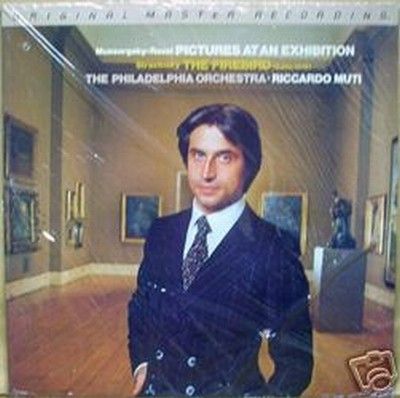
MoFi’s Pictures at an Exhibition Is as Wrong as Wrong Can Be

moussmofiHot Stamper Pressings of the Music of Mussorgsky Available Now

If you like orchestral spectaculars, have we got the record for you.

It’s the same recording of the works, but the one you want is on the real EMI label and pressed on UK import vinyl, not this awful Half-Speed recut from Japan.

The record you see pictured is awful sounding, a true hall of shame pressing.

And why are the colors of the album jacket so washed out? Compare their cover to the real thing below. As we often find ourselves asking after reviewing one of these MoFi records: What were they thinking?

The MoFi mastering of Pictures at an Exhibition and The Firebird here are a bad joke played on credulous audiophiles. And yes, I bought them both back when they came out. I was as credulous as everybody else buying these so-called superior pressings.

All that phony boosted top end makes the strings sound funny and causes mischief in virtually every other part of the orchestra as well. Not surprisingly, those boosted highs are missing from the real EMIs.

These appear to be the unbearably bright strings that Stan Ricker favors — why, we have no idea.

The proof? Find me a Mobile Fidelity classical record with that little SR/2 in the dead wax that does not have bright string tone. I have yet to hear one.

The last time I played a copy of the MFSL I found the sound so hi-fi-ish I couldn’t stand to be in the room with it for more than a minute. Of course the bass is jello as well.

The EMI with the right stampers is worlds better.

(Warning: The domestic Angel regular version and the 45 are both awful.)

MoFi had a bad habit of making bright classical records. (More reviews here.) I suppose you could say they had a bad habit of making bright records in general. A few are dull, some are just right, but most of them are bright in one way or another.

(more…)

Remind Me, What Is the Point of Listening to a Quiet Record with Mediocre Sound?

Hot Stamper Pressings of the Music of Igor Stravinsky Available Now

A lackluster reissue from Philips, bad enough to qualify for our hall of shame.

This is some truly dead as a doornail sound, sound which is not remotely competitive with the real Mercury pressings we’ve played. The FR pressings of the recording can be phenomenally good.  Even the later M2 pressings from Philips can be excellent. 

Back in the 80s and 90s, I actually used to like some of the Golden Import pressings.  That was a long time go, and thankfully our playback system is quite a bit more revealing than the one I had back in those days.

After playing literally tens of thousands of records since then, my critical listening skills are better too.

Now when I play these imports, they sound veiled, overly smooth, smeary and compressed, not too different from the average Philips pressing, which of course is exactly what they are. They’re all remastered by Philips, to give the Mercury tapes the sound that Philips thinks they should have. Sadly, not much of the Mercury Living Presence sound has survived.

We complain about mixing and mastering engineers who felt compelled to bring a new sound to old favorites.

The Philips label that produced the Golden Import series are serial offenders in this regard.

The Golden Import pressings might be good for audiophiles who care more about quiet surfaces than good sound.  We are firmly staked at the opposite side of that trade-off.

Quiet vinyl means nothing if the sound is poor, or, at the very least, wrong for the recording.

(more…)

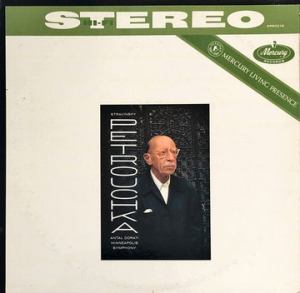
Stravinsky / Petrushka / Dorati

More of the Music of Igor Stravinsky

  • Excellent sound for this superb recording of Stravinsky’s ballet, with Double Plus (A++) grades on both sides of this vintage pressing (only the second copy to hit the site in nearly three years)
  • It’s also remarkably quiet at the high end of Mint Minus Minus, a grade that even our most well-cared-for vintage classical titles have trouble playing at
  • This spectacular Demo Disc recording is big, clear, rich, dynamic, transparent and energetic – here is the Mercury sound we love, and that is so hard to find
  • “Petrushka brings music, dance, and design together in a unified whole. It is one of the most popular of the Ballets Russes productions.”
  • 1960 was a great year for classical recordings – other Must Own orchestral releases can be found here.

This vintage Mercury pressing has the kind of Tubey Magical Midrange that modern records can barely BEGIN to reproduce. Folks, that sound is gone and it sure isn’t showing signs of coming back. If you love hearing INTO a recording, actually being able to “see” the performers, and feeling as if you are sitting in the studio with the band, this is the record for you. It’s what vintage all analog recordings are known for — this sound. (more…)

Stravinsky / The Rite of Spring – The Ultimate Recording of the Work

More of the music of Igor Stravinsky

  • An outstanding Shaded Dog pressing with superb sound from start to finish
  • Perhaps the greatest performance ever, certainly our favorite for performance and sound – this is not an easy piece of music to record judging by how many awful sounding versions exist — we should know, we played them
  • Monteux knows the work as well as anyone — he himself conducted the premier in 1913!
  • Mind boggling in its power to move the listener – a classic Decca Tree recording from 1956 by the master, Mr. Kenneth Wilkinson
  • There are about 150 orchestral recordings we’ve awarded the honor of having the best performances with top quality sound, and this recording certainly deserve a place on that list, close to the top I would think

It takes us three years — and a lot of hard work and a fair amount of luck — to get a shootout like this going.

The tympani and bass drum on this recording have few equals in our experience. This is the way HUGE and POWERFUL drums sound in concert. Those of you who go to classical concerts regularly will recognize that sound immediately. You probably also know that finding Golden Age recordings with this kind of deep bass is unusual to say the least.

The space and dynamic power of these sides are really something to hear on this groundbreaking work. Lush when quiet, clear and undistorted when loud, not many copies of Rite of Spring can do what these two sides can.

(more…)

Hovhaness / Mysterious Mountain / Reiner

More of the music of Alan Hovhaness (1911-2000)

More of the music of Igor Stravinsky (1882-1971)

  • Boasting two stunning Nearly Triple Plus (A++ to A+++) Living Stereo sides, this vintage Shaded Dog pressing is close to the BEST we have ever heard, right up there with our Shootout Winner
  • Tons of energy, loads of rich detail and texture, superb transparency and excellent clarity – the very definition of Demo Disc sound
  • This record will have you asking why so few Living Stereo pressings actually do what this one does.
  • The more critical listeners among you will recognize that this is a very special copy indeed. Everyone else will just enjoy the hell out of it.
  • We’ve reviewed most of the famous recordings Fritz Reiner did for RCA, and those reviews can be found here
  • With the advent of the stereo LP, RCA produced a large number of album titles using the wonderful Living Stereo banner across the top of the jacket. The link above will take you to titles either recorded or released in 1958.

(more…)

Stravinsky / Song Of the Nightingale / Reiner

More of the music of Sergei Prokofiev (1891-1953)

More of the music of Igor Stravinsky (1882-1971)

  • A vintage Shaded Dog pressing of these popular 20th century works featuring superb Double Plus (A++) Living Stereo sound from first note to last
  • The orchestra is wide, tall, and the dynamics and transparency of this copy are first rate
  • Spacious, rich and smooth – only vintage analog seems capable of reproducing all three of these qualities without sacrificing resolution, staging, imaging or presence

(more…)

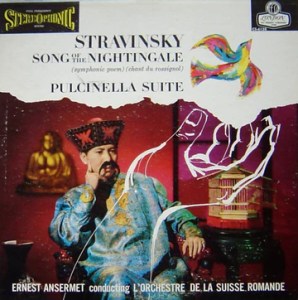
Stravinsky / Song of the Nightingale / Ansermet

More of the Music of Stravinsky

  • This vintage London stereo pressing of the L’Orchestre De La Suisse Romande‘s performance of Stravinsky’s symphonic poems earned STUNNING Shootout Winning Triple Plus (A+++) grades throughout
  • It’s also fairly quiet at Mint Minus Minus, a grade that even our most well-cared-for vintage classical titles have trouble playing at
  • Both of these sides of CS 6138 are BIGGER and RICHER than all the others we played – they’re clean and clear, tonally correct from top to bottom, and have all of the weight of the orchestra down low
  • Tons of energy, loads of detail and texture, superb transparency and excellent clarity – the very definition of demo disc sound
  • There are about 150 orchestral recordings we think offer the best performance coupled with the highest quality soundThis record has earned a place on that list.
  • More entries in our core collection of well recorded classical albums.

“Song of the Nightingale” is far more enjoyable in Ansermet’s hands than in Reiner’s or Dorati’s. The sound is significantly better on this pressing than on the Stereo Treasury, the RCA, and the Mercury versions.

Once past the obvious saturation that opens this recording, the sound is perfection. The percussion leaps off of this LP like it does with a good Direct To Disc recording.

The strength of this LP is “Song of the Nightingale.” The “Pulcinella Suite” never sounds as good. But what does?

(more…)