_Composers – Ravel

Destination Stereo – A Living Stereo Demo Disc

Hot Stamper Pressings of Living Stereo Titles Available Now

Your Destination — Stereo!

“Your passport to great music in new sound by the world’s greatest artists.”

This review was written about ten years ago.

This reasonably quiet RCA Shaded Dog LP has DEMONSTRATION QUALITY SOUND on BOTH sides. It is without a doubt THE best sounding copy we have ever heard*.

Side one is White Hot, with some of the best 1959 Living Stereo we’ve ever heard. Explosive dynamics, HUGE space and size, with unerringly correct tonality, this is a Demo Disc like no other.

When “in-the-know” audiophiles discuss three-dimensionalitysoundstaging and depth, they should be talking about a record that sounds like this.

Shockingly real – proof positive that the cutting systems of the day are capable of much better sound than many might think. 

(We admit that we have made the mistake of wrongthink in this regard.)

This record is designed to show off the Living Stereo sound at its best and it succeeds magnificently. The full range of colors of the orchestra are here presented with remarkable clarity, dynamic contrast, spaciousness, sweetness, and timbral accuracy.

If you want to demonstrate to a novice listener why modern recordings are unsatisfactory, all you have to do is play this record for them. No CD ever sounded like this.

Just play Gnomus to hear The Power of the Orchestra, Living Stereo style.

The fourth and fifth movements of Capriccio Espagnol, the second track on side one, sound superb, CLEARLY better here than on the Shaded Dog pressings of the original album we played about a year ago (which were terrible and never made it to the site. Great performance but bad mastering of what obviously was a very good master tape).

You can also hear the Living Stereo sound especially well on the excerpt from “The Fourth of July” performed by Morton Gould. It’s one of the best sounding tracks here.

I don’t think the RCA engineers can cut this record much better — it has all the Living Stereo magic one could ask for, as well as the bass and dynamics that are missing from so many other vintage Golden Age records.

This is as good as it gets, folks.

(more…)

Mussorgsky-Ravel / Pictures at an Exhibition / Reiner

  • For fans of Reiner’s performance from 1958, we here present a Shaded Dog pressing of this TAS Super Disc, here with outstanding Double Plus (A++) sound from start to finish
  • It’s also fairly quiet at Mint Minus Minus, a grade that even our most well-cared-for vintage classical titles have trouble playing at
  • Both of these sides are remarkably open and natural in the best Living Stereo tradition, with rich lower strings that have little Golden Age smear.
  • Spacious, rich and smooth – only vintage analog seems capable of reproducing all three of these qualities without sacrificing resolution, staging, imaging or presence

(more…)

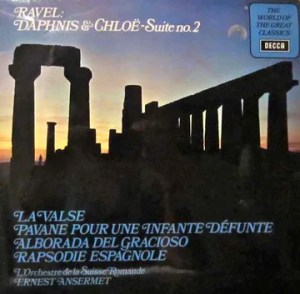
Ravel / Daphnis & Chloe – Suite No. 2 and more / Ansermet

More of the Music of Maurice Ravel

  • An incredible Decca pressing of these amazing orchestral works with a Shootout Winning Triple Plus (A+++) side one mated to a superb Double Plus (A++) side two
  • Both of these sides are clear, full-bodied and present, with plenty of space around the players, the unmistakable sonic hallmark of the properly mastered, properly pressed vintage analog LP
  • The presentation of the Suisse Romande is wide, tall, spacious, rich and tubey, exactly the way we want to hear them
  • When you hear how good this record sounds, you may have a hard time believing that it’s a budget reissue from the early-70s (1971 in this case), but that’s precisely what it is
  • Here is a link to more records like this one containing some of our Favorite Performances with Top Quality Sound

(more…)

Ravel / Haydn / Acoustic Recording Series, Volume 2 – Reviewed in 2008


More of the music of Maurice Ravel (1875-1937)

More of the music of Joseph Haydn (1732-1809)

A good sounding audiophile record?

Yes, it is possible, we would never deny it.

In fact, we actually sell some of the best ones ourselves.

The sound on the record is excellent. It was engineered by Mark Levinson, on special equipment designed to create virtually noiseless ultra-low-distortion master tapes, without noise-reduction systems.

It also doesn’t hurt that it’s been mastered by Robert Ludwig

(more…)

Ravel and Ansermet Produce The Best Bolero on Vinyl

Hot Stamper Pressings of the Music of Maurice Ravel Available Now

Here are some comments from a Hot Stamper listing we did years ago.

The sound is clear, with wonderful depth to the stage.

As a rule, the classic ’50s and ’60s recordings of Ansermet and the Suisse Romande in Victoria Hall are as big and rich as any you may have ever heard.

These recordings may just be the ideal blend of clarity and richness, with depth and spaciousness that will put to shame 98% of the classical recordings ever made.

Side One

Bolero (Ravel)

Tubey and clear, with both the snare and the flute coming from so far back in the hall. OUTSTANDING energy and dynamic power.

Turn it up and it really comes to life like LIVE MUSIC. It’s big, wide and believable. We loved it.

Side Two

The Sorcerer’s Apprentice (Dukas)

ZERO compression. ZERO distortion when loud. Which means it has ZERO compressor distortion, something not five out of a hundred Golden Age recordings can claim. Nice extended top too.

There is depth and richness to beat the band, as well as clarity and tonal correctness that let you forget the recording and just enjoy the music. This piece is not quite as transparent as the Ravel, but still has earned every one of its Three Pluses.

The timbre of the brass is right on the money. As we have noted before, the brass of the Suisse Romande is some of the best to have ever been committed to analog tape.

Again, this side had OUTSTANDING energy and dynamic power the likes of which we think you may never have heard.

La Valse (Ravel)

Boasting some of the best sound of the three works we played on this copy. Again, with that wondrously huge hall adding a sense of space that will allow your speakers to disappear. The performers are not too close, which is very much in keeping with live music.

In his tribute to Ravel after the composer’s death in 1937, Paul Landormy described the work as follows:

“….the most unexpected of the compositions of Ravel, revealing to us heretofore unexpected depths of Romanticism, power, vigor, and rapture in this musician whose expression is usually limited to the manifestations of an essentially classical genius.”

Big Speakers and Loud Levels Bring Out the Power of the Orchestra

Hot Stamper LPs that Sound Their Best on Big Speakers at Loud Levels

The darker brass instruments like tubas, trombones and french horns are superb here. Other Golden Age recordings of the work, as enjoyable as they may be in other respects, do not fully reproduce the weighty quality of the brass, probably due to limiting, poor eq, poor miking, or some combination of the three.

The brass on this record has the powerful weight and energy of live music like practically no other orchestral pressing we have ever played.

It’s also tonally correct. It’s not aggressive. It’s not irritating. It’s just immediate and powerful the way the real thing is when you hear it live. That’s what really caught my ear when I first played the recording.

There is a blast of brass at the end of Catacombs that is so big and real, it makes you forget you’re listening to a recording. You hear every brass instrument, full size, full weight. I still remember the night I was playing the album, good and loud of course, when that part of the work played through. The power of it was truly startling.

Back then I had the Legacy Whisper speaker system, the one with eight 15″ woofers. They moved air like nobody’s business. If you want to reproduce the power of the trombone, the loudest instrument in the orchestra, they’re the speaker that can do it.

Some of Ansermet’s recordings with the Suisse Romande are absolutely the best I’ve ever heard. It was a magical combination of the right hall, the right engineers, the right orchestra and the right technology — the pure tube ANALOG technology of the 50s and 60s!

Dynamics

Another thing this recording has going for it is dynamic power. This is a dynamic piece of music. Few recordings I have ever heard have the dynamic contrasts that this one does. It really gets loud when it needs to. The best pressings sound completely uncompressed. Although I’m sure there has to be compression of one kind or another, the listener is rarely made aware of it.

Dynamics such as these are thrilling. They let the music come alive.

(more…)

Ravel, Falla – Bolero, Three Cornered Hat, etc.

UPDATE 2026

This review is from 2011. Since then we have played many recordings of these works and mostly prefer others to this one. Please refer to the links below


Side two here has a SUPERB sounding Bolero, and an EVEN BETTER Alborado del Gracioso, possibly the best we have ever heard. Truly A Triple Plus sound.

As you probably know, Bolero is very hard to find on vinyl properly performed with audiophile quality sound. The sound of Bolero here is excellent: very natural, not harsh at the end where the trombones comes in, and not too compressed.

This is probably the biggest problem with most recordings of the work. Compression makes the quieter parts ravishingly open and clear, and positively ruins the climax with distortion caused by compressor overload.

A classic case of compression having sonic tradeoffs.

Alborado… has some of the best sound we have heard on London. It’s spacious, dynamic and clear. With an extended top end, the strings and horns sound harmonically correct. The orchestra from top to bottom is tonally correct as well.

Side One

The material on side one is not quite in the same league as that of side two, earning a grade of A+ for both works. The sound is a bit dry and lean, which means it is very detailed and clear but may not wear well unless your system is very rich and full in the lower mids and below.

My guess is that Old School Vintage Tube Equipment (or the modern equivalent thereof) may be just right for this side.

Either way, no matter what equipment you have, side two should be quite a thrill.

Side One

Weber / Berlioz – Invitation To The Waltz
Falla – The Three Cornered Hat

Side Two

Ravel – Bolero
Ravel – Alborado Del Gracioso

(more…)

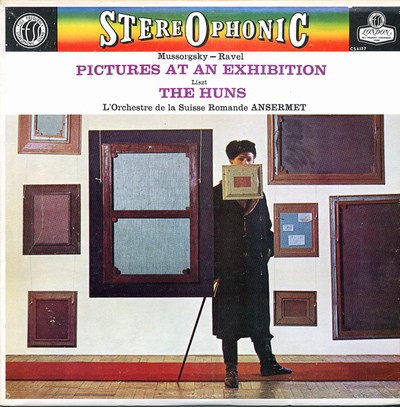
Mussorgsky / Pictures at an Exhibition / Ansermet

Hot Stamper LPs that Need to Be Played on Big Speakers at Loud Levels

Recordings that Sound Their Best on Big Speakers at Loud Levels 

I used to think Ansermet’s reading was ponderous, but this copy from 2013 is making me want to change my mind.

Is it more lively than others? Is the stereo that much improved since I last heard one of these Londons?

We have no way of knowing. All we do know is that we were enjoying Ansermet’s performance more than we ever had before.

The darker brass instruments like tubas, trombones and french horns are superb here. Other Golden Age recordings of the work, as enjoyable as they may be in other respects, do not fully reproduce the weighty quality of the brass, probably because of compression, limiting, tube smear, or some combination of the three.

The brass on this record has a power like practically no other recording of the work we know.

It’s also tonally correct. It’s not aggressive. It’s not irritating. It’s just immediate and powerful the way the real thing is when you hear it live. That’s what really caught my ear when I first played the recording.

There is a blast of brass at the end of Catacombs that is so big and real, it makes you forget you’re listening to a recording. You hear every brass instrument, full size, full weight. I still remember the night I was playing the album, good and loud of course, when that part of the work played through. It was truly startling in its power.

Some of Ansermet’s recordings with the Suisse Romande are absolutely the best I’ve ever heard. It was a magical combination of the right hall, the right engineers, the right orchestra and the right technology — the pure tube ANALOG technology of the ’50s and ’60s!

(more…)

Ravel / Concerto in G on Classic Records

Hot Stamper Pressings of the Music of Maurice Ravel Available Now

UPDATE 2025

We just played a Shaded Dog pressing of LSC 2271 and thought it was a good sounding record but not a great one. There may be great sounding pressings of available, but at the price clean copies command these days, $100 and up, we have decided not to pursue them anymore.


Classic Records did a passable job with this title, which is about the best they ever do. It’s a far cry from the sound heard on our Hot Stamper pressings, but for those of you who do not want to spend that kind of money, or for those who insist on quiet surfaces, the Classic is not a bad record.

The performance is excellent as well, and of course the Ravel Concerto is a piece of music that belongs in any serious collection.

This record also includes d’Indy’s Symphony on a French Mountain Air.

What do you get with Hot Stampers compared to the Classic Heavy Vinyl reissue?

Dramatically more warmth, sweetness, delicacy, transparency, space, energy, size, naturalness (no boost on the top end or the bottom, a common failing of anything on Classic); in other words, the kind of difference you almost ALWAYS get comparing the best vintage pressings with their modern remastered counterparts, in our experience anyway.

Now if you’re a Classic Records fan, and you like that brighter, more detailed, more aggressive sound, our Hot Stampers are probably not for you. We don’t like that sound and we don’t like most Classic Records. They may be clean and clear but where is the RCA LIVING STEREO Magic that made people swoon over these recordings in the first place?

Bernie manages to clean that sound right off the record, and that’s just not our idea of hi-fidelity.

(more…)

Ravel / Daphnis et Chloé / Monteux

More of the Music of Maurice Ravel

  • A vintage UK Decca pressing of Ravel’s complete Masterpiece that was doing everything right, earning INSANELY GOOD Shootout Winning Triple Plus (A+++) grades throughout. This copy of SXL 2164 is a knockout
  • The sound is big and rich, lively and open, with TONS of depth and huge climaxes that hold together
  • The voices in the chorus are clear, natural, separate and full-bodied — this is the hallmark of a vintage Golden Age recording: naturalness
  • We know of no other recording of the work that does as good a job of capturing such a large orchestra and chorus
  • Of course, Monteux is a master of the French idiom — his performance of the complete ballet here is definitive in our opinion
  • There are about 150 orchestral recordings we think offer the best performance coupled with the highest quality soundThis record is certainly deserving of a place on that list.

Both sides here are BIG, with the space and depth of the wonderful Kingsway Hall that the LSO perform in. John Culshaw produced the album, which surely accounts for the huge size and space, not to mention quality, of the recording. The sound is dynamic and tonally correct throughout.

(more…)