Rock and Pop LPs to Improve Your Playback

The Strings on Elton John’s Second Album Are a Tough Test

Hot Stamper Pressings of the Music of Elton John Available Now

What’s especially remarkable about Elton’s second album is the quality of Paul Buckmaster‘s string arrangements. I don’t know of another pop record that uses strings better or has better string tone and texture. Strings are all over this record, not only adding uniquely interesting qualities to the backgrounds of the arrangements but actually taking the foreground on some of the songs, most notably Sixty Years On.

When the strings give in to a lovely Spanish guitar in the left channel (which sounds like a harp!) just before Elton starts singing, the effect is positively glorious. It’s the nexus where amazing Tubey Magical sound meets the best in popular music suffused with brilliant orchestral instrumentation. Who did it better than The Beatles and Elton John? They stand alone.

Correct string tone and texture are key to the best-sounding copies. The arrangements are often subtle, so only the most transparent copies can provide a window into the backgrounds of the songs that reproduce the texture of the strings.

Without extension on the top, the strings can sound shrill and hard, a common problem with many pressings.

Without a good solid bottom end, the rockers (“Take Me to the Pilot”) don’t work either of course, but you can even hear problems in the lower strings when the bass is lightweight.

String tone on a pop record is a tough nut to crack, even more so on a record like this where the strings play such a prominent role. It’s the rare copy that allows you to forget the recording and let you just enjoy the music.

(more…)

The Turn Up Your Volume Test – Blood Sweat and Tears

Hot Stamper Pressings of the Music of Blood, Sweat and Tears Available Now

UPDATE 2025

This commentary was written about twenty years ago, back in the days when I could find clean 360 Label pressings of this album actually sitting in the bins of used record stores. The picture at the bottom says it all — I think we had more than forty copies to work through for our first shootout, pressings of the album that I had been buying (many from Robert Pincus, he was the B,S&T expert back then) since the late-80s. Blood, Sweat and Tears and I go way back.

You may notice that we rarely write about the album these days, and that’s simply because we are not able to find clean, early label pressings to play anymore. (The Red Label pressings can be good but they don’t come close to winning shootouts. Without at least some potential Shootout Winning copies, it makes no sense to do the shootout. The winners are the ones that pay for the losers, naturally, with some profit left over if things go as planned.)

Speaking of which: Our last shootout was quite a few years ago. If we somehow managed to luck into a few copies locally, it’s possible we could do the shootout tomorrow, but buying this title on Discogs and Ebay has been a nightmare, with upwards of 90% of the copies we buy ending up marked return to sender.

The cost in labor (and frustration) we incurred to pursue the album long ago forced us to move on, after plenty of swearing and licking of wounds of course. How is it that record sellers can be so oblivious to the scratches and wear on their consistently noisy vinyl offerings is beyond me.

For those of you who can’t devote the resources to finding a good copy on the Columbia 360 Label, the Gold CD put out long ago by Mobile Fidelity is excellent and well worth whatever you have to pay for it. And I mean that sincerely.


Our Old Commentary

In my opinion this is the BEST SOUNDING rock record ever made. I may be biased because I like the music so much, but played on a Big Speaker System a Hot Stamper pressing is nothing less than ASTOUNDING, the ultimate Demo Disc. It has the power of LIVE MUSIC.

You don’t find that on a record too often, practically never in fact. I put this record at the top of The Best Sounding Rock Records of All Time link (seen on the left) and said it was in a class of its own for good reason — IT IS IN A CLASS OF ITS OWN.

As I’ve noted before, this record is a milestone in the history of popular music. Not only is it The Most Successful Fusion of Rock and Jazz Ever. It’s also One of the Finest Recordings of Popular Music Ever.

The sound is nothing short of amazing. Just the drums alone are enough to win awards: the kick drum has real kick, the snare may actually be the best rock snare ever recorded, the cymbals shimmer like real cymbals; almost everything is right with this record. Especially the music.

Good Demo Disc, Good Test Disc Too

This is the kind of record that doesn’t fall into the good Demo Disc, bad test disc trap. It’s both a good Demo Disc and a good test disc; not too many records can make that claim. (Especially the kinds of records audiophiles tend to like.)

The good copies of this album sound good on almost any system. But the better systems reveal qualities to this recording that you are very unlikely to have ever heard on another record. That’s the Demo side.

On the test side, no matter what level your system is at, any change you make will be instantly obvious on this recording, for good or bad. Nothing can fool it. It’s too tough a test, the toughest I know of bar none. For this record to sound right, truly right, every aspect of its reproduction has to be at the highest level. Any shortcoming will be glaringly obvious. The record may still sound good, but it won’t really sound right. (Knowing what “right” means in this context makes all the difference in the world of course.)

One reason the turn up your volume test is such a great test — the louder the problem, the harder it is to ignore.

(more…)

Listening in Depth to Aja

Hot Stamper Pressings of the Music of Steely Dan Available Now

Generally, what you try to get on side one is a copy with ambience, because most copies are flat, lifeless and dry as a bone.

You want a copy with good punchy bass — many are lean, and the first two tracks simply don’t work at all without good bass. And then you want a copy that has a natural top end, where the cymbals ring sweetly and Wayne Shorter’s saxophone isn’t hard or honky or dull, which it often is on the bad domestic copies.

The truly amazing side twos — and they are pretty darn rare — have an extended top end and breathy vocals on the first track, Peg, a track that is dull on nine out of ten copies. (The ridiculously bright MoFi actually kind of works on Peg because of the fact that the mix is somewhat lacking in top end. This is faint praise though: MoFi managed to fix that problem and ruin practically everything else on the album.)

If you play Peg against the tracks that follow it on side two, most of the time the highs come back. On the best of the best, the highs are there all the way through.

Side One

Black Cow

Fagen’s voice on the first line will always sound grainy – it’s that way on the CD and every LP I have ever played, which means it’s on the tape that way. It will quickly pass, and the rest of the vocals will sound amazing if you have a Hot Stamper Copy.

This song is as BIG and BOLD sounding as any pop song I know. This is Demo Disc material if you have the system to do it justice.

And don’t you just love the way it starts on the upbeat? Now that’s the way to kick off an album!

Aja

Got a big speaker? Lots of power? You will need both to play this song right. Note how the percussion comes through the dense mix, without being abrasive in any way. That’s a sure sign that you have a copy with the transparency and resolution you need to bring out the track’s best qualities. The mix needs that percussion; it’s there for a reason. You, dear audiophile, need an LP that lets that percussion be heard. Many are called; few are chosen.

Deacon Blues

It’s the rare copy that gets the top end for the first two tracks right and still has enough presence and top end for this song, which will tend to sound dull even if the first two tracks don’t. The truly killer pressings get all three tracks to sound amazing, no mean feat.

Side Two

For some reason, side two is almost always cut at a lower level than side one. Pump up the volume a db or two in order to get the full Aja effect for the songs on this side.


UPDATE 2022

The commentary about Peg you see below was written many years ago, and I no longer agree with the claim it makes.

The MoFi is so bad in so many ways that whatever it fixes on the top end, it destroys everywhere else.

It’s one of the greatest audio disasters of the 80s, along with the equally awful Cisco pressing, which qualifies as one of the great audio disasters of the modern Heavy Vinyl era.

(more…)

These Records Helped Us Dramatically Improve Our Playback

Some of the Most Important Albums We Employed to Tune, Tweak and Improve Our Stereo, Room, Table Setup, Electrical Quality and More

The records on this list (limited to rock and pop for the most part but we’re working on adding in the classical and jazz) all have one thing in common: I made practical use of them to improve my equipment, room treatments, table setup, electrical quality and whatever else that I could think of that might result in higher quality playback.

Were it not for my desire to get the wonderful music on these albums to improve with each passing year (obsession may be the better word, and it’s certainly a better operating principle), Hot Stamper pressings would be at most a niche part of my collection. Worse, and a thought some may find too unpleasant to contemplate, Hot Stampers might have then accounted for only a small part of Better Records’ business.

By the mid-2000s when we started down this road for real, the stereo needed to evolve dramatically. It needed to become much more revealing and truthful than any system I had ever heard if we were going to carry out Hot Stamper shootouts all day.

The best of the best Hot Stamper pressings are often like needles in haystacks. No one in his right mind would go to all that trouble for music that was not emotionally powerful enough to be, for all intents and purposes, practically irresistible.

If you have records you can’t wait to play every time you make a change to your equipment, room, setup, etc., you know what I am talking about.

I favor large scale dynamic speakers because they are the only ones that seem capable of reproducing the demanding recordings you see listed below.

There is no question that the artists that made these albums, in concert with remarkably talented producers and engineers, sweated every detail of these exceptional recordings. For the last five decades I (now we) have been doing all we could to get these wonderful records to sound their best.

We know how good they can sound on systems that have what it takes to play them, because these are the records we used to test, tune and tweak the new studio we built.

The more of that kind of work you do — on your system, room and electricity — the more progress you will make in this hobby. With each improvement, these are the very recordings that will sound bigger and bolder than you ever imagined.

They are the most difficult-to-reproduce albums we know of. Difficult records are the ones that will help you make more real, demonstrable progress in this hobby than any others.

Again and again it was meeting the challenge of reproducing recordings such as these that allowed us to get to the next level, and the next one, and the one after that, and they can do the same for you.

The Top Two

By far the two most helpful records for testing over the last two decades were Tea for the Tillerman (going all the way back to 1984) and Bob and Ray Throw a Stereo Spectacular. We wrote about their uniquely valuable contributions to our audio progress in this commentary.

Led Zeppelin II is probably the main record our current listening panel uses to dial-in the Dynavector 17Dx cartridges we mount three or four times a year so that every record is always  being played with a relatively fresh cartridge. (We are dealers for Dynavector and would love to get you one to try.)

The records below in bold have been especially important for our work. They tend to be the titles that we played while tweaking and tuning the system, trying to solve one problem or another that we thought we heard when playing them. There should be quite a number of commentaries on the blog for each of them.

Also, at the bottom you will notice that more and more jazz and classical records are being added to the list as time permits.

Rock, Pop, etc.

(more…)

The Yes Album – Another Good Reason to Get Deeper into Audio

Hot Stamper Pressings of the Music of Yes Available Now

At its best, this album is a Big Speaker Prog-Rock opus with tremendous power and dynamic range, but it takes a special pressing to really bring the album to life. 

These guys — and by that I mean this particular iteration of the band, the actual players that were involved in the making of this album — came together for the first time and created the sound of Yes on this very album, rather aptly titled when you think about it.

With the amazing Eddie Offord at the board, as well as the best batch of songs ever to appear on a single Yes album, they produced both their sonic and musical masterpiece — good news for audiophiles with Big Speakers!

Drop the needle on a top copy and you will find yourself on a Yes journey the likes of which you have never known.

And that’s what I’m in this audiophile game for.

The Heavy Vinyl crowd can have their dead-as-a-doornail, wake-me-when-it’s-over pressings that are typically cheap to buy and tend to play quietly.  (Here’s one I couldn’t sit through with a gun to my head.)

The amount of effort that went into the recording of this album is comparable to that expended by the engineers and producers of bands like Supertramp, ELP, The Who, Jethro Tull, Ambrosia, Pink Floyd and far too many others to list.

It seems that no effort or cost was spared in making the home listening experience as compelling as the recording technology of the day permitted. Tubey Magical British Prog Rock just doesn’t get any better.

(more…)

This Mud Slide Slim Rocked Like No Other Pressing We’d Ever Heard

Hot Stamper Pressings of the Music of James Taylor Available Now

This Shootout Winning copy from 2008 or thereabouts showed us a Mud Slide Slim we had no idea could exist.

We have a name for records like this. We call them breakthrough pressings. They are one of the reasons we play so many thousands of records every year. We’re looking for records that sound as good as this one does, even for titles that no one thinks are particularly well recorded.

No, especially for those titles.

Experience has taught us they can only be found by playing lots of pressings and looking for whatever needles might be hiding in the haystacks. (The haystack for One Man Dog can be seen at the bottom of this post.)

As you will see from our commentary, the first track on side one, Love Has Brought Me Around, is a great test for energy.

If your copy does not seem very energetic to you, then we recommend you keep buying every green label original you see until you find one that does.

Our commentary from the early days of shootouts can be seen below.

(more…)

Our Tumbleweed Connection to the Tubey Magical Top Ten

Hot Stamper Pressings of the Music of Elton John Available Now

You don’t need tube equipment to hear the prodigious amounts of Tubey Magic that exist on Tumbleweed Connection. For those of you who’ve experienced top quality analog pressings of Meddle or Dark Side of the Moon, or practically any jazz album on Contemporary, whether played through tubes or transistors, that’s the luscious sound of Tubey Magic, and it is all over Elton John’s Masterpiece, Tumbleweed Connection

Ranked strictly in terms of Tubey Magic, I would have to put Tumbleweed Connection on our list of Most Tubey Magical Rock Recordings of All Time, right up there with, in alphabetical order (limited to one album per artist or band):

This has to be one of the best sounding rock records of all time — certainly worthy of a Top Ten spot on our Top 100 list. Engineered by Robin Geoffrey Cable at Trident, there is no other Elton John recording that is as rich, big, powerful and dynamic as Tumbleweed Connection. (Honky Chateau, the Self-Titled album and Madman Across the Water would not be far behind. All are amazingly good sounding Rock Demo Discs that — on the right pressings of course — will more than likely put to shame 99% of the records you own.)

Many of the albums you see here played an important role in helping me improve my stereo [1], some of them starting as far back as the mid-70s.

(more…)

Save the Life of My Child Is One Tough Test

Hot Stamper Pressings of the Music of Simon and Garfunkel Available Now

The big production songs on Bookends have a tendency to get congested on even the best pressings, which is not uncommon for four track recordings from the 60s.

Those of you with properly set up high-dollar front ends should have less of a problem than those of you without them. $3000 cartridges can usually deal with this kind of complex information better than $300 ones.

But not always. Expensive does not always mean better, since painstaking and exacting setup is so essential to proper playback.

Save the Life of My Child — A Tough Test

I used to think this track would never sound good enough to use as an evaluation track. It’s a huge production that I had heretofore found all but impossible to get to sound right on even the best original copies of the album. Even as recently as ten years ago I had basically given up on reproducing it right.

Thankfully things have changed. Nowadays, with carefully cleaned top copies at our disposal and a system that is really cooking, virtually all of the harmonic distortion in the big chorus near the opening has disappeared. It takes a very special pressing and a very special stereo to play this song. That’s precisely what makes it a good test!

America — Another Tough Test

America is another one of the toughest tracks to get right. The big ending with its powerful orchestral elements is positively stunning on the rare copies that have little or no congestion in the loudest passages.

On virtually every copy you will ever hear the voices on this track are a little sibilant. Modern records are made with what is known as a de-essing limiter. This limiter recognizes sibilance and keeps it under control, because once the cutter head sees that kind of high frequency information, which is already boosted for the RIAA curve, it will try to cut it onto the record and the result will be this kind of spitty distortion.

(more…)

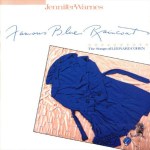
Listening in Depth to Famous Blue Raincoat

Hot Stamper Pressings of the Music of Leonard Cohen Available Now

I’m a huge fan of this FBR. It’s the only album Jennifer Warnes ever made that I would consider a Must Own recording or a Desert Island Disc. Without question this is her Masterpiece.

Key Test for Side One

Listen to the snare drum on Bird on a Wire. On most copies it sound thin and bright, not very much like a real snare. Let’s face it: most copies of this record are thin and bright, and that’s just not our sound here at Better Records. If the snare on Bird sounds solid and meaty, at the very least you have a copy that is probably not too bright, and on this album that puts it well ahead of the pack.

While you’re listening for the sound of that snare, notice the amazing drum work of Vinnie Colaiuta, session drummer extraordinaire. The guy’s work on this track — especially with the high hat — is genius.

Key Test for Side Two

Listen to the sound of the piano on Song of Bernadette. If it’s rich and full-bodied with the weight of a real piano, you might just have yourself a winner. At the very least you won’t have to suffer through the anemically thin sound of the average copy.

Side One

First We Take Manhattan

Don’t expect this song to be tonally correct. It runs the gamut from bright to too bright to excrutiatingly bright. Steve Hoffman told me that he took out something like 6 DB at 6K when he mastered it for a compilation he made, and I’m guessing that that’s the minimum that would need to come out. It’s made to be a hit single, and like so many hit single wannabes, it’s mixed brighter than we audiophiles might like.

(more…)

Neil Young’s Guitar Masterpiece – Danger Bird

Hot Stamper Pressings of the Music of Neil Young Available Now

Listen to the way Danger Bird (the second track on side one of  Zuma opens. Each instrument, one by one, slowly, deliberately, one could almost say haltingly, feeds into the mix, until the churning guitars give way to Neil’s spare vocal — fatalistic, doomed, already resigned to some fate he barely understands. 

Even though the song has just begun, you sense that Neil feels a weight and a darkness bearing down on him, that it’s ongoing, that it’s already started, that somehow you’re coming into it in the middle, well after the weight of it has begun to crush and perhaps even kill him. He knows the story of Danger Bird all too well.

It’s as powerful and intense a piece of music as any I have ever experienced; sublime in its simplicity, transcendental in effect. You feel yourself swept along, an out of body experience that you can’t control. When Neil launches into the first of many guitar solos the sense of journeying or exploring with him the imaginary musical world he is creating is palpable. He doesn’t seem to know where it will lead and neither do you. There is no structure to reassure you, no end in sight, only the succession of notes that play from moment to moment, first tensing, then relaxing; cresting, then falling away.

Music has the power to take you out of the world you know and place you in a world of its own making. How it can do that nobody knows. Whatever Neil tapped into to make that happen on Danger Bird, he succeeded completely.

If you’re in the right frame of mind, in the right environment, with everything working audio-wise, a minute into this song you will no longer be sitting in your comfy audio chair. You won’t know where you are, which is exactly where you should be.

(more…)