good-audio-advice

Azimuth – A Little Can Make a Lot of Difference

Robert Brook runs a blog called The Broken Record, with a subtitle explaining what the aim of his blog is:
A GUIDE FOR THE DEDICATED ANALOG AUDIOPHILE

We know of none better, outside of our own humble attempt to enlighten that portion of the audiophile community who love hearing music reproduced with higher fidelity and are willing to go the extra mile to make that happen.

Here is Robert’s latest posting. He recently spent some time with our favorite recording of the Beethoven First Piano Concerto, and needless to say, he’s glad he did.

AZIMUTH: A LITTLE Can Make A LOT of Difference!

You may enjoy our piece on azimuth and other aspects of turntable setup in this posting from many years ago.

Lately we have been writing quite a bit about how pianos are good for testing your system, room, tweaks, electricity and all the rest, not to mention turntable setup and adjustment.

(more…)

Bose Salutes the Sound Of Mercury Records (and Some Audio Lessons Learned Long Ago)

Hot Stamper Pressings of Mercury Recordings Available Now

This Bose / Mercury Demonstration LP is autographed by none other than Amar G. Bose. The autograph reads “To EMI, with regards and best wishes, Amar G. Bose.”

Bose may not have ever made very good speakers, but they sure knew good recordings when they heard them. This LP has excerpts from some of the top Mercury titles, including music by Copland (El Salon Mexico), Kodaly (Hary Janos Suite), Mussorgsky/ Ravel (Pictures At An Exhibition), and Rimsky-Korsakov (Russian Easter Overture).

I played one of these Bose records years ago and was surprised at how good it sounded. The transfers of the Mercury tapes were excellent. I guess that makes sense — if you want to show off your speakers you had better use a well-mastered record for the demonstration.

I was duped into buying my first real audiophile speaker, Infinity Monitors, when the clever salesman played Sheffield’s S9 through them. I bought them on the spot. It was only later when I got home that none of my other records sounded as good, or even good for that matter. That was my first exposure to a Direct to Disc recording.

To this day I can still picture the room the Infinity’s were playing in. It was a watershed moment in my audiophile life.

And of course I couldn’t wait to get rid of them once I’d heard them in my own system with my own records. I quickly traded them in for a pair of RTR 280-DRs. Now that was a great speaker! A 15 panel RTR Electrostatic unit for the highs; lots of woofers and mids and even a piezo tweeter for the rest. More than 5 feet tall and well over 100 pounds each, that speaker ROCKED.

(more…)

Does Anybody Ever Talk About the Dry String Tone on London LPs?

Hot Stamper Pressings of the Music of Tchaikovsky Available Now

Not that we know of.

If audiophiles and the reviewers who write for them are listening carefully to these famous recordings on the supposedly high quality (and often very high-dollar) equipment they use, why do they never talk about this problem?

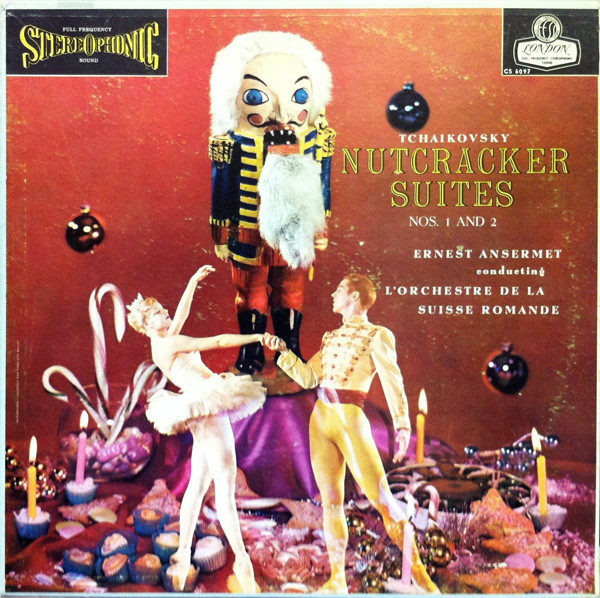
Here is what we noticed when we played a big batch of Nutcracker recordings on London and Decca:

On some copies of this album the strings are dry, lacking in that wonderful quality we like to call Tubey Magic. Dry is decidedly not our sound, although it can often be heard on the hundreds of London pressings we’ve played over the years.

And we imagined that this might be the culprit:

If you have a rich sounding cartridge, perhaps with that little dip in the upper midrange, the one that so many moving coils have these days, you may not notice this tonality issue nearly as often as we do.

Our Dynavector 17Dx Karat is ruler flat and quite tonally unforgiving in this regard. It makes our shootouts much easier, but brings out the flaws in all but the best pressings, exactly the job we require it to do.

We discussed the issue in a commentary entitled Hi-fi beats my-fi if you are at all serious about audio.

(more…)

Even Shootouts Won’t Teach You What You Can Learn from Variations in Your Table Setup

Hot Stamper Pressing of the Music of Joni Mitchell Available Now

As anyone familiar with album knows, Court and Spark has loud vocal choruses on a number of tracks. More often than not, during the loudest sections they sound like they are either breaking up or threatening to. This quality of “almost breaking up” is most easily heard on Down to You.

I always assumed it was compressor or board overload. But on the best of the best copies there doesn’t seem to be any breakup — the voices get loud and stay clean throughout.

Which means that instead of being on the master tape, it might be compressor distortion that is occurring during the mastering.

Regardless of the source of the distortion, or lack thereof, the loudest choruses are a tough test for any system.

Setup Advice

If you have one of our hottest Hot Stampers, try adjusting your setup — VTA, Tracking Weight, Azimuth, Anti-Skate — Especially! Audiophiles often overlook this one, at their peril — and note how cleanly the loudest passages play using various combinations of settings.

Keep a yellow pad handy and write everything down step by step as you make your changes, along with what differences you hear in the sound.

You will learn more about sound from this exercise than you can from practically any other. Even shootouts won’t teach you what you can learn from variations in your table setup.

And once you have your setup dialed in better, you will find that your shootouts go a lot smoother than they used to.

(more…)

In the Market for New Speakers? See How Well They Handle the Fat Snare on Dreams

Hot Stamper Pressings of the Music of Fleetwood Mac Available Now

Rumours is a record that is good for testing your speakers’ lower midrange and mid-bass reproduction.

What do the best copies of Rumours have that the also-rans don’t?

Lots and lots of qualities, far too many to mention here, but there is one you should pay special attention to: the sound of the snare.

When the snare is fat and solid and present, with a good “slap” to its sound, you have a copy with weight, presence, transparency, energy — all the analog stuff we adore about the sound of the best copies.

Now if your speaker is not capable of getting the snare to sound that way, perhaps because you have screen speakers or a small boxed design, or a lousy copy of the album (anything without KP in the deadwax), this is still a handy test. Next time you are on the hunt to buy new speakers, see which ones can really rock the snare.

That’s probably going to be the speaker that can do justice to Rumours, and The Beatles, and Zuma, and lots of other favorite records of ours, and we hope favorites of yours too.

The speaker you see to the left is probably not the right kind of speaker for a record such as Rumours. Three 6.5 inch woofers are just not going to be enough to get that snare to sound big and fat.

Here are some other records that are good for testing the sound of the snare drum.

(more…)

Cartridge Break-In and Setting Azimuth

Robert Brook runs a blog called The Broken Record, with a subtitle explaining that the aim of his blog is to serve as:

A GUIDE FOR THE DEDICATED ANALOG AUDIOPHILE

We know of none better, outside of our own humble attempt to enlighten that portion of the audiophile community who love records and are looking to understand them better.

Here is one of Robert’s most recent postings.

Cartridge BREAK-IN and Setting AZIMUTH

More of Robert’s advice on equipment and setup:

(more…)

We Was Wrong about Presence

Hot Stamper Pressings of Led Zeppelin’s Albums Available Now

My history with Led Zeppelin’s seventh album is a classic case of me mistakenly blaming the recording.

In our listings for Presence from about fifteen years ago (a lifetime in audio, at least for us) we noted:

“By the way, Royal Orleans (at the end of side one) never sounds good; it’s always grainy. Same story with the intro to Nobody’s Fault But Mine. It sounds like groove damage, but since it’s on every last one of our domestic copies (the only ones that have the potential to sound amazing in our experience) we know it has to be a pressing problem and not a problem with the individual copies. It’s a shame, but the rest of the songs here all sound amazing.”

This is no longer true, or at least the part about Nobody’s Fault But Mine being grainy or distorted isn’t, since I didn’t test Royal Orleans this time around.

I had just put in a fresh Dynavector 17d3 two days before and spent almost three hours getting the setup dialed in. In fact, it was so right when I was done that I spent the next three or four hours experimenting with room treatments.

When I was done the changes seemed to have opened up the sound and increased the transparency even further. (I went a little too far and had to dial it back a bit, but that’s not at all unusual in my experience.)

Wait a Minute

So now I’m reading about the problems we used to encounter with Nobody’s Fault and thinking to myself, “Wait a minute. I didn’t hear any grain or distortion. Not on the good copies anyway.”

Of course the reason I hadn’t heard those problems is that over the last year or so we’d fixed them.

How I don’t really know.

Maybe the main improvements happened just last week with the cartridge being dialed in better.

Or maybe it was that in combination with a few new room tweaks.

Or maybe those changes built upon other changes that had happened earlier; there’s really no way to know.

(more…)

Look Around, Then Listen for the Huge Room on Roda

Basic Audio Advice — These Are the Fundamentals of Good Sound

If you have a good copy of Look Around and a high-rez stereo/room and want to have some fun, play the second track on side one, Roda. In the left channel there is some double-tracked clapping (or two people, how could you tell the difference?) in a HUGE room. Actually, although it may sound like a huge room, it’s probably a normal-sized room with lots of reverb added to the recording.

Either way it sounds awesome. 

These hand claps drive the energy and rhythm of the song, and they are so well recorded you will think the back wall of your listening room just collapsed behind the left speaker. On the truly transparent copies the echo goes WAY back.

(Note that it can also be heard in the center of the soundfield and off to the right as well, but, of course, those effects can only be heard on the best copies, on the best equipment, in the best rooms.)

Without a doubt it was the most fun sound we heard in a full day of shootouts.

The typical copy of the album won’t show you how big that room is.

The long out of print Speakers Corner heavy vinyl pressing won’t either. Their version is okay, not bad, but by no stretch of the imagination competitive with any Hot Stamper pressing.

The typical audiophile stereo will also have a hard time reproducing the huge room in which those hand claps can so clearly be heard. You will need to have all the latest stuff, a very good front end and a very fast cartridge to get the sound of that room to come out of your speakers.

Most pressings of this album are grainy, shrill, thin, veiled, smeary and full of compressor distortion in the louder parts. This is not a recipe for audiophile listening pleasure.

Room Treatments Bring Out The Best

(more…)

Go Nude for Even Better Sound

Robert Brook runs a blog called The Broken Record, with a subtitle explaining what the aim of this blog is:

A GUIDE FOR THE DEDICATED ANALOG AUDIOPHILE

We know of none better, outside of our own humble attempt to enlighten that portion of the audiophile community who love hearing music reproduced with higher fidelity and are willing to go the extra mile to make that happen.

Nothing will bring you as much joy as when you manage, by whatever means, probably against all odds, to make significant audio progress.

The more progress you make, the more you will enjoy your favorite music. At least that’s what happened to me over the course of the last fifty years as I set about working on my system, room and a great deal more.

Here is Robert’s latest posting.

“NUDE” Your Dynavector KARAT 17DX Cartridge for EVEN BETTER Sound


More on Robert’s system here. You may notice that it has a lot in common with the one we use. This is not an accident.

And it is also no accident that these two systems just happen to be very good at showing their owners the manifold shortcomings of the modern remastered LP, as well as the benefits to be gained by doing shootouts in order to find dramatically better sounding pressings to play.

(more…)

Can Every Audiophile System Do Its Job Well?

More on the Subject of Speaker Advice

That depends on exactly what job you think you’re giving it to do.

If its job is to allow you to enjoy music in the comfort of your home, then the little box speakers you see pictured to the left can do that job just fine, with the caveat that you must be able to enjoy the kind of sound that comes out of little boxes.

If the job you give your stereo to do is to reproduce the full range of music with high fidelity, then the little boxes you see pictured are going to fail miserably. Until the laws of physics are repealed, however that might happen, they will never be able to reproduce music in a lifelike way.

I like big dynamic speakers because they do a better job of reproducing music in a lifelike way compared to every other speaker I have ever heard, horns included, which can be very lifelike indeed, but have other shortcomings that I cannot abide.

This is not just another post bashing small speakers. I say these things to introduce the comment sent to me that you see below.

I received this anonymous letter recently in reply to a commentary I had written entitled Tone Poets and one-legged Tarzans.

Another poster defended rl1856’s claims for the abilities of his system to judge different pressings, noting that his criticisms of these remastered records — both on Tone Poets and Classic Records — generally align with mine.

I find this ending hilarious: “Never Played One – To be clear, we have never played a Tone Poets record. We’ve played many titles mastered by Kevin Gray, and we know that he is credited with mastering some records for the label. Without exception we find that his remastered records leave a lot to be desired. You can find many of them in our Hall of Shame. Anyone defending his work to me has some heavy lifting to do.”

You condemn rl1856 for expressing an opinion regarding something YOU ADMIT YOU NEVER HEARD because you believe his equipment is not resolving enough ? The irony is that his opinion largely mirrors yours regarding the sonic virtues of original RVG recordings ! How is it that he, listening through his “inferior” system can hear the virtues you ascribe to RVG pressings, and also hear when those virtues are not present?

My reply, after a week of thinking about the points this gentleman makes, can be seen below.

Hi,
Thanks for writing.

Little box speakers do produce sound of some quality. It would be foolish for me to say that one can’t actually hear something through them. The question is how much?

I believe the answer is not much, and that nobody reviewing records, or comparing one pressing to another, should be fooling himself into thinking he can do either one with a speaker of such little fidelity to the sound of live music.

Good stereos playing good records can sound like live music. With the volume up high and a shootout winning pressing on the table, in our studio the best of RVG’s recordings sound very much like live music

Does anyone think that, brought into this gentleman’s listening room wearing a blindfold and seated in the listening chair, he could be fooled into thinking he was hearing live music instead something coming out of some boxes?

Nothing I’ve played that Kevin Gray mastered, when played on the system we use — the one we developed specifically to evaluate the sound quality of records — was ever noticeably better than mediocre.

We’ve played his records by the score. They all suffer from the same suite of shortcomings to one degree or another, the specifics of which we have described in detail in post after post throughout this blog. (Here is a good example of some of his recent work.)

(more…)