Live and Learn

Here we discuss the records we think we got, uh, wrong.

It’s not really a problem for us though. We feel no need to cover up our mistakes. Recognizing and correcting previous errors is how we’ve managed to learn so much about records that no one else seems to know.

Gaining knowledge — in any field, not just record collecting or music reproduction — is always slow, incremental and riddled with errors and bad judgments.

A common misperception among those visiting the site is that we think we know it all. Nothing could be further from the truth. We learn something new about records with practically every shootout.

By playing the records grouped here, under rigorously controlled conditions, on top quality equipment, we found out just how much better or worse they are than are we thought.

Workin’ And Steamin’ – We Were Dead Wrong about the Originals

davismiles

Hot Stamper Pressings of the Music of Miles Davis Available Now

This review is for a pressing we put up around 2010.

Up to that time we had never played a clean, early pressing, and when we finally were able to put some in our shootout, one of them had sound that was out of this world.

In the commentary below we discuss what we think the early pressings probably sound like. Now, having heard how good the best of them can sound, we admit we clearly needed to do more research and development.

The record pictured above can have superb sound, much better than any modern Heavy Vinyl reissue you care to name.

However, the right properly-cleaned early pressings have the potential to take the sound of this music to the next level, a level we had no idea could exist until that right record came our way.

(more…)

We Learned a Valuable Lesson About Goats Head Soup in 2016

More of the Music of The Rolling Stones

Presenting a classic case of live and learn.

We would agree with very little of what we had to say about Goat’s Head Soup as a recording when we wrote about it back in 2011 — and for the previous 35+ years since I had first played a domestic original. (Turns out the imports are no good either.)

Having done a big shootout for the album in 2016, we now know that there most certainly are great sounding pressings to be found, because we found some. We broke through.

The data are in, and now we know just how wrong we were.

In our defense, let me just ask one question: Did anybody else know this record was well recorded? I can find no evidence to support anyone having ever taken such a contrarian position.

But we’re taking that position now.

All it takes is one great sounding copy to show you the error of your ways, and we had more than one.

Here’s what we had to say back in 2011. After having played dozens of copies and never hearing the record sound more than passable, can you blame us?

(more…)

We Was Wrong about Presence

Hot Stamper Pressings of Led Zeppelin’s Albums Available Now

My history with Led Zeppelin’s seventh album is a classic case of me mistakenly blaming the recording.

In our listings for Presence from about fifteen years ago (a lifetime in audio, at least for us) we noted:

“By the way, Royal Orleans (at the end of side one) never sounds good; it’s always grainy. Same story with the intro to Nobody’s Fault But Mine. It sounds like groove damage, but since it’s on every last one of our domestic copies (the only ones that have the potential to sound amazing in our experience) we know it has to be a pressing problem and not a problem with the individual copies. It’s a shame, but the rest of the songs here all sound amazing.”

This is no longer true, or at least the part about Nobody’s Fault But Mine being grainy or distorted isn’t, since I didn’t test Royal Orleans this time around.

I had just put in a fresh Dynavector 17d3 two days before and spent almost three hours getting the setup dialed in. In fact, it was so right when I was done that I spent the next three or four hours experimenting with room treatments.

When I was done the changes seemed to have opened up the sound and increased the transparency even further. (I went a little too far and had to dial it back a bit, but that’s not at all unusual in my experience.)

Wait a Minute

So now I’m reading about the problems we used to encounter with Nobody’s Fault and thinking to myself, “Wait a minute. I didn’t hear any grain or distortion. Not on the good copies anyway.”

Of course the reason I hadn’t heard those problems is that over the last year or so we’d fixed them.

How I don’t really know.

Maybe the main improvements happened just last week with the cartridge being dialed in better.

Or maybe it was that in combination with a few new room tweaks.

Or maybe those changes built upon other changes that had happened earlier; there’s really no way to know.

(more…)

Ziggy Stardust Broke the Price Barrier in 2007

UPDATE 2024

The following is our 2007 commentary for the best Ziggy Stardust we had ever heard up to that time. Note that for the most part we were playing early British pressings back in those days, a mistake we did not know we were making. (Heroes was the same way, and it took us another ten years to figure out that one.)

In 2007, all we had to go by was the conventional wisdom that the original UK pressings on the RCA orange label should be the best, so that’s mostly what we were playing. I’m not even sure what pressing won this long-ago shootout. 

Looking back in 2024, it’s obvious to us that we had a great deal more research and development to do.

As best as I can tell, it would take us about ten more years to discover the pressings, like this one, that, based on our database going all the way back to 2017, consistently win our shootouts.


This RCA Import has DRAMATICALLY better sound than any Ziggy LP we’ve ever played here at Better Records. Whatever you think you know about the sound of this record, THINK AGAIN. The sound of this copy is so far beyond any expectation I had that hearing it was nothing short of a REVELATION. It’s TWO FULL GRADES better than any copy we played in our shootout.

After hearing this copy we had to lower our grades for every other pressing we had played. This was a completely new standard. (more…)

Who Knew that Dylan Could Sound This Good in 1983?

Hot Stamper Pressings of the Music of Bob Dylan Available Now

The short answer is we did, and it’s doubtful we have much company in the audiophile “community.”

Why? Because we actually sit down and play the records.

We don’t make judgments about their sound based on the fact that the album came out in 1983, long after the good old days of analog.

To put the cherry on the top of the sundae, this album is recorded digitally and it still sounds great. Or at least the best copies of it do. Speaking of fruit, how about them apples?

Our recent Shootout Winner was described this way:

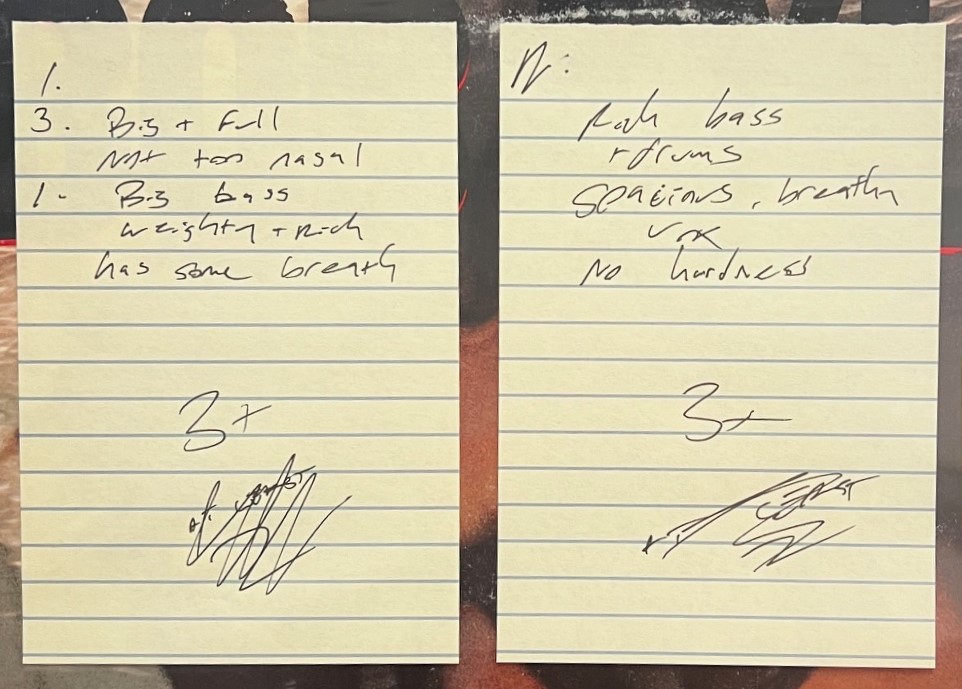
This vintage copy of Infidels could not be beat. Big and rich, with correct tonality from top to bottom, strong bass and plenty of space, this copy sounded just right to us.

Our post-it notes tell the album’s story. (By the way, if you like reading our post-it notes, we’re putting more and more of them on the blog these days. We talk about the importance of taking notes  as part of the shootout advice we share. This post will help you with the basics.)

(more…)

We Was Wrong About the Imports of Birds of Fire

Hot Stamper Pressings of Jazz-Rock Fusion Albums Available Now

In our shootout from 2021, we asked the question:

British or domestic?

The answer we gave was incorrect. At the time we wrote:

Both can be good in our experience. For a while we were convinced that the British originals were the way to go, but since then we’ve found domestic pressings that were their equal. We do the same shootouts over and over, and it’s not unusual for the rules to get broken. The records tell us their stories. Our job is to keep our minds and our ears open enough to hear what they are trying to say.

Now, in 2024, having just done the shootout, it’s clear to us that the early Brits are clearly a step up sonically over even the best domestics we have on hand. The domestics can earn a Super Hot (A++) grade, but it is unlikely — although you never know! — that they will earn the third plus it takes to win a shootout.

Live and learn is our motto, and progress in audio is a feature, not a bug, of record collecting at the most advanced levels.

(more…)

A Pink Label Island LP Left Us with Egg on Our Face

Hot Stamper Pressings of the Music of Traffic Available Now

We used to think that The Best of Traffic had better sound than the early pressings of Mr. Fantasy, but in a head to head comparison with a killer copy we played not long ago, we were proved wrong, or, perhaps more accurately, we proved ourselves wrong, something we pride ourselves in being able to do by carrying out regular shootouts for records we’ve been listening to for more than twenty years.

Oddly enough, in our shootouts we often learn new things about records we thought we knew well.

Here is what we had to say about one of the tracks on Mr. Fantasy that we thought sounded dramatically better on The Best of Traffic back around 2005:

Best evidence: Heaven Is In Your Mind, the second track on side one. It is amazing sounding here and such a disappointment on every Pink Label Island original we’ve played.

Once you know how good that song can sound — by playing a Hot Stamper copy of Best of Traffic like this one — going back to the original version of the song found on the album is not just a letdown, it’s positively painful. Where’s the analog magic? The weight to the piano? The startling clarity and super-spaciousness of the soundfield? The life and energy of the performance?

They’re gone, brother. Not entirely gone, mind you, more a shadow of what they should be, but once you’ve heard the real thing it’s not a lot of fun listening to a shadow.

You can be sure that we did not know what we were talking about when we wrote all that.

What we had done is assumed that all the pink label pressings of Mr. Fantasy sounded like the one we played, something we’ve been telling audiophiles for twenty years not to do, because collecting records by label is a fool’s game.

In this case, clearly we are the fools.

It probably — probably, since all the evidence points in the same direction — had the stampers you see below, apparently known as an Orlake Pressing, something I knew nothing about until reading about it on Discogs just now.

  • Matrix / Runout (Side A, stamped): ILPS+9061+A
  • Matrix / Runout (Side B, stamped): ILPS+9061+B

These same stampers would be used to press the Pink Rim Label copy you see below. We put it into a recent shootout and described it as having “hollow, dubby” sound.

Yes, we heard the very same “dubby” sound on a copy we played about twenty years ago, and thought all the early pressings on Island, pink and pink rim alike, had these same mastering shortcomings.

Back then we didn’t know what we know now, which is that the right UK pressings on Island of Mr. Fantasy are dramatically better sounding.

(more…)

Rock Of Ages – A Definitive Sonic Assessment?

Hot Stamper Pressings of Roots Rock Albums Available Now

In 2006 we put up a copy with with what we implied were Hot Stampers (before we were using the term regularly) on at least one side:

“Side One sounds tonally right on the money! This is as good as it gets… Robert Ludwig mastered all of the originals of these albums, but some of them have bad vinyl and don’t sound correct.

“I only played side one of the album, so I can’t speak for the other sides, but what I heard was sound about as good as I think this album can have.”

There are some truths along with some half-truths in the above comments, and let’s just say we would be quite a bit more careful in our language were we writing about that copy today.

One side is no indication whatsoever as to the quality of the other three, and without the kind of cleaning technologies we have available to us today, I wouldn’t want to make a “definitive” sonic assessment for any of them.

When you play uncleaned or poorly cleaned records, you’re hearing a lot of garbage that has nothing to do with the sound of the vinyl itself.

Note that we are joking above: there is no such thing as a definitive sonic assessment of a record, from us or anybody else.

Mistaken audiophile thinking? We’ve done our share and then some.

We firmly believe that plenty of audio progress awaits us all, but to realize that progress we must rationally approach the problems encountered in reproducing music in the home, thinking about them critically, not as True Believers, but as skeptics who require empirical evidence to support their beliefs.

It is axiomatic with us that the more skeptical you become, the more successful you will be in pursuing this devilishly difficult hobby of ours.

(more…)

Close to the Edge – A MoFi Winner, Or Was It? We’ll Never Really Know

Hot Stamper Pressings of the Music of Yes Available Now

Sonic Grade: Side One: B to B+ / Side Two: C


Many, many years ago (2005?) we wrote the commentary you see below. We can’t say if we would still agree with the sentiments expressed, so take what you read with a grain of salt, and remember that no two records sound the same. If your copy is better or worse on either side, it will not come as a surprise to us here at Better Records.


This is a great MOFI! (On side one anyway.) I have to admit I was partly wrong about this pressing. I used to think it was mud. Either the copy I have here is much better than the copy I played years ago, or my stereo has changed. I’m going to guess that it’s the stereo that has changed. I used to like the original American copies of this album and now I hear that they are upper midrangy and aggressive. [*] So my stereo must have been too forgiving in that area, which in turn would have made this MOFI sound too dull. [**]

Side one is as good as I’ve ever heard it outside of the best British originals. [We don’t even buy those anymore. Maybe that’s the problem with this comparison.] Since almost none of those have survived in clean enough condition to be played on modern audiophile turntables, there isn’t much of an alternative to this pressing.

And it should be noted that there is distortion on the tape. It’s on every LP copy and it’s on the CD too. There are cacophonous passages that have what sounds like board overload, mike preamp overload, tape saturation or something of the kind.

Eddie Offord, the recording engineer, is famous for complaining that the boys in the band were totally out of control when it came to adding layer upon layer and track upon track to their recordings, running the risk of creating such a dense mix that nothing would be heard above the din. He was always fighting a losing battle trying to rein them in. Although he did his best, it appears his efforts failed in some of the musical passages on this album.

So here’s a MOFI I like, but I only really like side one. Side two, although it’s decent enough, errs a little on the smooth, dull side. I have copies in which the guitars have wonderfully extended harmonics and sweeter tone. Some of them are even domestic pressings! On the MOFI there is a “blunting” of the acoustic guitar transients.

[*] Some pressings are indeed bright and aggressive, but that just shows how little I knew about the album in 2005. The later domestic pressings, and even some of the 4 digit catalog pressings, can indeed sound that way. Eventually I would figure out what the good stampers were and then I would no longer be as ignorant as I so clearly was when I wrote this. As for more stuff we’ve gotten wrong, you can find some of it here, under the heading: live and learn.

[**] My stereo was indeed too dark and forgiving back in those days. The way I know that is that records that are too bright and upper-midrangy to play now played just fine twenty years ago.

(more…)

How Good Are the Later Reissues of The Bridge?

When we did a shootout for The Bridge about ten years ago, we thought the reissues with the cover you see to the left actually sounded better than the original pressings, but we were clearly wrong and we have no other option than to admit it, as painful as that may be.

True, we never cared much for the later reissues described below — the tan labels can be passable but fall well short of the standards we set now.

However, even the best orange label pressings from 1975 don’t sound as good to us now as we thought they did ten years ago.

They can be good, but in our experience they can never be great. Great is the sound that can only be found on the best originals, and they win all the shootouts now.

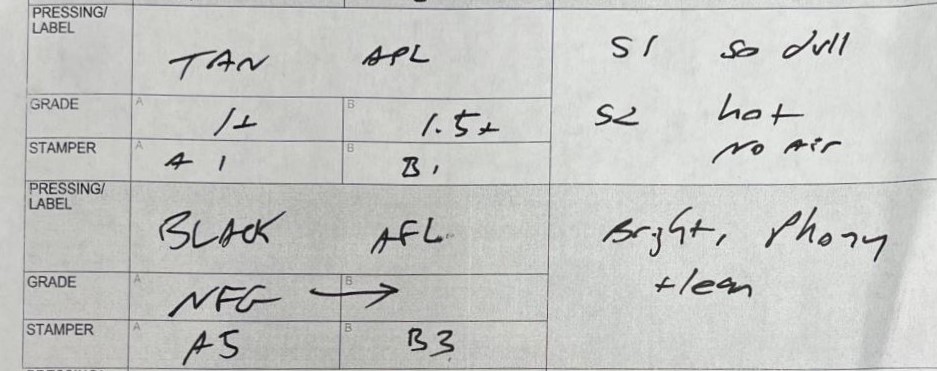
The notes for the AFL pressing with the black label describe it as bright, phony and lean.

This is the kind of sound better suited to the stone age stereos of the past.

I should know. I had a stereo all the way up until the late-90s — not exactly stone age quality, but far from the sound we have now — that prevented me from hearing my records with the highest quality reproduction.

(more…)