*Record Pressing Advice

The advice here should help you in your search for better sounding pressings.

At the very least it may help you avoid some of the worst ones.

Candy-O on the SP Label Is Hot, Flat and Not Worthy of a Shootout

Hot Stamper Pressings of the New Wave Recordings Available Now

These days it’s almost silly to give out title-specific advice on the Cars second album, Candy-O. We never have any Hot Stamper pressings of the record in stock!

You can’t find vintage copies in the bins anymore, and sellers on the internet send us too many misgraded noisy copies for us to want to spend the time returning them.

But here is a bit of advice that you won’t find anywhere else, and by anywhere else, I mean anywhere else in the entire world because nobody knows this album the way we do.

This is not a boast; this is, as far as we can tell, a fact. We’ve played scores of copies in shootouts for more than twenty years. Who else can say the same? To pretend that any such person or group of persons exists is believe in something for which there is no evidence.

Let’s be honest: Audiophiles and those who write for them have never done the work it would take to figure most of this stuff out. That’s why they don’t write about it and that’s why we get comments like “SP on the label means bad sound? Why would that be?”

I bought the album in 1979 as soon as it was released and fell in love with it the way I had the first album. (The first album is still their Masterpiece but Candy-O ranks a close second.) In 2007 we played a copy that sounded so good we could hardly believe it. Regardless of the struggles involved, we hope to be able to bring more copies to the site soon.

As far as the SP label goes, in this case we noticed a pattern that we typically would let the shootout make clear to us after the fact — that the SP pressings were the weakest of all the originals with RTB markings.

(more…)

Shootout Winning Stampers for the Scythian Suite Revealed

Hot Stamper Pressings of Orchestral Spectaculars Available Now

When it comes to the Scythian Suite, we’ve decided that there is no good reason to put the Ansermet recordings in our shootouts anymore.

Don’t get me wrong. They are perfectly good records, but the Abbado is a step up both in performance and sound. Our main listening guy summed up the differences of the two recordings this way.

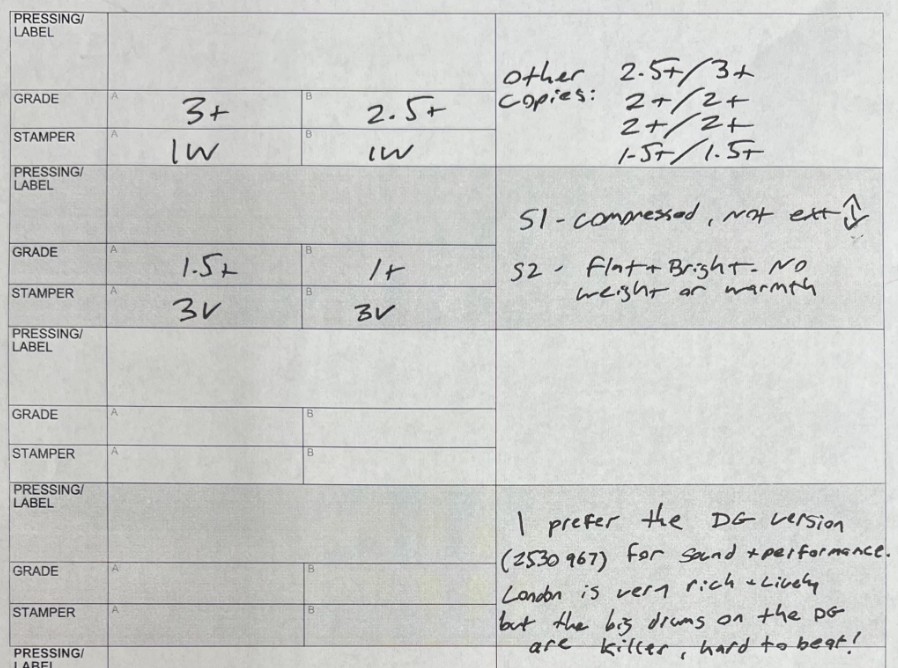
  • I prefer the DG version (2530 967) for sound and performance.
  • The London is very rich and lively but the big drums on the DG are killer, hard to beat!

So, out of the goodness of our hearts, we can now reveal the Shootout Winning stampers: 1W/1W.

However, in the case of CS-6538, knowing the right stampers is not going to get you very far.

You will actually need a pile of copies with those stampers in order to find one worthy of a 3+ White Hot stamper grade.

Obviously, knowing the “right” stamper information in this case gets you in the ballpark, but it won’t help you hit the grand slam home run you were hoping for. To do that you have to clean and play at least six copies the way we did.

(more…)

Side One Had Tubey Colorations Missing from Side Two

Hot Stamper Pressings of Vintage Columbia Albums Available Now

An undiscovered gem from 1967 on the 360 Columbia label.

Side two of this record blew our minds with its White Hot Stamper sound.

Musically and sonically this record is nothing short of wonderful.

Who knew? You could play fifty vintage piano recordings and not find one as good as this.

Tchaikovsky, Liszt, Beethoven, Debussy, Mozart — these shorter pieces and excerpts were composed by those with the greatest gift for melody, men who’ve produced works that have stood the test of time, enchanting audiences over the centuries with works of such beauty and charm.

Here at Better Records we have never been fans of Columbia classical LPs. To be clear, the fault more often than not has to be in the mastering, not the recording. We’ve raved about so many great copies of titles in the past, only to find that the next three or four LPs we pick up of the very same titles sound godawful.

There are some amazing Bernstein recordings out there, but the amount of work it takes to find the one that sounds good is overwhelming — how can such great recordings be mastered so poorly so often?

Side One

A++, with a huge, rich, sweet, natural sounding piano. The more you listen, the more apparent it becomes that, as natural as it may seem at first blush, there are still some old school tubey colorations that make the sound not quite as lifelike as one might wish.

And the confirmation of that finding comes as soon as you flip the record over.

(more…)

Delibes / Coppelia – A Superb Mono Pressing from 1957

Hot Stamper Pressings of Music Conducted by Ansermet Available Now

UPDATE 2026

This is a very old commentary so take it for what it’s worth. We no longer buy mono pressings of orchestral recordings from the golden age. The best stereo pressings are just so much better.

The stereo set (CSA 2201) came out in 1958. We appreciate the sound quality that stereo makes possible after having heard the mono.

However, there is nothing wrong with the recording, which was made for both stereo and mono in 1957.

In fact, 1957 just happens to be a wonderful year for analog recordings, as evidenced by this amazing group of albums, all recorded or released in that year.


DEMO QUALITY SOUND for this early London Mono pressing. 

Side one of this record sounds incredible! The sound is absolutely top notch. Check out the brass — it has the solid weight of the real thing.

This is the kind of record that the mono cartridge owners of the world worship. And for good reason. But you don’t need to have a mono cartridge to hear how good — in fact, how much BETTER — this copy sounds than the stereo pressing.

(more…)

“I felt wonderfully uplifted and clear-headed, and all the noise in my head had vanished. It lasted for hours. All that remained was a smile.”

New to the Blog? Start Here

One of our good customers recently wrote us an especially touching letter about two debut albums we share a love for: Led Zeppelin’s and Jeff Beck’s. After listening to them at length, he felt the need to put into words the deep and powerful feelings our records had given him. (Emphasis added.)

Dear Tom, Kenji, and the Better Records Team,

I am writing to share my absolute astonishment after listening to the Hot Stampers I recently acquired. To give you some context, I set up a rigorous shootout against my own collection.

For Led Zeppelin, I prepared seven of my finest vintage vinyl copies:

    • One UK “Turquoise” First Pressing
    • Six US copies (cut by RG or GP; pressed by Presswell or Monarch with △12703 / △18257 matrix codes, spanning the Broadway to Rockefeller eras)

For Jeff Beck, All from my brain memory not real records:

    • Two “Japanese” First Pressing and reissue
    • Two UK “Blue Columbia” MONO & STEREO Pressing and one EMI reissue

If the seven Zeppelin records that rivaled the HOT STAMPER were like 8mm film, then the HOT STAMPER was 70mm Cinemascope!

A vast, rich space—stretching from wall to wall, floor to ceiling—appeared right before my eyes, and the sound that burst forth passed right through me.

I was so astonished by the sheer difference in scale that I couldn’t believe it.

I kept turning up the volume, bathing in the sound like a shower.

When I played the UK Turquoise and GP/MONARCH records again at the same volume, the sound was so blindingly bright and overwhelmingly loud that I had to lift the needle after just a few seconds.

As for Beck, ever since I was a teenager, no matter how many times I listened to *TRUTH*, I could never be satisfied with its sound, so I ended up selling it. I’d concluded that while *TRUTH* is a matter of personal musical taste, it wasn’t a record that sounded good. However, after seeing *SKEPTICAL AUDIOPHILE* recommend this record, I decided to give it one last challenge.

When I turned up the volume, it was as if the band was right there in front of me, in the fifth row. I was sharing that space with them, and the sound came straight at me without any barriers.

It was as if I were actually there at the concert.

This was my first time having an experience like this with my home audio system.

This is what a “WHITE HOT STAMPER” is! What a blissful time I had! Warm, Rich, Dynamic, & Transparent!

P.S.

1. After finishing both records, I felt wonderfully uplifted and clear-headed, and all the noise in my head had vanished. It lasted for hours. All that remained was a smile; my wife even remarked, “You look so happy.”

I can say with certainty that this was due to the chemical effects of the HOT STAMPER. I believe it resulted from a decrease in stress hormones like cortisol and an increase in the secretion of “happiness hormones” such as dopamine and serotonin.

Furthermore, after I finished listening and was tidying up the room where the records were scattered—something I’ve experienced several times before—my digestive system became more active. I attribute this to the relaxation effect of the HOT STAMPER. It’s likely due to the “brain-gut axis,” where my favorite music and the superb sound quality triggered parasympathetic dominance, stimulating intestinal peristalsis.

2. Considering the time, energy, and money spent tracking down this rare Zeppelin record, this is no ordinary man’s job. There is a Bible verse that says, “Ask, and it will be given to you.”

I offer my deepest respect and admiration, as well as my boundless gratitude and love, to the treasure hunters led by Tom, who have successfully completed this mission—a mission truly bestowed upon them by God.

Sincerely yours,
Nobu

Dear Nobu,

Thanks for describing so elegantly what it feels like to finally hear music you have treasured for decades sounding the way you always dreamed it could. I know well the feelings of bliss, exhilaration and joy that coursed through you. I’ve experienced them countless times myself since I first got into home audio fifty years ago.

There is a joy that cannot be expressed when music sounds so good there are no words to describe it. This is what audiophiles such as you and me live for.

Few have had the pleasure of experiencing it outside of a live musical event. We were able to do it with records, but they were very special records, the kinds of records few audiophiles know exist, or have any reason to believe exist. Fewer still have ever experienced such records. Indeed, we must count ourselves fortunate to have had the privilege.

You describe us as treasure hunters, which is a very good way of looking at who we are and what we do. We have been hunting for treasure for more than 30 years. Our dedication increased dramatically over the last twenty or so. By then we had finally given up on the false promise of the modern remastered record. (Fittingly, it was a exceptional straw that broke the camel’s back.)

You played our Hot Stamper pressings (Super Hot for Zep 1, White Hot for Truth) against all the copies that the conventional wisdom told you were sure to have the best sound. Now you know something not widely understood by the audiophile community, which is simply that when it comes to records, the conventional wisdom is not very good at predicting which pressings will turn out to have better sound.

This blog has well over a thousand commentaries detailing chapter and verse (to make use of a phrase associated with the bible) how this is simply a fact that cannot be denied by anyone who has carefully studied the matter.

You proved it for yourself. You did your own shootout. Who can gainsay the insights you acquired? Certainly not those who have never played one of our records. What evidence do they have to support their views?

Do they have a theory to base their objections on?

Is it more than a conjecture? A feeling? Some intuition? A form of knowledge beyond our understanding?

As you now know better than anyone, whatever they think they have to disprove the possibility of the Hot Stamper pressing, it is surely a crock.

I very much enjoyed hearing about the happiness you felt when playing such exceptional pressings of these wonderful albums. The joy of music is in many ways the greatest joy there is. It is the one thing that has driven me to pursue our hobby more than any other — in fact, to dedicate much of my life to it — and I have never seen reason to regret a moment of it.

Thank you for writing and brightening our day here at Better Records!

Best, TP

Roger The Engineer Is Awful on the Early UK Pressing

Hot Stamper Pressings of British Blues Rock Albums Available Now

A hall of shame pressing if there ever was one.

The UK pressing of Roger the Engineer we played was pure crap.

Cool for collectors I suppose, but very bad news for audiophiles.

Your response to this news may depend on which camp you find yourself in. If you love collecting original pressings, we would put you in the record collector camp, not the audiophile one. Audiophiles are supposed to care about sound quality, so if the more original pressing is the one you want, then you are a record collector first and an audiophile second, if at all. Harsh? Let’s call a spade a spade.

Regardless, we ask that you please not buy into that record collecting / audiophile canard that the originals are always going to be the best sounding pressings. The hundreds of reissues listed here prove otherwise.

The original British pressing — true, we only had the one, so take it for what it’s worth — was a poor imitation of what was most likely on the master tape, as revealed by the Edsel reissues.

Maybe you have a good sounding one. We can’t say you don’t.  But we would be very unlikely to spend much money on an original import pressing after hearing this one.

And the domestic records we’ve played were clearly made from dub tapes, so they’re a bust too.

(more…)

Are You a Soundphile? I Used to Be One

Hot Stamper Classical and Orchestral Pressings Available Now

UPDATE 2026

About 30 years ago I got hold of a Japanese pressing of Marriner conducting Haydn’s Toy Symphony and Mozart’s Eine Kleine Nachtmusik and was blown away by the absolutely phenomenal quality of the Haydn. Listing the record for sale, I raved:

DEMO QUALITY SOUND! This is the best sounding Toy Symphony you will ever hear!

…all the little toys that play along with the music just JUMP out of the speakers. The recording is so transparent and the toys are so well miked it’s like hearing the work for the first time, or live.

Now we know definitively that this is clearly not true, assuming yoy have one of our Hot Stamper pressings of the EMI original. They are better in every way than the Japanese pressing, which is the one purporting to have audiophile sound.

If this sounds familiar to you, I’m guessing this is not your first visit to the blog or our site. There is almost always a vintage pressing with superior sound when compared to the audiophile pressings made from the same recording.

The problem is: You just don’t know which vintage pressing will have superior sound. Maybe they all will. Maybe none of the copies you own will. There is one, but how do you find it?

In order to get that answer, you have to know how to do carefully controlled shootouts, and not just once, but more often than not a number of them over a period of years. Whatever answer you may come up will most likely be provisional, not definitve, because that’s the only way the process of discovery can work when applying scientific methodologies to the solution of a problem like “which pressings sound best on record X?”.

We did the shootout in 2022 and found out that the best of the original EMI pressings are quite a bit better, a classic case of live and learn, as well as one of the hundreds of breakthrough discoveries we’ve made over the years. That’s what happens when you are in the business of playing records and then selling the best of them to audiophiles looking for superior sound.

I believe I had at least one or two UK EMI pressings to play against the Japanese ones, but all the details of how I came to this conclusion — a proto-shootout, carried out long before I knew how to do a real one — are lost to the mists of time.

Keep in mind that my stereo was dramatically less revealing back then. Also I had not learned how to clean records properly. Those two facts, combined with the underdeveloped listening skills that go with them, helped me to arrive at the wrong conclusion.

No, the Japanese pressing, specifically targeted to audiophiles, or “soundphiles” if you like, is not superior to a properly mastered and pressed UK LP.

If you have more than a handful of Japanese pressings in your collection, you can be sure that there is still plenty of room for improvement in your audio system.

(more…)

Isn’t This Supposed to Be a Good Sounding Sonny Rollins Record?

Hot Stamper Pressings of the Music of Sonny Rollins Available Now

It is — or can be — but that’s only possible — as far as we know — on the early stereo pressings. On the mono pressings, the ones originally pressed in 1965 on the black dynagroove label, and never pressed again, not so much. They’re not awful, but they’re not very good either.

Which means that as a general rule, audiophiles should stick to the stereo pressings of this album, in the same way that they should almost always stick to stereo pressings of stereo recordings.

This is a Core Insight we only arrived at after playing hundreds of mono pressings made from tapes originally recorded in stereo. [1] Rarely do the mono pressings of such titles sound remotely as good as the stereo pressings.

Here is how we described a killer stereo copy of The Standard Sonny Rollins we encountered during the course of a shootout in 2025:

The Standard Sonny Rollins is back on the site for only the second time in over four years, here with outstanding sound throughout this original stereo pressing.

Once again the brilliant engineering of Ray Hall for RCA conveys the vitality of live music for these sessions (which were undoubtedly recorded live). Includes superstars like Herbie Hancock, Jim Hall, and Bob Cranshaw, who’ve lent their talents to some of the greatest jazz recordings of all time.

Here is the stamper sheet showing how the mono pressing fared. In the past we’ve had similar luck with the mono pressings of Living Stereo recordings, but this one was cheap and we figured why not?

Collectors often say that the mono pressings of jazz albums are often the best sounding. Well, why not put that proposition to the test? That is after all the business we are in, testing whether something is true or not to the best of our ability.

(more…)

For Scottish Fantasy, Forget the Red Seal Pressings

Hot Stamper Pressings Featuring the Violin Available Now

The 70s Red Seal pressings we’ve played recently have all left a lot to be desired, but, since we had one sitting on a shelf in the backroom with lower stampers, we figured what the hell, let’s clean it up, throw it into our next shootout and hope for the best.

As you can see, the best was not to come.

There are quite a number of other records that we’ve run into over the years with obvious shortcomings.

Here are some of them, a very small fraction of what we’ve played, broken down into the three major labels that account for most of the best classical and orchestral titles we’ve had the pleasure to play.

(more…)

Our Four Plus Shootout Winner for Dire Straits from 2011

Hot Stamper Pressings of the Music of Dire Straits Available Now

UPDATE 2026

This review for Dire Straits’ first album was written in 2011. We had just discovered that a pressing of the album was clearly superior to every other pressing we had ever played. We were pretty excited about it and wanted to share the news about our breakthrough.

A substantial amount of the time, breakthroughs come about due to the conventional wisdom being wrong — and us not knowing it until an experiment proved it wrong. The needle is the only thing that can give us an answer we can trust, certainly not the pundits or the self-described experts.

What makes them experts? We have no idea and they never say. They just seem to “know” things, but they never tell us how they know them.

We do. We can’t shut up about all the stuff we know!

No concept is more fundamental to collecting the best sounding pressings than to be able to test records to find out if the received wisdom you are using as a guide is right, wrong or something in-between.

At the bottom of the listing for the album you can see a number of links to other records that share the same qualities as the first Dire Straits release does.

(more…)