weighty-brass-orchestral

Rimsky-Korsakoff / Scheherazade – Reiner (White Dog)

More of the Music of Rimsky-Korsakov

  • Reiner and the Chicago Symphony’s performance of this dazzling symphonic suite returns to the site on this vintage White Dog pressing that boasts outstanding Double Plus (A++) Living Stereo sound or close to it from first note to last
  • We guarantee there is more richness, fullness, and performance energy on this copy than others you’ve heard, and that’s especially true if you own any of the Heavy Vinyl pressings that are currently on the market
  • Our favorite Scheherazade for about the last 15 years or so has been the one Ansermet conducted for Decca in 1961, but the roller-coaster excitement Reiner and the CSO bring to the fourth movement is something very special
  • True, the side with the fourth movement earned a minimal Hot Stamper grade of 1.5+, but we still guarantee that it will beat the pants off any Heavy Vinyl reissue, because every one of those that we’ve played was ridiculously opaque, muddy and thick enough to have us crying “uncle” after five minutes (reviews available on the blog)

UPDATE 2024

Now that we know which stampers have the potential to win our shootouts, the Shaded Dog originals have lately been coming out on top, although the White Dog pressings can still sound quite good, just not as good


We did a monster shootout for this music in 2014, one we had been planning for more than two years. On hand were quite a few copies of the Reiner on RCA; the Ansermet on London (CS 6212, his second stereo recording, from 1961, not the earlier and noticeably poorer sounding recording from in 1959); the Ormandy on Columbia, and a few others we felt had potential.

The only recordings that held up all the way through — the fourth movement being the Ball Breaker of all time, for both the engineers and musicians — were those by Reiner and Ansermet. This was disappointing considering how much time and money we spent finding, cleaning and playing those ten or so other pressings, but such is the nature of our business.

TAS List

Harry Pearson put this record on his TAS list of super discs.

Of course, the fact that a recording is on the TAS list doesn’t guarantee that the pressing you buy will have great sound, but Better Records does precisely that. If you don’t think a record sounds as good as we’ve described it, we’ll always happily take that record back and refund your money.

(more…)

Liszt / Smetana / Mussorgsky – Les Préludes / The Moldau / Night On Bald Mountain / Dorati

More of the music of Franz Liszt (1811-1886)

More Recordings on Mercury

  • Boasting superb Double Plus (A++) sound throughout, this original copy will show you just how good the Mercury engineers were back in those days
  • Dorati breathes life into these concert hall favorites as only he can, and the Mercury engineers (Fine and Eberenz) capture the excitement on tape as only they can
  • We have a preference for Dorati’s recordings with the London Symphony Orchestra, and a record like this will show you exactly why we do
  • The exciting sound of Mercury lives on through the vintage disc they made all those years ago – you can forget the idea that anybody will come along and produce sound of this quality
  • If you’re a fan of orchestral showpieces such as these, this LP from 1960 belongs in your collection

(more…)

Ravel / Dukas et al. – Works by Ravel, Honegger and Dukas / Ansermet

More Classical and Orchestral Recordings

  • An incredible London pressingof this superb release with Nearly Triple Plus (A++ to A+++) grades on both sides – just shy of our Shootout Winner
  • It’s also fairly quiet at Mint Minus Minus, a grade that even our most well-cared-for vintage classical titles have trouble playing at
  • This spectacular Demo Disc recording is big, clear, rich, dynamic, transparent and energetic – here you will find some of the best orchestral Hot Stamper sound we offer
  • The sound of the orchestra is dramatically richer and sweeter than you will hear on practically all other pressings – what else would you expect from Decca’s engineers and the Suisse Romande?
  • 1963 was a great year for classical recordings – other Must Own Orchestral releases can be found here.

The sound is clear, with wonderful depth to the stage. As a rule, the classic ’50s and ’60s recordings of Ansermet and the Suisse Romande in Victoria Hall are as big and rich as any you may have ever heard. These recordings may just be the ideal blend of clarity and richness, with depth and spaciousness that will put to shame 98% of the classical recordings ever made.

Side One

Bolero (Ravel)

Tubey and clear, with both the snare and the flute coming from so far back in the hall. OUTSTANDING energy and dynamic power.

Turn it up and it really comes to life like LIVE MUSIC. It’s big, wide and believable. We loved it.

Side Two

The Sorcerer’s Apprentice (Dukas)

ZERO compression. ZERO distortion when loud. Which means it has ZERO compressor distortion, something not five out of a hundred Golden Age recordings can claim. Nice extended top too.

There is depth and richness to beat the band, as well as clarity and tonal correctness that let you forget the recording and just enjoy the music. This piece is not quite as transparent as the Ravel, but still has earned every one of its Three Pluses.

The timbre of the brass is right on the money. As we have noted before, the brass of the Suisse Romande is some of the best to have ever been committed to analog tape.

Again, this side had OUTSTANDING energy and dynamic power the likes of which we think you may never have heard.

La Valse (Ravel)

Again, with that wondrously huge hall adding a sense of space that will allow your speakers to disappear. The performers are not too close, which is very much in keeping with live music.

In his tribute to Ravel after the composer’s death in 1937, Paul Landormy described the work as follows:

“….the most unexpected of the compositions of Ravel, revealing to us heretofore unexpected depths of Romanticism, power, vigor, and rapture in this musician whose expression is usually limited to the manifestations of an essentially classical genius.”

(more…)

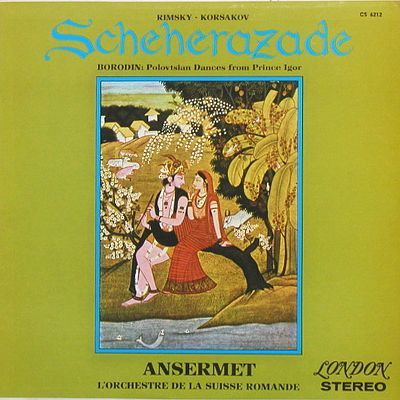
Rimsky-Korsakov / Scheherazade – As Good As It Gets

More of the Music of Rimsky-Korsakov

rimskscheh_6212_1610_1389793105

  • Outstanding Double Plus (A++) sound throughout this vintage London pressing of Ansermet and the Suisse Romande’s superb performance of this dazzlingly symphonic suite
  • It’s also fairly quiet at Mint Minus Minus, a grade that even our most well-cared-for vintage classical titles have trouble playing at
  • This copy will go head to head with the hottest Reiner pressing and is guaranteed to blow the doors off of it
  • The top end is natural and sweet – this is the way the solo violin in the left channel is supposed to sound
  • Extraordinary Demo Disc sound – the brass displays weight and power throughout the powerful first movement like nothing you’ve ever heard in your life, outside of a live performance of course
  • Finding the best sounding pressings of this exceptional recording was a breakthrough for us – here was sound we had never experienced for the work, and let me tell you, that was a thrill we will not soon forget
  • These are the stampers that always win our shootouts, and when you play this copy, you will know why – the sound is big, rich and clear like no other Scheherazade you’ve heard
  • We’ve come up with a simple listening test to help our audiophile brethren judge pressings of Scheherazade, especially those woeful iterations of the music on Heavy Vinyl. We hope you will find time to avail yourself of the lessons we’ve learned
  • There are about 80 orchestral recordings that are personal favorites, and this one deserves a place right at the top of that list

We did a monster shootout for this music in 2014, one we had been planning for more than two years. On hand were quite a few copies of the Reiner on RCA; the Ansermet on London (CS 6212, his second stereo recording, from 1961, not the earlier and noticeably poorer sounding recording from in 1959); the Ormandy on Columbia, and a few others we felt had potential.

The only recordings that held up all the way through — the fourth movement being THE Ball Breaker of all time, for both the engineers and musicians — were those by Reiner and Ansermet. This was disappointing considering how much time and money we spent finding, cleaning and playing those ten or so other pressings.

Here it is many years later and we’re capitalizing on what we learned from the first big go around, which is simply this: the Ansermet recording on Decca/London can not only hold its own with the Reiner on RCA, but beat it in virtually every area. The presentation and the sound itself are both more relaxed and natural, even when compared to the best RCA pressings.

The emotional content of the first three movements (all of side one) under Ansermet’s direction are clearly superior. The roller-coaster excitement Reiner and the CSO bring to the fourth movement cannot be faulted, or equaled. In every other way, Ansermet’s performance is the one for me. We did a monster shootout for this music in 2014, one we had been planning for more than two years. On hand were quite a few copies of the Reiner on RCA; the Ansermet on London (CS 6212, his second stereo recording, from 1961, not the earlier and noticeably poorer sounding recording from in 1959); the Ormandy on Columbia, and a few others we felt had potential. (more…)

Stravinsky / The Rite of Spring – The Ultimate Recording of the Work

More of the music of Igor Stravinsky

  • An outstanding Shaded Dog pressing with superb sound from start to finish
  • Perhaps the greatest performance ever, certainly our favorite for performance and sound – this is not an easy piece of music to record judging by how many awful sounding versions exist — we should know, we played them
  • Monteux knows the work as well as anyone — he himself conducted the premier in 1913!
  • Mind boggling in its power to move the listener – a classic Decca Tree recording from 1956 by the master, Mr. Kenneth Wilkinson
  • There are about 150 orchestral recordings we’ve awarded the honor of having the best performances with top quality sound, and this recording certainly deserve a place on that list, close to the top I would think

It takes us three years — and a lot of hard work and a fair amount of luck — to get a shootout like this going.

The tympani and bass drum on this recording have few equals in our experience. This is the way HUGE and POWERFUL drums sound in concert. Those of you who go to classical concerts regularly will recognize that sound immediately. You probably also know that finding Golden Age recordings with this kind of deep bass is unusual to say the least.

The space and dynamic power of these sides are really something to hear on this groundbreaking work. Lush when quiet, clear and undistorted when loud, not many copies of Rite of Spring can do what these two sides can.

(more…)

Holst – The Planets / Previn – Our 2022 Shootout Winner

Hot Stamper Classical and Orchestral Pressings Available Now

This early British EMI pressing of Previn’s reading from 1974 is guaranteed to be the best copy of Holst’s Magnum Opus you have ever heard. Previn’s and the LSO’s performances are without peer in our estimation. These sides are rich, clear and dynamic, with weighty brass, and the kind of dynamic power that lifts the energy level right into space.

A TAS List Super Disc, with a performance that’s as spectacular as the recording (thanks to the work of the two Christophers).

As you might imagine, on a big system this would make for a powerful listening experience, which is exactly the experience we ourselves had during our recent shootout. This copy actually deserves its place on the TAS List.

The EMI Sound

EMI’s are usually recorded with a mid-hall perspective, which is somewhat distant for our taste. That’s not our sound. We prefer the Front Row Center seats (especially at these prices). That said, when an EMI from the ’70s is recorded, mastered and pressed properly, it actually sounds more like the real thing, more like the live performance of orchestral music in a concert hall.

It’s uncanny how real the best copies of this record sound. For a recording of The Planets it has no equal in our experience.

A Must Own Record

This orchestral spectacular should be part of any serious Classical Collection. Others that belong in that category can be found here.

Side One

Mars, the Bringer of War
Venus, the Bringer of Peace
Mercury, the Winged Messenger
Jupiter, the Bringer of Jollity

Side Two

Saturn, the Bringer of Old Age 
Uranus, the Magician 
Neptune, the Mystic

Structure

The suite has seven movements, each of them named after a planet and its corresponding Roman deity (see also Planets in astrology):

  • Mars, the Bringer of War
  • Venus, the Bringer of Peace
  • Mercury, the Winged Messenger
  • Jupiter, the Bringer of Jollity
  • Saturn, the Bringer of Old Age
  • Uranus, the Magician
  • Neptune, the Mystic

With the exception of the first two movements, the order of the movements corresponds to increasing distance of their eponymous planets from the Earth. Some commentators have suggested that this is intentional, with the anomaly of Mars preceding Venus being a device to make the first four movements match the form of a symphony.

One alternative explanation may be the ruling of astrological signs of the zodiac by the planets. If the zodiac signs are listed along with their ruling planets in the traditional order starting with Aries, ignoring duplication, Pluto (then undiscovered and now de-planetised), and the luminaries (the Sun and the Moon), then the order of the movements matches.

Another possibility, this time from an astronomical perspective, is that the first three movements, representing the inner terrestrial planets, are ordered according to their decreasing distance from the Sun. The remaining movements, representing the gas giants that lie beyond the asteroid belt, are ordered by increasing distance from the Sun. Critic David Hurwitz offers an alternative explanation for the piece’s structure: that “Jupiter” is the centerpoint of the suite and that the movements on either side are in mirror images. Thus “Mars” involves motion and “Neptune” is static; “Venus” is sublime while “Uranus” is vulgar, and “Mercury” is light and scherzando while “Saturn” is heavy and plodding. (This hypothesis is lent credence by the fact that the two outer movements, “Mars” and “Neptune,” are both written in rather unusual quintuple meter.)

“Neptune” was the first piece of music to have a fade-out ending. Holst stipulates that the women’s choruses are “to be placed in an adjoining room, the door of which is to be left open until the last bar of the piece, when it is to be slowly and silently closed”, and that the final bar (scored for choruses alone) is “to be repeated until the sound is lost in the distance”. Although commonplace today, the effect bewitched audiences in the era before widespread recorded sound – after the initial 1918 run-through, Holst’s daughter Imogen (in addition to watching the charwomen dancing in the aisles during “Jupiter”) remarked that the ending was “unforgettable, with its hidden chorus of women’s voices growing fainter and fainter… until the imagination knew no difference between sound and silence”.


Further Reading

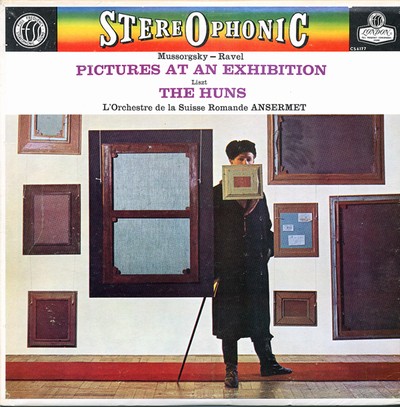
Mussorgsky / Pictures at an Exhibition / Ansermet

Hot Stamper LPs that Need to Be Played on Big Speakers at Loud Levels

Recordings that Sound Their Best on Big Speakers at Loud Levels 

I used to think Ansermet’s reading was ponderous, but this copy from 2013 is making me want to change my mind.

Is it more lively than others? Is the stereo that much improved since I last heard one of these Londons?

We have no way of knowing. All we do know is that we were enjoying Ansermet’s performance more than we ever had before.

The darker brass instruments like tubas, trombones and french horns are superb here. Other Golden Age recordings of the work, as enjoyable as they may be in other respects, do not fully reproduce the weighty quality of the brass, probably because of compression, limiting, tube smear, or some combination of the three.

The brass on this record has a power like practically no other recording of the work we know.

It’s also tonally correct. It’s not aggressive. It’s not irritating. It’s just immediate and powerful the way the real thing is when you hear it live. That’s what really caught my ear when I first played the recording.

There is a blast of brass at the end of Catacombs that is so big and real, it makes you forget you’re listening to a recording. You hear every brass instrument, full size, full weight. I still remember the night I was playing the album, good and loud of course, when that part of the work played through. It was truly startling in its power.

Some of Ansermet’s recordings with the Suisse Romande are absolutely the best I’ve ever heard. It was a magical combination of the right hall, the right engineers, the right orchestra and the right technology — the pure tube ANALOG technology of the ’50s and ’60s!

(more…)

Borodin / Symphony No. 2 / Tchaikovsky / Francesca Da Rimini / Varviso

Hot Stamper Classical and Orchestral Imports on Decca & London

More Classical ‘Sleeper” Recordings We’ve Discovered with Demo Disc Sound

This London Whiteback pressing (CS 6578) has SHOCKINGLY GOOD sound; in many ways it deserves to be called a Demo Disc. It has at least one quality that one virtually never hears on an audiophile reissue: a smooth, natural top end. This record only sounds correct and “real” at louder volumes, in the same way that a live orchestra often sounds a bit lifeless in the quiet passages, only to get exciting, big and powerful when the score calls for it. For this to happen on record you need real dynamics and tonal neutrality.

We have not heard many audiophile reissues pull these things off either, just two of the reasons we no longer carry them.

And you can find all the other reasons on the site easily enough. We can’t stop talking about how disappointing Heavy Vinyl sounds to us now.

We graded both sides AT LEAST A++, a bit vague we admit; we just don’t have enough copies to know if the sound could get much better.

We played a good many vintage classical LPs that day and this was clearly one of the best sounding, so we feel this grade should be accurate, perhaps even conservative.

Credit for the sound must go to the Decca engineers, of course, but also to the hall that the L’Orchestre de la Suisse Romande played in, where so many of the great Ansermet recordings were made. This recording is from 1968. Ansermet died in 1969. One imagines that he was perhaps not able to conduct at this stage of his life and turned his wonderful orchestra and hall over to Varviso, a man better known for conducting operas at the time.

Side One – Borodin

At Least A++, with the kind of Golden Age sound that has rarely if ever been realized in the modern era. Big, wide and deep, with smooth, rich orchestral sound, these are the kind of records that let you forget the sound and just enjoy the music. The performance is taken a brisk pace, rarely a bad thing.

More reviews and commentaries for recordings of the Second Symphony.

Side Two – Tchaicovsky

At Least A++, and a lovely work that has never made it to the site in Hot Stamper form before, hint hint.

Rich, with deep bass, big stage, huge space and so 3-D, this is what we love about vintage recordings. And a great performance as well.

Borodin – Symphonies 2 & 3 / Ansermet

More of the music of Alexander Borodin (1833-1887)

More Classical and Orchestral Recordings

  • Excellent Double Plus (A++) sound or BETTER on both sides of this UK London STS pressing, with the Second Symphony having the better sonic grades (and better music)
  • It’s also fairly quiet at Mint Minus Minus, a grade that most of our classical records cannot match, with side one even a bit better
  • It’s simply bigger, more transparent, less distorted, more three-dimensional and more REAL than most of what we played
  • The right reissues can sound quite good, as is the case here – the best early pressings are better, but plenty of early pressings just sound like old records, which simply means that having a clean original is no guarantee of anything in this crazy record world

This Super Hot Stamper pressing has outstanding DEMO QUALITY sound on remarkably quiet vinyl no less. We’ve long considered the album one of the greatest of all the Decca / London recordings.

Big, rich and dynamic, this is the sound of LIVE MUSIC, and it can be yours, to enjoy for years to come — if you’ve got the stereo to play it and the time to listen to it.

The powerful lower strings and brass are gorgeous. Ansermet and the Suisse Romande get that sound better than any performers I know. You will see my raves on record after record of theirs produced during this era. No doubt the world renowned Victoria Hall they recorded in is key. One can assume Decca engineers use similar techniques for their recordings regardless of the artists involved. The only real variable should be the hall.

Ansermet’s recordings with the Suisse Romande exhibit a richness in the lower registers that is unique in my experience. His Pictures At Exhibition has phenomenally powerful brass, the best I’ve ever heard. The same is true for his Night On Bald Mountain. Neither performance does much for me — they’re both too slow — but the sound is out of this world. Like it is here.

(more…)

Albeniz / Suite Espanola / De Burgos – Such a Dynamic Recording

More of the Music of Isaac Albeniz

  • With two Shootout Winning Triple Plus (A+++) sides, we guarantee you’ve never heard Suite Espanola sound remotely as good as it does on this amazing London pressing
  • The orchestral power on display is positively breathtaking – few recordings we know of are this DYNAMIC and EXCITING
  • Wilkie’s Decca Tree recording is overflowing with the kind of clear, spacious, realistic sound that can only be found on the best vintage vinyl LPs
  • Performances and sound like no other – De Burgos’s Suite Espanola is practically in a league of its own

Wow, is this record ever DYNAMIC! I would put it right up there with the most dynamic recordings we have played over the course of the last twenty five years. It also has tons of DEPTH. The brass is at the far back of the stage, just exactly where they would be placed in the concert hall, which greatly adds to the realism of the recording.

Note that careful VTA adjustment for a record with this kind of dynamic energy is a must. Having your front end carefully calibrated to this record is the only way to guarantee there is no distortion or shrillness in even the loudest passages.

What to Listen For

Clear castanets.

Big bass drum thwacks.

Crescendos that build to intense climaxes.

We Was Wrong (Already?)

The last time we did this shootout we noted:

The strings may not be quite as sweet as the best earlier Londons, but the trade off is well worth it when you hear a record with this kind of LIFE and so little distortion. Rich strings (or as rich as they can be in 1969, a good ten years after the amazingly Tubey Magical recordings of the ’50s).

This time around we heard plenty of Tubey Magic on our Shootout Winning pressing. Did we find a hotter one than last time? Are we doing a better job of bringing out that quality during playback?  Would this pressing hold its own against another recording made in Kingsway Hall a decade earlier?

Yes. No. Maybe? Who really knows?

We will leave it to the lucky customer who ends up with this killer copy to tell us. (more…)