Mastering Info

Helpful title-specific information on mastering houses and engineers to help you find better pressings and avoid the worst ones.

Strawberry Cut By Far the Best Sounding Pressings of Zenyatta Mondatta

Hot Stamper Pressings of Sting and The Police Available Now

Forget the domestic pressings, forget the lightweight Nautilus Half-Speed, forget whatever lame reissues have come or will come down the pike – if you want to hear this album right, a Hot Stamper UK pressing is the only way to go.

And take it from us, you need to see that little Strawberry marking in the dead wax of your UK pressing to have any hope of hearing audiophile-quality sound.

Why go to all that trouble? Because the album is an absolute classic – it leads off with “Don’t Stand So Close To Me” and never lets up. (Well, toward the end of side two it lets up, but it’s plenty strong before then.)

Consider taking our moderately helpful advice concerning the pressings that tend to win our shootouts.

(more…)

Is It Possible to Find Out Who Mastered the Japanese Thrillers?

Hot Stamper Pressings of the Music of Michael Jackson Available Now

A letter we received not long ago made the point that the Japanese pressing of Thriller the owner had been listening to for years, even decades, fell well short of the mark set by the sound of the White Hot Stamper pressing he now owned.

To think, I spent all those years playing and re-playing a record that was bright and edgy, none the wiser to matrix numbers and pressing variations.

I agreed, saying that I myself learned the hard way, having wasted some of my own money on them. that Japanese pressings were almost always a crock, writing:

Most Japanese pressings cater to what a mid-fi system would need to sound good and a hi-fi system would find ruinous. They are almost always made from dubbed tapes, which are then brightened up in the mastering phase since that is the sound that appeals to the Japanese market for some reason unknown to me. Old school audio equipment — horn speakers and vintage tube electronics — would be my guess.

A fellow who saw an opening to set me straight and take me down a peg, all without having to learn how to use that pesky shift key on his computer, left the following comment in that post:

the japanese pressings were mastered by BG. the only difference being the quality of the material. nice try though, snakeoil salesman.

I immediately went to battle stations. I doubted whether Bernie Grundman has mastered any pressings for the Japanese market, but I couldn’t say for sure. It’s a question that had never come up. We ourselves had discovered a very good sounding pressing of Tusk that was mastered by Ken Perry and pressed in Japan, so I knew it was possible that the original mastering engineer could have sent metalwork to Japan for the Japanese to produce properly-mastered records for their market.

Fortunately, Discogs makes checking such things fairly easy. I went right up to the listing for Thriller and clicked on all the Japanese original pressings to see if there was any evidence to show that he had mastered them.

Bernie Grundman’s name was credited on the back cover as the mastering engineer, but I didn’t put much stock in that. I assumed that he did not master the album for their market, since that is hugely impractical. I surmised that removing his credit would have badly defaced the jacket, something I doubted the Japanese would have found acceptable. They seem to be very particular about these things.

Sure enough, here is what the stampers look like for the typical Japanese pressing that supposedly would have been mastered by BG:

There are about half a dozen original Japanese pressings for the album on Discogs and all the stamper listings look like the one above.

If you know anything about records, you know that these markings could not have been created by Bernie Grundman’s mastering operation here in the states.

(more…)

Exile on Main Street – A Good Test for Grit and Grain

More reviews and commentaries for the music of The Rolling Stones

The best copies will tend to have the qualities we discuss below, and the more abundant these qualities are on any given pressing, the higher its grade will be.

Yes, it is a science, an empirical one, which can only be carried out by the use of strict protocols and controls, but it sure ain’t rocket science.

All you need is the system, the room, the records, the time and the will to do the painstaking critical listening required to carry out the task.

It can be done, but you could spend a lifetime meeting audiophiles of the vinyl persuasion and never run into a single one who has made the effort more than a handful of times.

To be honest, shootouts are a bitch. If you aren’t getting paid to do them the way we are, finding the motivation to devote the time and energy required to do them right — not to mention the piles of copies of each record you will need — is daunting to say the least.

So, back to the question: what to listen for? (more…)

Does Your Pressing of Death and Transfiguration Have These Shortcomings?

More of the Music of Richard Strauss

Many of the later pressings of CS 6211 were not competitive with the earlier pressings, something we had no idea was true until we actually did the shootout.

This is why we do our shootouts with every kind of pressing we can find that has any hope of sounding good to us.

(This is of course something that cannot be predicted with much certainty. What we are saying is simply that we do not expect the German, Dutch, Japanese and such like pressings from other countries outside the UK to do well because they have almost never done well in the past, not for Decca recordings anyway.)

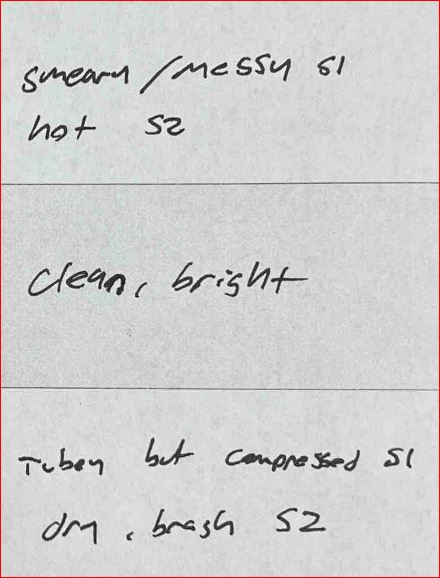
The notes on the left in the box are for the copies that did not do as well as our best copies.

If your copy of the album has any of the shortcomings we mention, and you would like a better pressing to play, rest assured we will have something for you down the road, as this is our favorite for both performance and sound.

Stamper Information

The stampers of the pressings that consistently came in last in our shootout had the mastering marking of L, which signifies the work of George Bettyes. He has done good work in the past, but odds are that any pressing of this title mastered by L is going to be inferior to those that are not.

Our advice: stick with E and G.

As is sometimes the case, there is one and only one set of stamper numbers that consistently wins our shootouts for CS 6211.  Here are some of the others we’ve discovered through the shootout process.

Our notes for an exceptionally good sounding copy from the last shootout can be seen below.

(more…)

These Stampers Consistently Come in Last in Our Shootouts

Hot Stamper Pressings of the Music of The Eagles Available Now

All the original domestic pressings are cut by Ted Jensen at Sterling as far as we know.

You can find TJ and STERLING on every last one of them (with the notable exception of the SRC pressings, best avoided). What you can’t find is good sound on every last one of them.

The most common stampers can be found from pressing plants using the following label designations: MON, PRC, PRCW, AR and SP.

In our experience, two of the five labels listed above have the potential to win shootouts. Two of the others tend to end up somewhere in the middle of the grading curve. One consistently ends up at the bottom.

It’s important to keep in mind that in our shootouts, the person hearing the copy being played, the one who is carefully noting its strengths and weaknesses, has no idea what pressing plant actually produced the record, or what its specific stampers numbers might be.

That kind of  information is compiled after the grading has been done. That’s when these patterns emerge.

The domestic pressings with the stampers shown above have not done well in our shootouts for years now. If you own a copy with these stampers, or ones like them, the good news is that we can get you a much better sounding copy of The Long Run than you have ever heard. It won’t be cheap, but we guarantee that it will be very, very good.

Stamper numbers are not the be-all and end-all in the world of records, but after hearing too many copies with these stampers and less than stellar sound, from now on we are going to focus our attention on the stampers that do well and leave copies with these markings sitting in the bins.

Stampers

That the stampers are entirely responsible for the quality of any given record’s sound is a mistaken idea, and a rather convenient one when you stop to think about it. Audiophiles, like most everybody else on this planet, want answers, the simpler the better. Easier to memorize that way.

(more…)

Can Chris Bellman Cut Records As Well As Artisan Used to?

Robert Brook has a blog which he calls

A GUIDE FOR THE DEDICATED ANALOG AUDIOPHILE

Robert’s story begins:

Recently a friend and a frequent reader of my website suggested I review the 50th Anniversary Edition of David Crosby’s debut. He’d read my article from a while back in which I made comparisons between two different Hot Stamper copies of the record, and he knew I was a fan the album.

I’m sure he also knew, as any of my regular readers would, that I’m extremely skeptical of modern reissues. You can find many examples on this site of reissues I’ve written about that have failed miserably to impress me. But this friend was pretty insistent that this one, remastered by long time engineer Chris Bellman, was different. He also told me it was on par with original Monarch pressing of If Only I Could Remember My Name he also owned.

Bellman was responsible for cutting one of the few heavy vinyl reissues that my friend Tom Port has liked and recommended – a European pressing from 2020 of the Dire Straits record Brothers In Arms. Tom likes precious few “audiophile” reissues. He’s mentioned maybe 4 or 5 over the years as being worthy of any consideration. Given that, and the fact that my friend was so insistent, I figured why not give Bellman’s recut of If Only I Could Remember My Name a shot?

Click on the link below to read the whole thing. I left some comments at the end you may enjoy reading.

IF ONLY I COULD REMEMBER MY NAME: 50th Anniversary Edition

If you are interested in picking up an amazing Hot Stamper pressing of the album, we currently (as of 2/24) have some in stock. Click on this link to see what is available.

On the website, we talk about just how much we love this album:

(more…)

A Very Bad Porky/Pecko Cutting of My Aim Is True

Hot Stamper Pressings of Elvis’s Albums Available Now

My notes for the one and only UK pressing I’ve played in many years, the one with Porky is the dead wax, note its many weaknesses:

Really loud and full.

Too loud and hot vocal.

Strains a lot.

You know what the sound of this record reminds me of?

An old 45 RPM 7″ single. Remember those?

It’s not unusual for 45 RPM singles from back in the day to be very loud, very compressed, and they often have much-too-hot vocals designed to jump right into your lap.

Mono mixes sometimes have some of that same lowest-common-denominator sound.

This mix is stereo but it sounds like it’s coming right out of a jukebox.

No doubt Mr. Peckham was told to make the record sound that way, and he did his job very well.

But audiophiles looking for good sound should heed this warning and avoid the UK LPs of the album. It’s a joke next to the domestic pressings with the right stampers. (The right stampers are hard to find but you will never hear a good sounding early pressing unless you have a copy with the stampers that sound right, a tautology to be sure but one worth noting.)

(more…)

Lee Hulko Cut All the Best Sounding Cat Stevens Albums, Regardless of Label

Hot Stamper Pressings of the Music of Cat Stevens Available Now

UPDATE 2020

This commentary was written many years ago, circa 2005 I would guess.

Way back then, doing Hot Stamper shootouts was much more difficult than it is now. We didn’t have the right cleaning machine, and we hadn’t discovered the Prelude Record Cleaning System.


Is the Pink Label Island original pressing THE way to go? That’s what Harry Pearson — not to mention most audiophile record dealers — would have you believe.

But it’s just not true. And that’s good news for you, Dear (Record Loving Audiophile) Reader.

Hot Stamper Commentary for John Barleycorn

Since Barleycorn is a Lee Hulko cutting just like Tea here, the same insights, if you can call them that, apply.

Here’s what we wrote:

Lee Hulko, who cut all the Sterling originals, of which this is one, cut this record many times and most of them are wrong in some way. A very similar situation occurred with the early Cat Stevens stuff that he cut, like Tea & Teaser, where most copies don’t sound right but every once in a while you get a magical one.

Lee Hulko cut all the original versions of this album, on the same cutter, from the same tape, at the same time.

(more…)

Is This Bill Halverson’s Engineering Masterpiece?

Hot Stamper Pressings of the Music of Stephen Stills Available Now

This listing for the White Hot Stamper pressing we put up years ago was written around 2007. A few points have been added since then.

When all the elements are working together as they do here, the music on Steve Stills’ first album is positively AMAZING. Until I hear something better, I’m going to have to call this Bill Halverson‘s engineering masterpiece.* Yes, on the best copies it’s that good.


UPDATE 2024

We have now discovered something even better, an album from earlier in the same year in fact, Deja Vu.


What to Listen For

Both sides can be rich and full-bodied, as well as transparent, with lots of separation between the parts. Most copies tend to be murky, thick, and veiled. The overall sound here is airy, open, and spacious, with TONS of ambience.

Check out the sound of Booker T’s big organ solo on Love The One You’re With — you can really hear the air moving through the instrument. That’s what a Hot Stamper pressing is all about.

(more…)

“Just curious as to why you never point out a Bob Ludwig “RL” pressing?”

One of our good customers had this to say about some Hot Stampers he purchased recently:

Hey Tom, 

I am an avid vinyl cat and have been all of my life. I am super curious about your vinyl. I have a pretty good ear myself for top-shelf LP’s but I am just curious as to why you never point out a Bob Ludwig “RL” pressing? Or maybe you have and I just have not noticed?

Thanks so much for a response and much respect for what you are doing and selling…

Dana

Dana, we explained it here, in a commentary we called The Book of Hot Stampers.

We give out precious little in the way of stamper numbers, no information about cutting engineers as a rule, although we do break that rule from time to time. Here is an excerpt of a listing for Rock of Ages from way back when:

What We Thought We Knew

In 2006 we put up a copy with with what we implied were Hot Stampers (before we were using the term consistently) on at least one side:

Side One sounds tonally right on the money! This is as good as it gets… Robert Ludwig mastered all of the originals of these albums, but some of them have bad vinyl and don’t sound correct.

I only played side one of the album, so I can’t speak for the other sides, but what I heard was sound about as good as I think this album can have.

There are some truths along with some half-truths in the above comments, and let’s just say we would be quite a bit more careful in our language were we writing about that copy today.

One side is no indication whatsoever as to the quality of the other three, and without the kind of cleaning technologies we have available to us today, I wouldn’t want to make a “definitive” sonic assessment for any of them.

When you play uncleaned or poorly cleaned records, you’re hearing a lot of garbage that has nothing to do with the sound of the actual vinyl. (Note that we are joking above: there is no such thing as a definitive sonic assessment of a record, from us or anybody else.)

Ludwig cut many bad sounding records. Roxy Music’s Avalon original domestic pressings are RL. They’re made from dubs and sound like it.  Same with Dire Straits’ Alchemy.

Some RL Houses of the Holy sound amazing and some only decent. It’s the nature of the beast. (more…)