*Mastering Issues

Wild Things Run Fast – A Personal Favorite

Hot Stamper Pressing of the Music of Joni Mitchell Available Now

One of our favorite Joni Mitchell albums.

A Desert Island disc for me and one of the few good reasons to listen to new music in the 80s. 

My personal Must Own Joni Mitchell list includes:

  1. 1968 Song to a Seagull
  2. 1971 Blue
  3. 1974 Court and Spark
  4. 1982 Wild Things Run Fast

WTRF is a TAS list Super Disc with many good qualities, but you’d never know it from the typically lean, bass-shy pressing you might find on your turntable.

Also, since this record can be a little cold sounding — it’s a modern recording after all, and 1982 is sadly nothing like 1972  — filling it out and warming it up is just what the doctor ordered.

John Golden (JG) mastered the originals. The best of them prove that he did a great job at least some of the time. (To find “the best of them,” aka Hot Stampers, read on.)

You can count on the fact that our Hot Stamper pressings will be unusually rich and full-bodied, with lovely warmth and presence.

(more…)

Graham Nash’s Wild Tales and Their Mysteries Many and Deep

Hot Stamper Pressings of the Music of Graham Nash Available Now

What hurts so many pressings of this album is a generally lifeless quality and a lack of presence in the midrange.

Were the stampers a bit worn for those copies, or no good to start with, or was it bad vinyl that couldn’t hold the energy of the stamper, or perhaps some stampers just weren’t cut right?

Maybe it’s something as simple as the pressing plates going out of alignment at some point in the cycle?

Don’t ask us. We sure don’t know. And one thing we’ve learned over the years is not to pretend to.

These are record mysteries, and they are mysteries that will always be mysteries, if for no other reason than the number of production variables hopelessly intertwined at the moment of a pressing’s creation can never be teased apart no matter how smart you are.

As we never tire of saying, thinking is really not much help with regard to finding better sounding records.

Not surprisingly, we’ve found that cleaning and playing them seems to work fairly well.

Those two things work fairly well because nothing else works at all.

(more…)

Shootout Winning Stampers for Rhythms of the South Revealed

Hot Stamper Pressings of Exotica and Bachelor Pad Recordings Available Now

There are some records that, no matter how amazing the sound, and how good the music is, simply will not find favor with our customers. This is one of them. I happen to like the music, and the sound is shockingly good, a true Demo Disc for those of you with big speakers pulled well out from the back wall in a spacious, heavily treated room like the one you see below.

We are most likely not going to be doing shootouts for this title in the future, so we thought we would share with everyone what we know about the record, which boils down to which stampers have the potential to do well and which do not.

As you can see, Stan Goodall did a much better job mastering the early Blueback London pressings for Decca than Jack Law.

What information can you rely on when trying to find the best sounding pressings?

The originals all have the same Blueback cover.

In this case, the stamper numbers are the only way to separate the potential winners from the sure losers.

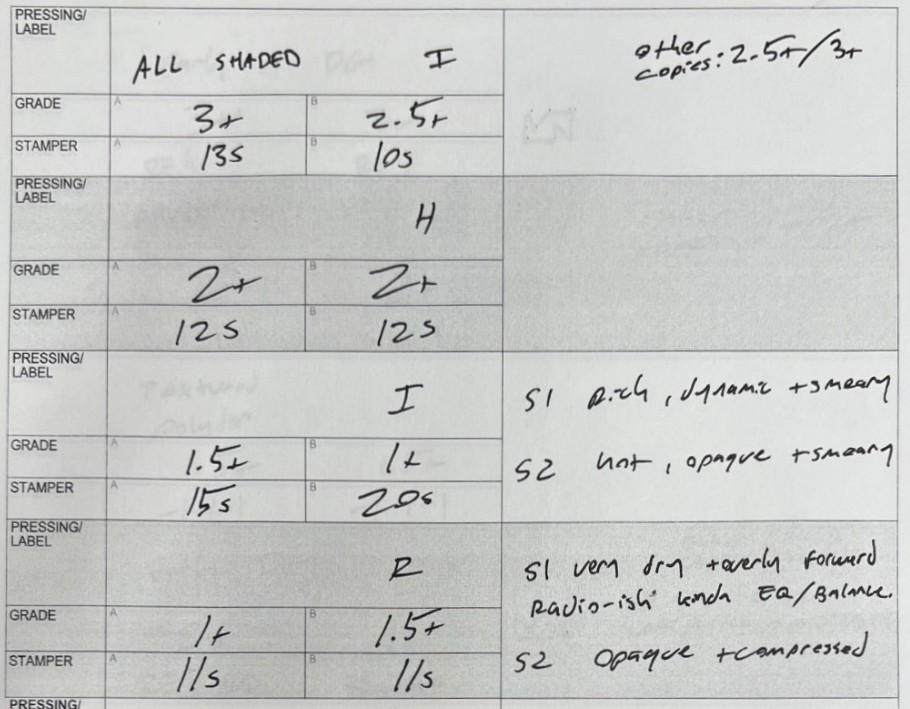
11/2023 Ros, Edmundo Rhythms of the South (PS 114 London) early Blueback 3 3 1E 1E other copies: 2.5/2, 2/2.5
11/2023 Ros, Edmundo Rhythms of the South (PS 114 London) early Blueback 1.5 1 2D 2D s1 dry, flat, trashy. s2 smeary, messy, boring
RE ABOVE: I FOUND THIS IN A BOX. THOUGHT IT SOUNDED REALLY GREAT, ESP. T1, S1

Jack Law’s cutting for side one was

(more…)

MoFi Mastering Variations – Will the Real Sgt. Pepper Please Stand Up?

Hot Stamper Pressings of the Music of The Beatles Available Now

Sgt. Pepper can be a pretty good sounding MoFi when it’s mastered by the right guy.

Say what?

Yes, dear reader, this album was mastered by two different engineers at Mobile Fidelity, and one of them, based on experiments we carried out years ago, did a much better job than the other.

This copy, which is far more rare by the way, has the better mastering — much less top end boost was added. As an aside, I used to like the other version better, but as I’ve gotten older and wiser, I realize that this pressing is superior, being noticeably less phony sounding.

It sounds much more like a good Parlophone and less like the typical Mobile Fidelity album.

(more…)

Could This Be the Sound Audiophiles Complain About with Vintage Pressings?

Hot Stamper Pressings of the Music of Red Garland Available Now

A rare and expensive (!) early stereo pressing that we played in a recent shootout for Bright and Breezy was passable at best.

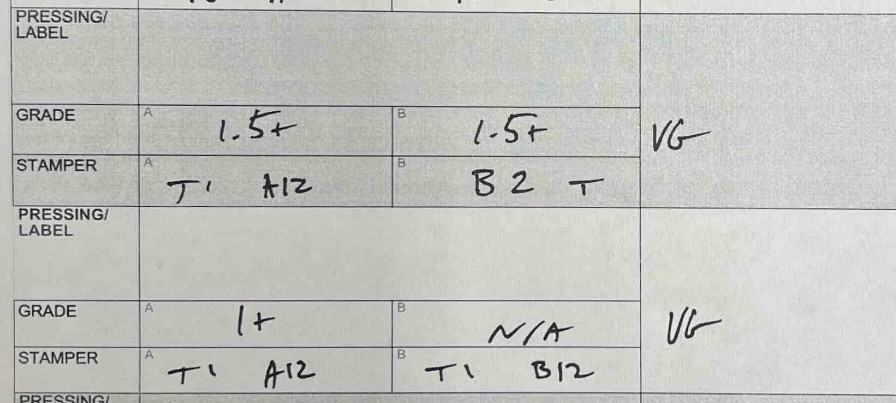
As you can see from the notes reproduced below, we found the sound to be “sweet, relaxed, but badly veiled and lacking weight and bass.” (Note that records without a 1.5+ grade or better on both sides are not considered Hot Stamper pressings.)

In other words, it sounded too much like an old record, and not a very good one at that. The world is full of them. (For this album, clearly the best sound is found on the right OJC.)

(more…)

You’ll Be Crying When You Get This Record on Your Turntable

Hot Stamper Pressings of the Music of Linda Ronstadt Available Now

UPDATE 2026

This review was most likely written when the record came out, circa 2008 I’m guessing. The intro is of course new for 2026.


You’re looking at one of the worst sounding audiophile releases in recent memory, a remastering disaster that has no reason to exist other than to satisfy the needs of the mid-fi collector market for numbered, limited editions on premium vinyl, perhaps so that they can be sold at a later date for a profit (discogs average price today: $62.50.)

This is a label that should have gone under decades ago but, with a nod to Frank Zappa channeling Edgar Varese, refuses to die.

Like this guy, this guy and far too many others, they are making money hand over fist at the expense of audiophiles who have yet to get very far — anywhere, really — in audio. (I know whereof I speak. I was one of those guys and you couldn’t tell me anything back then.)

We go to great pains to lay out the problems with these records in detail, but what good does reading about their problems do if the systems playing these records iare not only hiding their flaws, but making up for some of their weaknesses. The junk pressings these collectors are buying practically guarantee they will never manage to put together a system that can show them what is really on their records.

Regardless of what kind of equipment they own, if this crap is sounding good to them, which it seems to be based on the comments section I make the mistake of reading on Discogs from time to time, nothing we say can possibly interfere with them buying more of it.

(more…)

3s Can Have Amazingly Good Sound, or 3s Can Have Mediocre Sound

Hot Stamper Pressings of Living Stereo Recordings Available Now

But how can you tell which 3s copies sound amazing and which 3s copies don’t?

Below you will see the stamper sheet for a shootout we did not long ago.

A lot of our stamper sheets look like this one, close to half I would guess.

As you can see, the stampers and the sound are all over the map. This is not the least bit unusual in our experience. It’s simply the nature of records — they tend to come off the press with very different sound depending on factors that no one seems to understand very well, not even us!

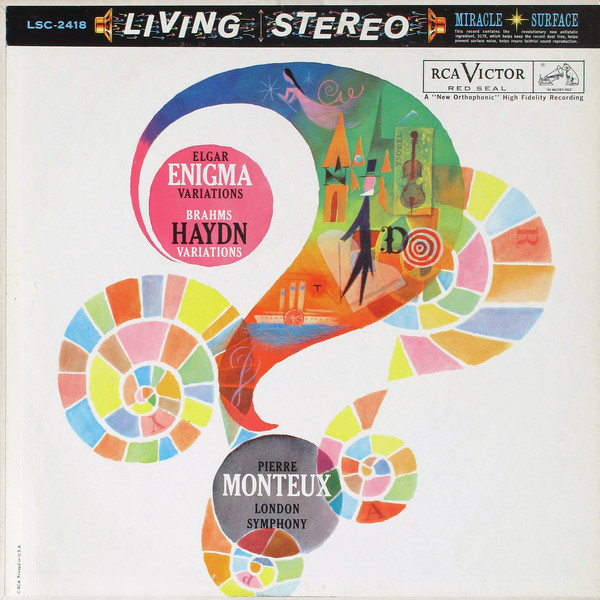
Note that the album you see pictured is not the record we did the shootout for.

(more…)

Cat Stevens Part 2 – Is This the Truest Tillerman of Them All?

If you haven’t read Part 1 of this story, please click here.

Back to our real story. I listened to my good original pressing. I call it White Hot at least!

Then I put the new pressing on the table, set the SDS for 45 RPM, and got the volume just right. I proceeded to carefully adjust the VTA by ear, going up and down with the arm until the sound was right, which is simply standard operating procedure for every record we audition.

These are my actual notes for But I Might Die Tonight.

This is what I heard as the song worked its way through the various sections, in real time.  The first thing I heard at the start was Zero Tubey Magic for the first verse. One of the last things I heard at the end was No Real Space. Space is what you hear at the end for the big piano and drums finish.

Let’s take it line by line. First up:

Zero Tubey Magic

I didn’t hear much Tubey Magic on the new pressing. The best early pressings — domestic A&M Browns, Pink or Sunray UK Islands — often have simply phenomenal amounts of the stuff. It’s a hallmark of the recording.

If a new pressing comes along without it, that’s a problem. I guess that George Marino‘s cutting system at Sterling could probably do some things well, but it sure doesn’t seem to be able get the sound of tubes right. His 33 RPM cutting had no Tubey Magic, and this one has no Tubey Magic. If I had hired him to cut a record for me and it came out sounding like this, I would find somebody else to cut records for me.

He’s dead now, rest in peace. I would doubt that anyone at Sterling has a better cutting system, and therefore no one should expect any records that have been mastered there to sound very good.

Vocal Is Clear, Clean and Dry

This is the sound you sometimes get with modern, super-clean transistor cutting equipment. It’s low distortion, like a CD is low distortion. We don’t think we should have to put up with dry vocals on records when the good pressings we have been playing all our lives have noticeably richer vocals.

Not rich like Dream With Dean, nothing is that rich, but rich and full-bodied the way the good pressings of this album always make them sound.

(more…)

We Were Wrong about the Reissues of Christmas with Chet Atkins

Hot Stamper Pressings of the Music of Chet Atkins Available Now

In 2006 we wrote our review for an orange label RCA reissue of the album.

Recently we did a shootout for the album and only one side of one of the later orange label pressings earned a Super Hot (2+) grade.

Our system was noticeably darker and clearly far less revealing than the one we have now, and those two qualities did most of the heavy lifting needed to compensate for the shortcomings of the reissue reviewed below.

What I couldn’t hear on my system back in those days (and even as late as 2006) no doubt explains most of these kinds of errors. That’s why we are constantly harping on the idea that audiophiles would do well to get good sound before they spend a fortune on vinyl.

Higher quality playback is what makes it possible to recognize and acquire better sounding records.

(more…)

Hey, Maybe Rudy Van Gelder IS as Bad a Mastering Engineer as Some Say

Hot Stamper Pressings of Recordings by Rudy Van Gelder Available Now

It’s certainly a proposition worth considering, mostly because so many audiophiles seem to believe it. Or maybe in spite of their believing it, skeptics such as myself being the troublemakers they always are.

So let’s dig down into the dirt of a record that Rudy both recorded and mastered.

None of the Rudy Van Gelder cuttings we played of Eric Dolphy’s 1961 release of Out There were better than passable, and some had sides that were downright awful sounding, as you can plainly see from our notes.

The copies that won our most recent shootout were mastered by George Horn, and the best of them sound amazing. Here are some comments we made for the album years back as well as the Allmusic review:

Insanely good sound throughout with both sides earning Shootout Winning Triple Plus (A+++) grades. This copy was doing it all right: rich, full-bodied and Tubey Magical yet still super open and spacious.

“A somber and unusual album by the standards of any style of music, Out There explores Dolphy’s vision in approaching the concept of tonality in a way few others — before, concurrent, or after — have ever envisioned.” – 5 stars

As you will see from our notes, we played some very disappointing early pressings. All the early pressings we had on hand were expensive to acquire, the vintage jazz pressing market being what it is: expensive and full of optimistic record graders of questionable skill. (For these kinds of vintage pressings we probably return 70-80% of what comes our way.)

We have to pay top dollar to get copies that are clean, even on the 60s and 70s reissue labels. Noisy old jazz records are simply not saleable to audiophiles no matter how good they sound.

None of the early copies we played earned grades good enough to bother pursuing, not when there are wonderful sounding vintage reissues from the 80s available. On a more positive note, this being our first shootout for the album in many years, we certainly learned a lot, so let’s just chalk up the losses to the cost of doing business. Our newfound knowledge of the best pressings will continue to pay dividends for years to come now that we know what the right stampers tend to be.

(more…)