Orchestral Composers, Conductors, Performers

50 Years Later and What, If Anything, Has Changed?

Audiophile Quality Pressings of Orchestral Music Available Now

In 1975 Klavier licensed and reissued some well-regarded EMI recordings with mastereing by one of our favorite mastering engineers, Doug Sax. They were to be produced here in the states for the domestic audiophile market.

I wrote a long piece many years ago about how ridiculously bad these records sounded. You can find it here.

I just happened to look up the album today to find out what year it had come out (1975) and discovered that back in 2015, when I first wrote about the record, I had somehow ignored the fact that not all the pressings were produced the same way. There was a special version made for a company called Eastern Pacific Sounds, no doubt serving the Asian audiophile market. It differed in ways that will be familiar to the audiophiles of today, even though it came out 50 years ago.

Single Step processing was used for this “Limited Edition” release. The stamper was made from the first generation master and not more than 1,000 were pressed from each stamper. This process allows all records to be of “test pressing” quality. Klavier records are used by many manufacturers and audio specialty shops for demonstrating their equipment.

For the Klavier release of Offenbach Overtures with Fremaux, our current favorite, they managed to produce even fewer pressings per stamper:

Single Step processing was used for this “Limited Edition” release. The stamper was made from the first generation master and not more than 500 were pressed from each stamper. This process allows all records to be of “test pressing” quality.

The problem with this way of thinking about records has always been a lack of evidence to support any of the supposed gains in sound or pressing quality. As with so much of audio and records, no doubt confirmation bias is at the heart of the problem

We did some testing ourselves years ago for the 45 RPM “Very Limited Edition” of Rumours, in which we demonstrated fairly conclusively that no two records sound the same, no matter how few you press from a stamper. (You can read all about it here.)

We discussed the conventional wisdom of buying promos so that you can get “test pressing” quality or something close to it. This also has proven to be of little value.

And now we have “one-step” pressings, some of which have been reviewed on this blog, either by me, Robert Brook or my customers. (This might be a good place to start to learn more about their sound quality, which, as far as we can tell, is consistently dismal.)
(more…)

The Not So Swingin’ Nutcracker in Living Stereo

Hot Stamper Pressings of Living Stereo Recordings Available Now

UPDATE 2026

We wrote the commentary you see below about 15 years ago.

We liked the record back then just fine. However, we recently got another couple of copies in and they sounded OK, not great, but what really had aged badly was the music, which was corny and, worst of all, contra the album’s title, definitely did not swing. Don’t waste your money on this one the way we did.

There are many jazz pressings we’ve discovered with audiophile quality sound and enjoyable music, but we reluctantly had to admit that this title should no longer be considered one of them. Live and learn, right?

We hope we can be forgiven for our mistaken bias in favor of a Golden Age title with a cool vintage cover. (And it wouldn’t be the first time.)

Another source of mistaken thinking: The Swingin’ Nutcracker came out in 1960, a year known for a great many other exceptionally good sounding titles produced during the Golden Age of vacuum tube recording. After playing so many wonderful recordings on that label, from that era, we were primed to like it regardless of whatever shortcomings it might have had.

This is why we recommend audiophiles pull titles off their massive shelves and give them a spin from time to time. Some records have simply not stood the test of time as well as others. Some will be better than we remember, some worse.

A wall full of records, most of which have not been played in years, even decades, is not a record collection worthy of the name. It’s better understood as a pile of vinyl that has been doing nobody any good for a very long time and, according to Newton’s Laws of Motion, will continue doing nothing for nobody forever.

(more…)

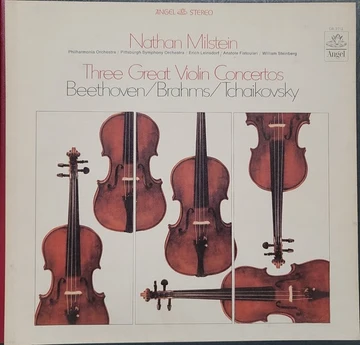
Three Great Violin Concertos / Milstein

       More Hot Stamper Pressings Featuring the Violin

  • Three Great Violin Concertos debuts on the site with roughly Nearly Triple Plus (A++ to A+++) grades on all SIX sides of these vintage Blue Angel Stereo pressings – just shy of our Shootout Winner (sides two and five actually won the shootout)
  • Exceptionally spacious, rich and smooth – only vintage analog seems capable of reproducing all three of these qualities without sacrificing resolution, staging, imaging or presence
  • The immediacy of Milstein’s violin is simply in a league of its own, with some of the sweetest, richest, most “rosiny” violin tone we’ve had the good fortune to hear

(more…)

Another Fine Entry for Our Heavy Vinyl Hall of Shame

Hot Stamper Pressings of Orchestral Spectaculars Available Now

UPDATE 2026

It just so happens that I had the time to listen to this work from start to finish twice just last night, 2/11/2026. Saw it performed live just a few months back at Atlanta Symphony Hall.

This wonderful work never gets old.  Next time we do a shootout for the performance we like with Muti on EMI I hope you will see your way to picking up a copy. You won’t regret it.


The Classic Records repressings of Pictures at an Exhibition — whether at 33, 45, or any other speed, on one disc or four –are all godawful sounding.

(Yes, we have auditioned both versions, for as long as we could stand them, which wasn’t long as the sound was painfully bad. The details can be found below.)

Everything that was bad about the worst original Shaded Dog pressings not only hasn’t been fixed, it’s been made even worse!

Yes, we admit to having played a good pressing of LSC 2201 in 2024, but there are just too many bad pressings of the album to bother doing a shootout for it. It’s hard to justify the cost when so few have the sound we are looking for.

The shrillness, the hardness, the sourness, the loss of texture to the strings, the phony boosted deep bass — this is the kind of sound that makes my head hurt and my skin crawl. After a minute or two of listening to sound this bad I’ve had it.

And can you believe that HP put this miserable remastered pressing on his TAS Super Disc List? Sad but true.

(more…)

Side One Had Tubey Colorations Missing from Side Two

Hot Stamper Pressings of Vintage Columbia Albums Available Now

An undiscovered gem from 1967 on the 360 Columbia label.

Side two of this record blew our minds with its White Hot Stamper sound.

Musically and sonically this record is nothing short of wonderful.

Who knew? You could play fifty vintage piano recordings and not find one as good as this.

Tchaikovsky, Liszt, Beethoven, Debussy, Mozart — these shorter pieces and excerpts were composed by those with the greatest gift for melody, men who’ve produced works that have stood the test of time, enchanting audiences over the centuries with works of such beauty and charm.

Here at Better Records we have never been fans of Columbia classical LPs. To be clear, the fault more often than not has to be in the mastering, not the recording. We’ve raved about so many great copies of titles in the past, only to find that the next three or four LPs we pick up of the very same titles sound godawful.

There are some amazing Bernstein recordings out there, but the amount of work it takes to find the one that sounds good is overwhelming — how can such great recordings be mastered so poorly so often?

Side One

A++, with a huge, rich, sweet, natural sounding piano. The more you listen, the more apparent it becomes that, as natural as it may seem at first blush, there are still some old school tubey colorations that make the sound not quite as lifelike as one might wish.

And the confirmation of that finding comes as soon as you flip the record over.

(more…)

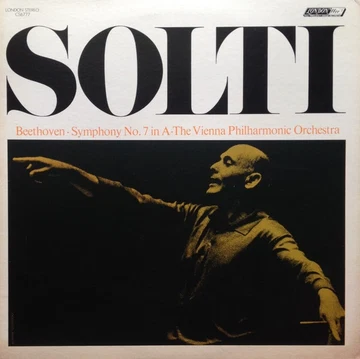
Beethoven – Symphony No. 7 / Solti

More of the Music of Beethoven

  • Solti and the Vienna Phil’s commanding performance of Beethoven’s Symphony No. 7 (CS-6777) debuts on the site with big, spacious, and lively Shootout Winning Triple Plus (A+++) sound or close to it throughout this vintage London pressing
  • It’s also fairly quiet at Mint Minus Minus, a grade that even our most well-cared-for vintage classical titles have trouble playing at
  • These sides are doing practically everything right – they’re rich, clear, undistorted, open, and has depth and transparency to rival the best recordings you may have heard
  • The texture on the strings is captured perfectly – this is an area in which modern pressings fail utterly, and without good string reproduction, especially in the lower registers, a Beethoven symphony is simply not a pleasurable experience on highly resolving equipment

(more…)

Overtures in Hi-Fi / Wolff

More Imported Pressings on Decca and London

  • This vintage London Stereo pressing was doing practically everything right, with both sides earning KILLER Shootout Winning Triple Plus (A+++) grades
  • It’s also fairly quiet at Mint Minus Minus, a grade that even our most well-cared-for vintage classical titles have trouble playing at
  • Both of these sides are big, clear, rich, dynamic, transparent and energetic, and will surely put to shame any pressing of the album you own
  • Although not long, every second is packed with color and energy, exactly what a good overture needs (And it even has a glockenspiel! How can you go wrong?)
  • Also notable is the choice of material, with a few of the more obscure overtures really brought to life here, such as the opening piece by Adam on side one: “Si j’etais roi”

(more…)

The Bloated Cello Sound Some Find Appealing

Hot Stamper Pressings of the Music of Claude Debussy Available Now
UPDATE 2026

We made a crack about the Starker Mercury recordings below which we gernerally no longer agree with, although I am sure there are some pressings which have bloated sound. Those are the ones that don’t win shootouts.


On this pressing we were a bit surprised at how natural the cello sounded — more like the real instrument and less like the typical recording of it. 

Normally when recording the cello, the microphones are placed fairly close to the instrument. This often results in what’s known as the “proximity effect,” which simply describes a boost in the lower frequencies relative to the more linear response of the microphone when placed at a distance.

The famous Starker cello recordings on Mercury — you know the ones, the originals and even the reissues sell for hundreds and hundreds of dollars — suffer from this effect, which audiophiles seem to prefer. (The Mercury heavy vinyl reissues, at least the ones I’ve played, were ridiculously fat and bloated in the bottom.)

Audiophiles did not seem to mind much, judging by the apparently strong sales and the rave reviews I read. Bass shy systems, and that means most of the systems owned by audiophiles, probably benefited from the bass boost.

Systems with lots of large woofers — at least in our case — would of course make the sound of these pressings positively unbearable. That indeed was our experience.

(more…)

Delibes / Coppelia – A Superb Mono Pressing from 1957

Hot Stamper Pressings of Music Conducted by Ansermet Available Now

UPDATE 2026

This is a very old commentary so take it for what it’s worth. We no longer buy mono pressings of orchestral recordings from the golden age. The best stereo pressings are just so much better.

The stereo set (CSA 2201) came out in 1958. We appreciate the sound quality that stereo makes possible after having heard the mono.

However, there is nothing wrong with the recording, which was made for both stereo and mono in 1957.

In fact, 1957 just happens to be a wonderful year for analog recordings, as evidenced by this amazing group of albums, all recorded or released in that year.


DEMO QUALITY SOUND for this early London Mono pressing. 

Side one of this record sounds incredible! The sound is absolutely top notch. Check out the brass — it has the solid weight of the real thing.

This is the kind of record that the mono cartridge owners of the world worship. And for good reason. But you don’t need to have a mono cartridge to hear how good — in fact, how much BETTER — this copy sounds than the stereo pressing.

(more…)

Beethoven / Symphony No. 5 / Ansermet

More of the Music of Beethoven

  • A vintage London pressing of this superb performance of Beethoven’s legendary 5th, here with KILLER Shootout Winning Triple Plus (A+++) sound or close to it from first note to last
  • It’s also fairly quiet at Mint Minus Minus, a grade that even our most well-cared-for vintage classical titles have trouble playing at
  • The texture on the strings is captured perfectly – this is an area in which modern pressings fail utterly, and without good string reproduction, especially in the lower registers, a Beethoven symphony is simply not a pleasurable experience on highly resolving equipment
  • Clear, transparent, natural – throw this one on your turntable and your ability to suspend disbelief will require practically no effort at all
  • Guaranteed to put to shame any Heavy Vinyl pressing of orchestral music you own or your money back

Everything sounds so right on this record, so much like live music, there is practically nothing to say about the sound other than you are there.

This is the kind of record that will make you want to take all your heavy vinyl classical pressings and put them in storage. Practically none of them will ever begin to sound the way this record sounds. Some of the worst of them can be found here.

Quality record production is a lost art, and it’s been lost for a very long time. (more…)