Composers

Have You Ever Noticed that Sometimes the Highs Come Back on Some Pressings?

More of the music of Sergei Rachmaninoff (1873-1943)

This side one is interesting., I would say that it starts out Super Hot (A++) and within a few minutes becomes White Hot (A+++). The piano is a bit veiled at the start, but within a relatively short period of time that subtle loss of transparency disappears and the piano is RIGHT THERE.

This is not unusual in our experience.

The first track on many records can sound dull, and by the second track the highs come back and the tonality is right from top to bottom. Who knows why?

We speculate that the vinyl did not have time to fully heat up the edge of the record, but that’s speculation, something that has almost no value in our (yours and mine) quest for better sounding records. 1A, 1B, first off the stamper, who gives a flying you-know-what. You have to play the record to know how it sounds.

The rest is BS, proffered mostly by those who are simply too lazy (or busy; some folks do have real jobs!) to do the work of cleaning and playing multiple copies of an album in order to have the evidence they need to support their opinions.

We much prefer real knowledge supported by real evidence, not the other kind.

(more…)

Grieg / Peer Gynt Suite / Barbirolli

Hot Stamper Classical and Orchestral Pressings Available Now

UPDATE 2025

This is a very old review and one that may not be especially accurate as it was written before the advent of the modern record shootout. Pick this one up for cheap if you like though.

Our current favorite pressing of the Peer Gynt Suite is the one Fjeldstad recorded for Decca.

1959 was a phenomenal year for audiophile quality recordings – as of 2025 we’ve auditioned and reviewed more than one hundred and seventy titles, and there are undoubtedly a great many more that we’ve yet to discover.

We think there are close to 50 that belong in any audiophile record collection worthy of the name.

(more…)

A Deep, Deep Dive into LSC 2323 – A Shootout Like No Other

Hot Stamper Pressings of Orchestral Spectaculars Available Now

Years ago, around 2005 if memory serves, I played a copy of the Classic Records remastered pressing of LSC 2323 and thought it was pretty good.

It seemed better than the Shaded Dog copies I had compared it to, which, based on the hundreds of other Classic Records titles I had auditioned up to then, was unexpected to say the least.

Unheard of is more like it. (That is no longer true — stay tuned for the story of the one Classic Records classical record that actually won a shootout not that long ago.)

Little did I know that the Shaded Dog pressings on this title are not remotely competitive with the right early reissues.

The best of the Shaded Dog pressings we could find, which just happened to have a 1s side one, came in tied for last with the one 70s Red Seal pressing we thought sounded good enough to make the shootout. (Most are terrible.)[1][2]


Some Inside Baseball

Most of the Shaded Dogs and Red Seals were needle-dropped, and all but two were eliminated before the shootout. It takes time and wastes money to clean and play pressings that sound hopeless, so a quick elimination round often precedes the cleaning process.


Back then it was tough to wrap my head around the idea that a Classic Record classical title could actually be better sounding than a Shaded Dog — it had never happened, so I knew there had to be more to the story.

The time to do a serious investigation of LSC 2323 necessary to get to the bottom of what was truly a head scratcher was not in the cards, so I shelved the project for close to the next twenty years. (Other such oddities have their own section here by the way.)

This title would have to wait until 2025 to go through a proper shooout, and when it did, naturally the Classic was part of the mix, which is the way we do things here at Better Records.

Why? Because every record with any hope of sounding good must be given the chance to show us what it can do. It deserves to be evaluated fairly, without the listener having any knowledge as to which pressing my be playing.

It turns out that side one of the Classic was passable, but side two — the side I had never played — was every bit as bad as most of their other classical offerings, which is very bad indeed.

(more…)

Are You a Soundphile? I Used to Be One

Hot Stamper Classical and Orchestral Pressings Available Now

UPDATE 2026

About 30 years ago I got hold of a Japanese pressing of Marriner conducting Haydn’s Toy Symphony and Mozart’s Eine Kleine Nachtmusik and was blown away by the absolutely phenomenal quality of the Haydn. Listing the record for sale, I raved:

DEMO QUALITY SOUND! This is the best sounding Toy Symphony you will ever hear!

…all the little toys that play along with the music just JUMP out of the speakers. The recording is so transparent and the toys are so well miked it’s like hearing the work for the first time, or live.

Now we know definitively that this is clearly not true, assuming yoy have one of our Hot Stamper pressings of the EMI original. They are better in every way than the Japanese pressing, which is the one purporting to have audiophile sound.

If this sounds familiar to you, I’m guessing this is not your first visit to the blog or our site. There is almost always a vintage pressing with superior sound when compared to the audiophile pressings made from the same recording.

The problem is: You just don’t know which vintage pressing will have superior sound. Maybe they all will. Maybe none of the copies you own will. There is one, but how do you find it?

In order to get that answer, you have to know how to do carefully controlled shootouts, and not just once, but more often than not a number of them over a period of years. Whatever answer you may come up will most likely be provisional, not definitve, because that’s the only way the process of discovery can work when applying scientific methodologies to the solution of a problem like “which pressings sound best on record X?”.

We did the shootout in 2022 and found out that the best of the original EMI pressings are quite a bit better, a classic case of live and learn, as well as one of the hundreds of breakthrough discoveries we’ve made over the years. That’s what happens when you are in the business of playing records and then selling the best of them to audiophiles looking for superior sound.

I believe I had at least one or two UK EMI pressings to play against the Japanese ones, but all the details of how I came to this conclusion — a proto-shootout, carried out long before I knew how to do a real one — are lost to the mists of time.

Keep in mind that my stereo was dramatically less revealing back then. Also I had not learned how to clean records properly. Those two facts, combined with the underdeveloped listening skills that go with them, helped me to arrive at the wrong conclusion.

No, the Japanese pressing, specifically targeted to audiophiles, or “soundphiles” if you like, is not superior to a properly mastered and pressed UK LP.

If you have more than a handful of Japanese pressings in your collection, you can be sure that there is still plenty of room for improvement in your audio system.

(more…)

Beethoven / Violin Concerto / Heifetz / Munch

More of the Music of Beethoven

  • Our superb vintage pressing of this brilliant Living Stereo recording – from 1956! – boasts solid Double Plus (A++) sound or BETTER throughout
  • It’s also fairly quiet at Mint Minus Minus, a grade that even our most well-cared-for vintage classical titles have trouble playing at
  • The orchestra is wide, tall, spacious, rich and tubey, yet the dynamics and transparency are first rate
  • White Dogs and Shaded Dogs can both sound good on this title – just avoid the Red Seals and later pressings if you are looking for the best possible sound
  • There are about 150 orchestral recordings we think offer the best performances with the highest quality sound. This record is certainly deserving of a place on that list.
  • If you’re a fan of Beethoven’s music, this superb All Tube Recording from 1956 belongs in your collection.
  • This Classic Records pressing, however, was a piece of garbage, and we made our position clear right from the start

The reproduction of the violin here is superb — harmonically rich, natural, clean, clear, resolving. What sets the truly killer pressings apart is the depth, width and three-dimensional quality of the sound, as well as the fact that they become less congested in the louder passages and don’t get shrill or blary.

(more…)

This Pressing of Carmen Had Dry Strings on One Side, Rich Strings on the Other

Hot Stamper Pressings on Decca and London Available Now

My notes for side two on a copy we recently auditioned read:

Could use more tubes.

Strings could be a bit smoother.

Needs a bit more weight down low.

My notes for side one:

Side one had all of this and more!

Some Common Issues with Londons and Deccas

Many London and Decca pressings lack weight down low, which thins out the sound, easily heard in the lower strings, which sound washed out.

On some sides of some copies the strings are dry, lacking Tubey Magic. This is decidedly not our sound, although it can easily be heard on many London pressings, the kind we’ve played by the hundreds over the years.

If you have a rich sounding cartridge, perhaps with that little dip in the upper midrange that so many moving coils have these days, you will not notice this tonality issue nearly as much as we do.

Our 17Dx is ruler flat and quite unforgiving in this regard. It makes our shootouts much easier, but brings out the flaws in all but the best pressings, exactly the job we require it to do.

Here are some other records that are good for testing string tone and texture.

(more…)

Living Stereo Vs. Classic Records

Hot Stamper Pressings of Living Stereo Recordings Available Now

We described a Hot Stamper pressing of Symphonie Fantastique (LSC 2362) we put up not long ago this way:

The size and power of a large orchestra in Living Stereo sound.  The hall is huge, the brass solid and powerful, the top and bottom extends properly, the stage is wide and clear — what more can you ask for? 

So open and spacious, with gorgeous, richly textured strings — this is the VIVID sound we love from the Golden Age!

Classic Records and Their Abysmal String Tone

Of course, this was always the most obvious shortcoming of the Classic Records RCA remasterings — just not obvious to the audiophile press or the audiophiles who bought the records. None of them seemed to notice how the strings of the new pressings never sounded remotely the way they had on the originals and early reissues (reissues which were, unsurprisingly, sometimes better).

Classic’s pressings had bass and dynamics, no one could deny it, but the strings were unusually shrill and smeary, and the hall practically non-existent. (We chalked it up to the bad transistor cutting equipment Bernie was using back then, but how could anyone know for sure what was really going on? All we knew was that most of the classical titles they released did not sound good, so there was simply no need to investigate further.)

We found out some years ago that there was a new series of recuts coming from Acoustic Sounds. Based on their dismal track record, I will be very surprised if they are much better than mediocre.


UPDATE 2024

We finally got one in and put it in a shootout. The results: a passable-at-best side one and a bad sounding side two.

In other words, really not worth the vinyl it’s pressed on. Almost any White Dog or Shaded Dog will beat it (although it should be noted that there are plenty of vintage pressings of the album that don’t sound much better than mediocre. Still, on side two it should be no contest.)


(more…)

Prokofiev / Peter and the Wolf – Sargent

Hot Stamper Pressings of the Music of Sergei Prokofiev
UPDATE 2026

What you see below is a very old review. After hearing better performances with better sound, we are no longer big fans of this recording, but if you can pick one up for cheap — which is very doable as this record should be sitting in the bins for under ten bucks — you might want to give it a try.

We recommend you look for the earlier STS label, Silver and Black, and avoid the later Orange and Black label pressings, as those are almost always inferior sounding.

We prefer Previn’s recording for EMI but this one is very good and easily found in record stores.


Our Old Review

SUPERB SOUND! This Orange and Black label British pressing has sweet strings, powerful dynamics, plenty of depth and a wide soundstage.

It’s major faults are a lack of deep bass and some congestion during loud passages.

(more…)

Why Did Suite No. 2 Sound Better than Suite No. 5?

Hot Stamper Pressings of the Music of J.S. Bach Available Now

We described our most recent Shootout Winning pressing of SR-90370, Bach’s Suites Nos. 2 and 5 for Solo Cello this way:

An early Mercury label pressing of Starker’s legendary 1963 recording of Bach’s sublime music for solo cello with INCREDIBLE Shootout Winning Triple Plus (A+++) grades or close to them.

The bass-boosted, muddy, veiled and ambience-challenged sound of the typical modern Heavy Vinyl remaster is nowhere to be found here.

I would bet money that whatever version is currently available has plenty of shortcomings along those lines, which may be acceptable to the mid-fi crowd but is positively ruinous on the high-fidelity systems that our customers have (or why on earth would they keep paying these prices?)

Some Mercury pressings from the 50s have absolutely amazing sound – we should know, we’ve played them by the score

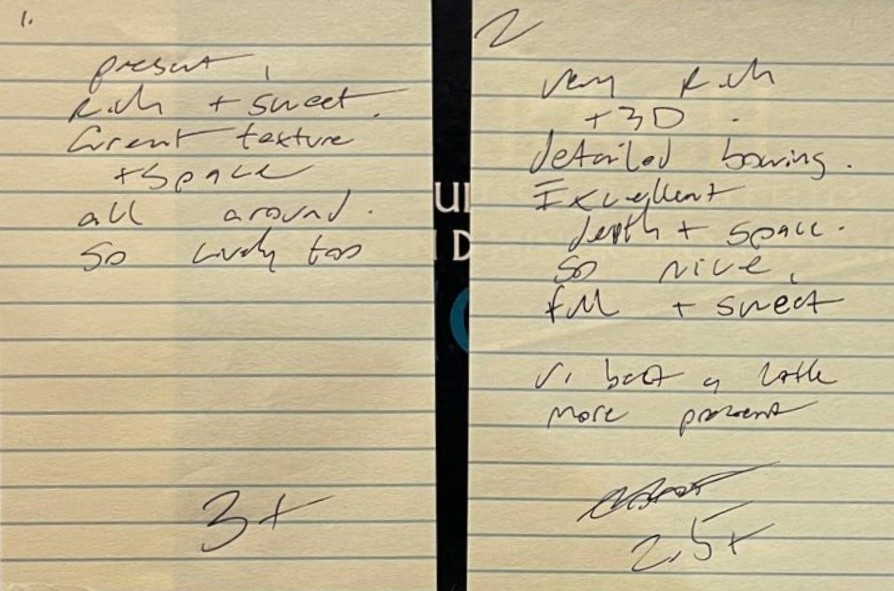
Side one was killer in every way, and the way we know that is we played a bunch of copies and nothing could beat it. This side one took top honors for having exactly the sound we described above.

  • Present
  • Rich and sweet
  • Great texture and space all around
  • So lively too

Side two is another matter. We came across a side two that was slightly better than the side two you see here.

(more…)

For Scottish Fantasy, Forget the Red Seal Pressings

Hot Stamper Pressings Featuring the Violin Available Now

The 70s Red Seal pressings we’ve played recently have all left a lot to be desired, but, since we had one sitting on a shelf in the backroom with lower stampers, we figured what the hell, let’s clean it up, throw it into our next shootout and hope for the best.

As you can see, the best was not to come.

There are quite a number of other records that we’ve run into over the years with obvious shortcomings.

Here are some of them, a very small fraction of what we’ve played, broken down into the three major labels that account for most of the best classical and orchestral titles we’ve had the pleasure to play.

(more…)