Month: April 2026

Pitchfork’s Review of the 2012 Roxy Music CD Box Set

More of the Music of Roxy Music

Reviews and Commentaries for the Music of Roxy Music

Tom Ewing has written a beautiful piece here about one of my favorite bands of all time.

This career-spanning box set to mark Roxy Music’s 40th anniversary is often startling, usually wonderful, and more affecting than expected. It’s also fascinating as the story of a gradual hardening of an elegant, enigmatic persona, of Bryan Ferry’s transformation from art-school pop star to self-made sphinx.  

In their 1970s heyday, Roxy Music enjoyed enormous critical and commercial success, but even so, they and their art-school rock were admired more than trusted. American critics snipped at leader Bryan Ferry’s arch romanticism, while the Brit press considered the models Ferry squired and the suits he doffed and dubbed him “Byron Ferrari”. Almost everyone affirmed that the band were great, while disagreeing as to when, exactly. For some, the great achievement was 1982’s farewell, Avalon– impeccably designed pop for weary grown-ups. Others went a decade further back, to the early, playfully experimental albums Roxy released when Brian Eno was in the band, playing androgyne peacock to Ferry’s tailored lothario. Whether you see their development between those points as progress or cautionary tale, it’s easy to let this contrast define the band.

This box set of remasters to celebrate the band’s 40th anniversary– not lavish, but thorough and reasonably priced– is an opportunity to break free of narrative and see what sets every phase of Roxy Music apart. The answer is Bryan Ferry, one of rock’s great, sustained acts of self-definition. In classic 70s style, like Bowie or Bolan, Ferry invented a pop star. A sybarite with a plummy, awkward croon, gliding through his own songs like they were parties he’d forgotten arriving at. A flying Dutchman of the jet set, doomed to find love but never satisfaction. Having worked his way into character over an album or two, he simply never left it, becoming more Bryan Ferry with every record and every year, whether performing or not.

(more…)

Robert Brook Says: No Azimuth? No Problem!

Robert Brook runs a blog called The Broken Record, with a subtitle explaining that the aim of his blog is to serve as:

A GUIDE FOR THE DEDICATED ANALOG AUDIOPHILE

We know of none better, outside of our own humble attempt to enlighten that portion of the audiophile community who love hearing music reproduced with the highest fidelity and are willing to go the extra mile to make that happen.

Here is Robert’s latest posting.

No Azimuth? No Problem!

After making some adjustments to the arm, getting it in the ballpark, Robert writes:

I changed records to a Jascha Heifetz violin concerto that I like to use for tonearm settings. As I’ve mentioned in an earlier article, I particularly like using concertos for adjusting tonearms because of the challenge of getting both the soloist and the orchestra to sound their best. When the azimuth is just right, the soloist will sound full and present, while the orchestra behind them will be clear and distinct.

A few more tweaks and it was sounding right. Robert continues:

Now it was my friend’s turn to play some of his records, most of which I’d heard before adding the shim. On “Mediocre Bad Guys,” Jack Johnson’s voice now sounded more natural, and the thwack of the drum stick had lost its annoying glare. Zeppelin’s “D’yer Mak’er” was now rocking the way it should with the drum kit sounding appropriately huge and the cymbals showing plenty of top end sparkle and with a long decay. And on Eagles “Take It Easy” I could now better make out the many instruments in the mix, as well as the backing vocals, which I’d been struggling to hear clearly before.

Here’s the first question that comes to mind: Could this tonearm/cartridge tweaking and testing have been done using these other albums instead of the violin concerto recording?

Possibly, but it would have taken all day, because nobody really knows exactly how these records actually sound. Were they good recordings? No doubt, at least in some ways. But were these good pressings of those recordings? Who can say? And we have no business assuming.

Houses of the Holy sounds very different from copy to copy to us. We’ve easily played more than fifty of them, maybe closer to a hundred, and we’ve heard them sound every which way.

(more…)

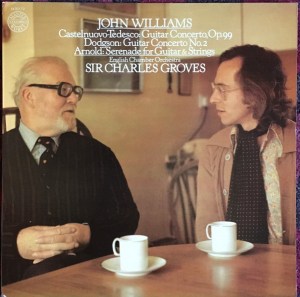
Arnold et al. / Guitar Concertos / Williams – Superb Sound from Columbia in 1977

More Classical and Orchestral Pressings


  • Amazing sound throughout this Columbia Masterworks pressing, with both sides earning superb Shootout Winning Triple Plus (A+++) grades or very close to them
  • It’s also fairly quiet at Mint Minus Minus, a grade that even our most well-cared-for vintage classical titles have trouble playing at
  • These sides are wonderfully rich, full-bodied and Tubey Magical, with a present guitar and tons of space around all of the instruments in this lovely chamber orchestra recording
  • A friend played me this record more than twenty years ago and I was knocked out by the beauty of the sound at the time, especially considering it was recorded in 1979, long after great classical recordings had become so rare as to be practically nonexistent
  • With top quality cleaning and the ability to find even better sounding pressings in our shootouts, you can be sure the copies we offer are a big step up from what I heard all those years ago
  • There’s a very good chance that you have never heard a better guitar concerto record, let alone owned one of such quality

If I could have only one guitar concerto recording in my collection, there’s a very good chance I would choose this one — that’s of course assuming I could have a copy that sounds as good as this one does on side one. It’s spacious and open and three-dimensional in a way that few classical recordings we play are, and we play an awful lot of top quality classical records. 

Although it may not be from the Golden Age or on London, it sounds to these ears every bit as good as any guitar concerto record I can remember hearing from that era or that label.

And the music is sublime. I heard this piece at a customer’s home in a very large room with a high ceiling, the speakers pulled well out from the walls. The speakers disappeared, leaving sound that was nothing less than glorious, as big as the room and as natural as any I had heard up until that time. That was about twenty years ago. 

(more…)

Bill Evans – Explorations

Hot Stamper Pressings of the Music of Bill Evans Available Now

UPDATE 2026

This is a very old review. The last time we sat down to play some OJC copies of this recording we were underwhelmed. There may be some great sounding pressings out there, but we did not have any on hand and don’t want to commit the resources that would be needed to find them.

Our old commentary follows.


Outstanding sound throughout with both sides rating a solid Double Plus (A++) or close to it

The sound here is, above all, natural – the tonality is correct, and the recording sounds right for Riverside circa 1961

4 1/2 stars: “Explorations proves that the artist was worth waiting for no matter what else was going on out there. Evans, with Paul Motian and Scott LaFaro, was onto something as a trio, exploring the undersides of melodic and rhythmic constructions that had never been considered by most… an extraordinary example of the reach and breadth of this trio at its peak.”

(more…)

Listening in Depth to McCartney

Hot Stamper Pressings of the Music of Paul McCartney Available Now

The best tracks here have the quality of LIVE MUSIC in a way that not one out of a hundred rock records do. The music jumps right out of the speakers and fills up the room.

The album sounds like it’s recorded live in the studio, but of course that’s impossible, because Paul plays practically all the instruments himself! It just goes to show how good a multi-track studio recording can sound when done well. (More rock and pop recordings with live in the studio sound can be found here.)

Side Two

Oo You

The distorted guitar in a huge and reverberant room that leads off this side is one of my favorite “sounds” on any McCartney album. The bigger, richer and grungier the guitar sounds, the better.

Momma Miss America
Teddy Boy

This is a very tough track to get right. There is processing on Paul’s voice that some copies make a mess of, adding a kind of unpleasant resonance, which of course the better copies do not.

It’s a fairly simple arrangement: acoustic guitar, bass, voice and Linda’s backing vocals. When all of these things are in balance, the sound will be lovely. Paul’s voice, because of the processing I mentioned, doesn’t sound as natural as it does on other tracks, but it shouldn’t be irritating or disagreeable.

Singalong Junk
Maybe I’m Amazed

Another exceptionally hard track to get right. On a top copy the guitar solo will JUMP right out of your speakers. It should have the energy of LIVE MUSIC

Kreen-Akrore

(more…)

Paris 1917-1938 – Side One Versus Side Two

Hot Stamper Pressings of Mercury Living Presence Records Available Now

UPDATE 2025

This listing was written all the way back in 2012 for the first Hot Stamper pressing of SR 90435 we’d ever listed as a Hot Stamper.

Note that it only had one good side, and even that side had a serious problem.

Thirteen years later in 2025 we would do a real shootout for this wonderful recording and learn something very few audiophiles know to this day — that the best stampers and the worst stampers are sometimes the same stampers.


Our 2012 Review

Super Hot Stamper sound for Eric Satie’s wonderfully eccentric Parade (and the Auric piece as well) can be found on this rare original promo copy of Mercury SR 90435, a record that was previously on the TAS List if I’m not mistaken.

It certainly deserves to be. The sound is BIG and OPEN, and like so many Mercury recordings with the London Symphony, it’s rich and full-bodied, not thin and nasally as is so often the case with their domestically recorded releases. Above all the sound is transparent, lively and dynamic.

In many ways this album would certainly serve quite well as an audiophile Demo Disc: the timbre of the wide array of instruments used is (mostly) Right On The Money.

Check out the lengthy and humorous producer’s notes for the sessions below. And people think The Beatles discovered experimental sounds in the studio.

The Brass Lacked Weight

With one small exception: the brass doesn’t have all the weight of the real thing, and for that we have deducted one plus from our top grade of three.

Side one has classic bad Mercury sound.

So screechy, hard and thin. How many audiophiles own records like this and don’t know that the sound of one side is awful and the other brilliant?

Since so few have ever commented publicly about such matters — and even supposedly knowledgeable audiophile reviewers never bother to even bring up the subject of one side versus the other — one must conclude that this is a subject that has yet to pierce the consciousness of most of our audiophile brethren, especially the ones who haven’t yet discovered this site.

Now’s a good time to start. Dig in, you may be surprised by what you find.

(more…)

Joni Mitchell – An Overview

Hot Stamper Pressings of the Music of Joni Mitchell Available Now

When the dust settles, Joni Mitchell may stand as the most important and influential female recording artist of the late 20th century. Uncompromising and iconoclastic, Mitchell confounded expectations at every turn; restlessly innovative, her music evolved from deeply personal folk stylings into pop, jazz, avant-garde, and even world music, presaging the multicultural experimentation of the 1980s and 1990s by over a decade. – Allmusic

Discography 1968-1991

1968 Song to a Seagull
1969 Clouds
1970 Ladies of the Canyon
1971 BlueTop 100, TAS List
1972 For the RosesSome of her best sound
1974 Court and SparkTop 100, TAS List, her best sounding recording
1974 Miles of AislesLovely analog sound
1975 The Hissing of Summer Lawns
1976 Hejira
1977 Don Juan’s Reckless Daughter
1979 Mingus
1980 Shadows and LightModern sound, a far cry from the Miles of Aisles
1982 Wild Things Run FastTAS List and a personal favorite
1985 Dog Eat Dog – Awful sound and music
1988 Chalk Mark in a Rain Storm – Maybe even worse
1991 Night Ride HomeSurprisingly good, but very hard to find these days and expensive to buy when you do

(more…)

Tears For Fears – Songs From The Big Chair

More of the Music of Tears For Fears

  • An incredible vintage UK pressing with Shootout Winning Triple Plus (A+++) sound on the first side and solid Double Plus (A++) sound on the second side
  • Rich, spacious and lively, with an open, extended top end – this is the sound you’ve been waiting for from Tears for Fears
  • More great songs than practically any other record made in the ’80s – “Shout,” “Everybody Wants To Rule The World” and “Head Over Heels” are just a few of the better known hits from this, their breakthrough third album
  • 4 1/2 stars: “It is not only a commercial triumph, it is an artistic tour de force. And in the loping, percolating “Everybody Wants to Rule the World,” Tears for Fears perfectly captured the zeitgeist of the mid-’80s while impossibly managing to also create a dreamy, timeless pop classic. Songs From the Big Chair is one of the finest statements of the decade.”

This is a classic in the Tears for Fears canon, probably the album most people regard as their best. I myself prefer Seeds of Love, which should take nothing away from Big Chair — both are exceptional productions from the ’80s no matter how you look at them.

SFTBC went to Number One on the charts for a reason. There’s really not a bad song on either side and mostly absolutely brilliant ones.

(more…)

Listening in Depth to Romantic Warrior

Hot Stamper Pressings of the Music of Return to Forever Available Now

Romantic Warrior is my favorite Jazz/Rock Fusion album of all time. As good as the music is, the sound is even better.

This is the Jazz/Rock Demo Disc that stands head and shoulders above the rest. In my experience, no record of this kind is more dynamic or has better bass. Not one.

Demo Disc doesn’t begin to do this kind of sound justice.

Simply put, not only is this one of the greatest musical statements of all time, it’s one of the great recording achievements. Few albums in the history of the world can lay claim to this kind of sonic power and energy.

But the Super Sound has a purpose, a raison d’etre. This is the kind of music that requires it; better yet, demands it. In truth, the sound is not only up to the challenge of expressing the life of the music on this album, it positively enhances it.

Just to take one example: Those monster Lenny White drum rolls that run across the soundstage from wall to wall may be a recording studio trick, but they’re there to draw your attention to his amazing powers, and it works! The drums are everywhere on this album, constantly jumping out of the soundfield and taking the music into the stratosphere where it belongs.

Side One

Medieval Overture

The grandiose opening of this record serves as an important sonic checkpoint, as well as a tipoff for the pyrotechnics to come. On the better copies Corea’s multi-layered, swirling synths occupy their own space, clearly separated from each other, not blurred and inarticulate as they are on the poorer pressings.

Also notice how much attack Lenny White’s drums have, especially in the more exposed sections. The transients are breathtakingly immediate. Run-of-the-mill copies tend to flatten Mr White, making his acrobatic playing seem two-dimensional and less-than-inspired. The best copies prove that nothing could be further from the truth.

(more…)

Genesis / Nursery Cryme

More of the Music of Genesis

  • With solid Double Plus (A++) grades from top to bottom, this vintage UK Charisma pressing was giving us the big and bold sound we were looking for
  • These sides have the bass, real rock energy and lovely midrange transparency that was missing from all others we played
  • For fans of the Classic Lineup involving Phil Collins and Steve Hackett — this being the first album with them on board — this Brit will show you a Nursery Cryme the likes of which you have never heard
  • If you own the Classic Heavy Vinyl pressing you are really in for a shock – that pressing is a smeary lifeless mess next to this LP (and don’t even get us started on the domestic copies)
  • Marks in the vinyl are sometimes the nature of the beast with these vintage LPs – there simply is no way around them if the superior sound of vintage analog is important to you
  • “If Genesis truly established themselves as progressive rockers on Trespass, Nursery Cryme is where their signature persona was unveiled … these are the songs that showed what Genesis could do, and they still stand as pinnacles of what the band could achieve.”

(more…)