LSC-1817

Reversed Polarity on Gaite Parisienne

Hot Stamper Pressings of Living Stereo Titles Available Now

UPDATE 2026

LSC 1817 is one of the pressings we discovered with reversed polarity. a very long time ago, 2005, before we got our EAR 324p phono stage that has a convenient switch for reversing polarity.


Superb sound! The top end of this record is PERFECTION. When you hear all the percussion instruments, — the tambourines, triangles, wood blocks and whatnot — they just sound so lovely.

The overall sound is rich and sweet, just like a good vintage RCA should sound. Some may find the sound colored, but I find it enchanting.

Side two, however, sounded fairly unpleasant when I first played it.

As I listened more and more, I came to the realization that the absolute phase was probably inverted. The orchestra, rather than being back behind the speakers where they belong, was coming AT me, a sure sign that something is funny. One way to think about it is the sound stage becomes convex instead of concave.

So I switched my headshell leads and sure enough everything got much better — the orchestra now had depth and the strings became less forward and shrill, and the horns took on more body and had less of that blary quality they sometimes do. (more…)

Our Shootout Winning Stampers for Gaite Parisienne

More of the Music of Jacques Offenbach (1819-1880)

UPDATE 2026

Our favorite performance of Gaite Parisienne is the one from Readers Digest. (Don’t bother to look for it on our site. We never have any stock as it is too hard to find and usually too noisy for most audiophiles.)


In 2004 we wrote:

11S/10S are the best stampers we have found for this amazing DEMONSTRATION QUALITY record!

I think that information still holds up.

I can also tell you that 5S/5S has never impressed us much. We’re not sure if it’s bad enough to belong in the bad shaded dog category, but audiophiles would be wise to give it a miss at anything over a nominal price.

Side 1 plays nearly NM without a pop! Side 2 opens with a half inch scratch. But think about it — isn’t one side about the right amount for this kind of music? Do you really need to play side 2 after hearing side 1? This copy gives you a good portion of the music with AMAZINGLY GOOD SOUND.

This 1954 2-track recording is RCA’s first stereo recording of the work.

1954. Can you believe it? Four mics and two channels and it blows away 90% of all the classical recordings ever made.

Some old record collectors and tube equipment lovers [not so much anymore] say classical recording quality ain’t what it used to be. This record proves it.

(And this record proves that sometimes old records just sound like old records.)

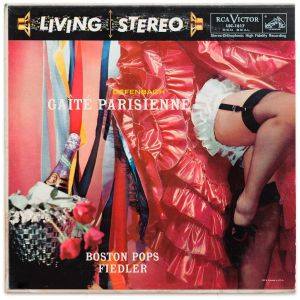
Offenbach / Gaite Parisienne / Fiedler

More of the Music of Jacques Offenbach

  • Stunning sound on both sides of this Shaded Dog pressing of LSC-1817 from 1954 (!) with each earning Shootout Winning Triple Plus (A+++) grades – exceptionally quiet vinyl too
  • This is a true Demo Disc quality recording – both sides are big, full-bodied, clean and clear, with huge amounts of energy and tons of space around all of the players
  • This 2-track recording is RCA’s first stereo recording of the work, made all the way back in 1954 – can you believe it?
  • Two mics and two channels and it blows away most of the classical recordings that followed it
  • Some old record collectors (like me) say classical recording quality ain’t what it used to be – this record proves it
  • In the 90s I was regularly selling this title for $1000+ and people were happy to pay it! They were getting their money’s worth

In a listing from a while back we wrote:

I love Fiedler’s performance and the 1954 two track RCA Living Stereo sound but finding an original Shaded Dog pressing in clean condition under $500 with the right stampers (something above 10 as I recall) is all but impossible nowadays. If you want to go that way more power to you.

Well we found one! With the right stampers! There are other good stampers for this album, but none that sounded as good as these in the shootout. And the vinyl is exceptionally quiet for a pressing from circa 1958 (the first year that stereo pressings were available; before that you had to buy the music on reel to reel to hear it in stereo). (more…)