Top Studios and Concert Halls

Mussorgsky et al. / Night On Bare Mountain / Solti

More of the music of Modest Mussorgsky (1839-1881)

Hot Stamper Pressings of Orchestral Spectaculars Available Now

  • This vintage London pressing of these Russian Orchestral Showpieces earned STUNNING Shootout Winning Triple Plus (A+++) grades or close to them on both sides
  • Big and dynamic as all get out – the work is performed with a speed and precision that will make your jaw drop
  • Tons of energy, loads of rich detail and texture, superb transparency and excellent clarity – the very definition of DEMO DISC sound
  • Solti is clearly the man for this music – he’s on fire with this fiery material

Don’t go looking for the Tubey Magic of an earlier era. What you get instead is super-low distortion, full-bandwidth sound with deep powerful bass and more transparency than most later Londons.

(more…)

Ravel / Dukas et al. – Works by Ravel, Honegger and Dukas / Ansermet

More Classical and Orchestral Recordings

  • An incredible London pressingof this superb release with Nearly Triple Plus (A++ to A+++) grades on both sides – just shy of our Shootout Winner
  • It’s also fairly quiet at Mint Minus Minus, a grade that even our most well-cared-for vintage classical titles have trouble playing at
  • This spectacular Demo Disc recording is big, clear, rich, dynamic, transparent and energetic – here you will find some of the best orchestral Hot Stamper sound we offer
  • The sound of the orchestra is dramatically richer and sweeter than you will hear on practically all other pressings – what else would you expect from Decca’s engineers and the Suisse Romande?
  • 1963 was a great year for classical recordings – other Must Own Orchestral releases can be found here.

The sound is clear, with wonderful depth to the stage. As a rule, the classic ’50s and ’60s recordings of Ansermet and the Suisse Romande in Victoria Hall are as big and rich as any you may have ever heard. These recordings may just be the ideal blend of clarity and richness, with depth and spaciousness that will put to shame 98% of the classical recordings ever made.

Side One

Bolero (Ravel)

Tubey and clear, with both the snare and the flute coming from so far back in the hall. OUTSTANDING energy and dynamic power.

Turn it up and it really comes to life like LIVE MUSIC. It’s big, wide and believable. We loved it.

Side Two

The Sorcerer’s Apprentice (Dukas)

ZERO compression. ZERO distortion when loud. Which means it has ZERO compressor distortion, something not five out of a hundred Golden Age recordings can claim. Nice extended top too.

There is depth and richness to beat the band, as well as clarity and tonal correctness that let you forget the recording and just enjoy the music. This piece is not quite as transparent as the Ravel, but still has earned every one of its Three Pluses.

The timbre of the brass is right on the money. As we have noted before, the brass of the Suisse Romande is some of the best to have ever been committed to analog tape.

Again, this side had OUTSTANDING energy and dynamic power the likes of which we think you may never have heard.

La Valse (Ravel)

Again, with that wondrously huge hall adding a sense of space that will allow your speakers to disappear. The performers are not too close, which is very much in keeping with live music.

In his tribute to Ravel after the composer’s death in 1937, Paul Landormy described the work as follows:

“….the most unexpected of the compositions of Ravel, revealing to us heretofore unexpected depths of Romanticism, power, vigor, and rapture in this musician whose expression is usually limited to the manifestations of an essentially classical genius.”

(more…)

Listening in Depth to Parsley, Sage, Rosemary, and Thyme

More of the Music of Simon and Garfunkel

Presenting another entry in our extensive listening in depth series with advice on what to listen for as you critically evaluate your copy of Parsley, Sage, Rosemary, and Thyme.

Here are some albums currently on our site with similar track by track breakdowns.

Side One

Scarborough Fair/Canticle

Listen carefully to the voices on this track, one of our favorites to test with. On the best copies they sound exceptionally delicate yet full-bodied.

Patterns

The percussion on this track is a great test for smear, a problem that plagues most pressings to one degree or another. On the better copies you’ll distinctly hear the sound of the drummer’s hands hitting the skins of the bongos, as well as lots of ambience and echo around the drums.

Note also that every stereo copy we’ve ever played spits at least a little on this song.

(more…)

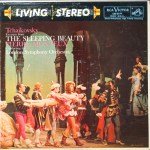
This Living Stereo from 1958 Didn’t Make the Grade

Hot Stamper Pressings of Living Stereo Records Available Now

Our notes for this copy of LSC 2177 read “blary, bright, not nearly as good as Anserment’s recordings,” which are the ones we compared it to, both the complete ballet and the highlights.

In other words, it just sounded like an old record.

If you are looking for a top quality pressing with a performance to match, we recommend two:

  1. The complete ballet on three discs with Anserment conducting, and/or
  2. The highlights, on a single disc, again with Ansermet conducting.

This Shaded Dog might be passable on an old school audio system, but it was unpleasant when played on the high quality modern equipment we use.

There are quite a number of other vintage classical releases that we’ve run into over the years with similar shortcomings. For fans of vintage Living Stereo pressings, here are some to avoid.

(more…)

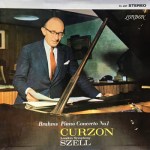
Brahms / Piano Concerto No. 1 – What to Listen For

Hot Stamper Pressings of of the Music of Brahms Available Now

Our general notes for the recording seen below explain why the typical copy in our shootout fell short.

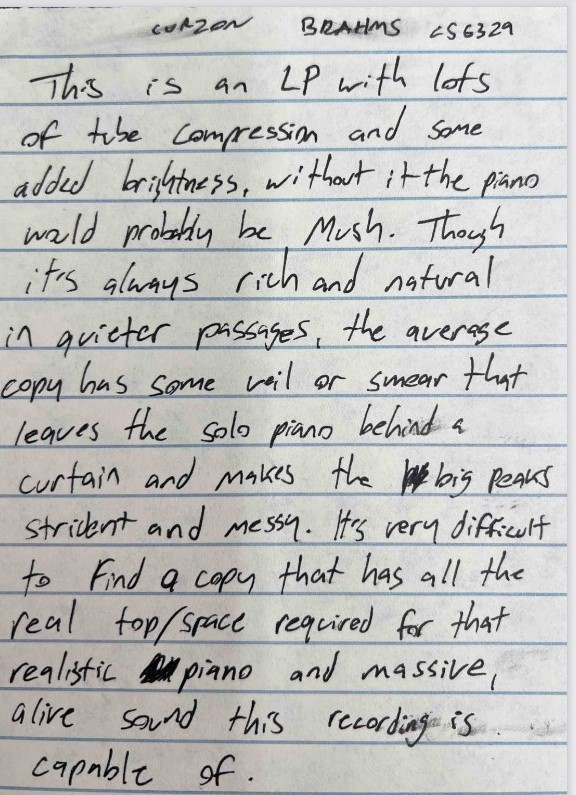
This is an LP with lots of tube compression, and some added brightness.

Without the added brightness, the piano would probably be mud.

The added brightness and compression results in a piano that always sounds rich and natural in the quieter passages.

The average copy also has some veiling or smearing that make the solo piano parts sound like they are coming fom behind a curtain. On these copies, the big peaks can often get strident and very messy.

It’s difficult to find a copy that has all the top end extension and space required to reproduce both a realistic piano and the massive live sound the orchestra is capable of.


All of which adds up to a difficult shootout in which relatively few copies had the sound we were looking for.

Production and Enginneering

(more…)

Mussorgsky / Pictures at an Exhibition (Piano Version) / Ashkenazy

More of the music of Modest Mussorgsky (1839-1881)

  • A superb early London stereo pressing of our favorite solo piano performance of Mussorgsky’s masterful suite, with Double Plus (A++) sound from the first note to the last
  • The weight and warmth of side one’s recording from Kingsway Hall is faithfully captured in all its beauty on this very disc
  • The orchestral performance of the work is squeezed onto the second side of the record, and that is just not going to work with a 30-minute-long piece of music — the sound is compressed and bass-shy

(more…)

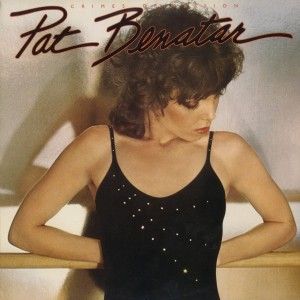
Pat Benatar – Crimes of Passion

More Pat Benatar

More Women Who Rock

  • This vintage copy (only the second to hit the site in nearly three years) is close to the BEST we have ever heard, with both sides earning incredible Nearly Triple Plus (A++ to A+++) grades, just shy of our Shootout Winner – exceptionally quiet vinyl too
  • All kinds of big hits can be found on this one, including Benatar classics such as “Treat Me Right,” “You Better Run” and “Hit Me With Your Best Shot”
  • 4 1/2 stars: “Benatar avoids the synth-happy trends of the early 80s and delivers a hard rocking ten-song session of power pop tempered with a few ballads for balance.”

Credit for the sound must go to the brilliant engineer Keith Olsen, the man behind the amazing sounding Fleetwood Mac self-titled release from 1975. Is there a better sounding Fleetwood Mac album? I certainly can’t think of one.

The man knows Big Rock sound as well as anyone in the business. The two recordings mentioned above and our Crimes of Passion here have too much in common for it to be a mere coincidence. All three have tons of bass (which is the sine qua non of live rock music), huge size and scope, richness, Tubey Magic, a smooth top and last but not least, hard-rockin’ energy.

Those of you who’ve seen the documentary on Sound City know its reputation for great acoustics, along with all the best analog recording equipment and tube microphones. You can clearly hear all of it come together on this album — if you have a copy that sounds like this one that is.

By the way, I note with special interest their first few recording projects from 1970 as listed on their discography page: Spirit’s Twelve Dreams of Dr. Sardonicus (a personal favorite of yours truly), produced by David Briggs, along with another rather well known David Briggs production, After the Gold Rush. The list of Great Sounding Timeless Classic Rock Albums recorded there is a long and glorious one.

(more…)

Falla – El Amor Brujo / El Retablo De Maese Pedro / Ansermet / Argenta

More of the music of Manuel De Falla (1876-1946)

More Classical and Orchestral Recordings

  • This vintage London Stereo Treasury Import LP of Falla’s wonderful classical works boasts superb Double Plus (A++) grades or close to them from first note to last
  • Side two is big, rich, open, and natural sounding with wonderfully full vocals and a more three-dimensional sound than most other copies we played, and side one is not far behind in all those areas
  • The Argenta recording of El Retablo de Maese Pedro (Master Peter’s Puppet Show) is High Fidelity Audiophile Demo Disc Quality Gold, with bells, drums, voices, trumpets, strings, woodwinds and more, all sounding so real it will take your breath away.
  • Our favorite performance with top quality sound is found on a 1967 Decca with Fruhbeck De Burgos at the helm, but the Ansermet we are presenting here is still a very good record if you know what to look for

This Golden Age tape has been mastered brilliantly with “modern” mastering equipment from 1967, not the low-rez junk they’re forced to make do with these days, giving you, the listener, sound that only the best of both worlds can offer.

You can be pretty sure of two things when you hear a record of this quality: one, the original won’t sound as good, having been cut on much cruder equipment.

And two, no modern recutting of the tapes by the likes of Speakers Corner for example could begin to capture this kind of naturalistic sound. I have never heard a Heavy Vinyl pressing begin to do what this record is doing. This STS may be a London budget reissue pressing, but it was mastered by Decca, pressed in England on high quality vinyl, using fairly fresh tapes, and mastered about as well as a record can be mastered. The sound is REAL and BELIEVABLE.

When have you ever heard a modern remastering with this kind of depth and width to the soundstage? I have yet to have the pleasure and I’ve played scores of them, close to a hundred I would guess. We used to carry all that Heavy Vinyl back in the day and I played them and reviewed them as they came out, rejecting a good 80% right from the get go. None, not one, ever sounded like this.

This price for a reissue might seem to be a stretch, but we know an amazing record when we hear one, and we know that the next copy that comes along is very unlikely to sound as good as this one does. That’s simply “regression toward the mean,” a reality we have learned to respect. We don’t sell our records based on their reputations. We sell them based on the sound inscribed in their grooves, and these are some mighty fine grooves on both of these sides.

(more…)

Listening In Depth to Catch Bull At Four

More of the Music of Cat Stevens

If you’re familiar with what the best Hot Stamper pressings of Tea for the Tillerman, Teaser and the Firecat or Mona Bone Jakon can sound like — amazing is the word that comes to mind — then you should easily be able to imagine how good a killer copy of Catch Bull at Four sounds.

All the ingredients for a Classic Cat Stevens album were in place for this release which came out in 1972, about a year after Teaser and the Firecat. His amazing guitar player Alun Davies is still in the band, and Paul Samwell-Smith is still producing as brilliantly as ever.

Side One

Sitting

This track often sounds a bit flat and midrangy, and it sounds that way on most domestic pressings and the “wrong” imports.

The best imports and domestic pressings are the only ones with the sweeter, tubier Midrange Magic that we’ve come to associate with the best Cat Stevens recordings.

Boy With a Moon & Star on His Head

Another very difficult track to get to sound right. The better copies have such amazingly transparent sound you can’t help feeling as though you really are in the presence of live human beings. You get the sense of actual fingers — in this case the fingers of Cat’s stalwart accompanist Alun Davies — plucking the strings of his Spanish guitar.

Angelsea

This is one of the best sounding tracks on the album, right up there with Cat’s most well recorded big productions such as Tuesday’s Dead, Changes IV, Where Do The Children Play and Hard Headed Woman. On Hot Stamper copies this is a Demo Track that’s hard to beat.

The midrange magic of the acoustic guitars is off the scale. Some of Catch Bull At Four has the magic and some of it does not, unlike Tea and Teaser, which are magical all the way through.

Silent Sunlight
Can’t Keep It In

On the best copies this track is as Huge and Powerful as anything the man ever recorded. It’s another one of the best sounding tracks on the album. On our top copies this is a Demo Track that’s hard to beat.

The midrange magic of the acoustic guitars is off the scale. Some of Catch Bull At Four has the magic and some of it does not, unlike Tea and Teaser, which are magical all the way through.

Side Two

(more…)

Tchaikovsky – Sleeping Beauty Highlights / Ansermet

More of the music of Peter Ilyich Tchaikovsky (1840 – 1893)

More Classical and Orchestral Recordings

  • With STUNNING Shootout Winning Triple Plus (A+++) Demo Disc sound from first note to last, this Decca pressing from 1974 could not be beat
  • These sides are doing everything right – they’re rich, clear, undistorted, open, spacious, and have depth and transparency to rival the best recordings you may have heard
  • Ansermet is of course a master of the ballet – the complete performance of Tchaikovsky’s Sleeping Beauty by the Suisse Romande is outstanding, perhaps even definitive
  • 1959 was a great year for classical recordings – other Must Own Orchestral releases can be found here.
  • Here are more of the orchestral “sleeper” recordings we’ve discovered with demo disc sound

Big Decca sound! Powerful deep bass. Beautiful string tone and sharply articulated brass. This is a simply wonderful record.

Ansermet is surely the man for this music, and the famously huge hall he recorded in just as surely contributes much to the wonderful sound here.

Production and Engineering

James Walker was the producer, Roy Wallace the engineer for these sessions from 1958 in Geneva’s glorious Victoria Hall. It’s yet another remarkable disc from the Golden Age of Vacuum Tube Recording.

The gorgeous hall the Suisse Romande recorded in was possibly the best recording venue of its day, perhaps of all time. More amazing sounding recordings were made there than in any other hall we know of. There is a solidity and richness to the sound that goes beyond all the other recordings we have played, yet clarity and transparency are not sacrificed in the least.

It’s as wide, deep and three-dimensional as any, which is of course all to the good, but what makes the sound of these recordings so special is the weight and power of the brass, combined with timbral accuracy of the instruments in every section.

(more…)