
Hot Stamper Pressings of Orchestral Spectaculars Available Now
Years ago, around 2005 if memory serves, I played a copy of the Classic Records remastered pressing of LSC 2323 and thought it was pretty good.
It seemed better than the Shaded Dog copies I had compared it to, which, based on the hundreds of other Classic Records titles I had auditioned up to then, was unexpected to say the least.
Unheard of is more like it. (That is no longer true — stay tuned for the story of the one Classic Records classical record that actually won a shootout not that long ago.)
 Little did I know that the Shaded Dog pressings on this title are not remotely competitive with the right early reissues.
The best of the Shaded Dog pressings we could find, which just happened to have a 1s side one, came in tied for last with the one 70s Red Seal pressing we thought sounded good enough to make the shootout. (Most are terrible.)[1][2]
Some Inside Baseball
Most of the Shaded Dogs and Red Seals were needle-dropped, and all but two were eliminated before the shootout. It takes time and wastes money to clean and play pressings that sound hopeless, so a quick elimination round often precedes the cleaning process.
Back then it was tough to wrap my head around the idea that a Classic Record classical title could actually be better sounding than a Shaded Dog — it had never happened, so I knew there had to be more to the story.
The time to do a serious investigation of LSC 2323 necessary to get to the bottom of what was truly a head scratcher was not in the cards, so I shelved the project for close to the next twenty years. (Other such oddities have their own section here by the way.)
This title would have to wait until 2025 to go through a proper shooout, and when it did, naturally the Classic was part of the mix, which is the way we do things here at Better Records.
Why? Because every record with any hope of sounding good must be given the chance to show us what it can do. It deserves to be evaluated fairly, without the listener having any knowledge as to which pressing my be playing.
It turns out that side one of the Classic was passable, but side two — the side I had never played — was every bit as bad as most of their other classical offerings, which is very bad indeed.
Key to the Sheet Above
What you see is the right hand side of the stamper sheet, with our shorthand notes attached to each stamper number for every label and cover. (This title comes with three different covers: the original, and reissues with either a black border or a white border.)
The top box, the one with the comments for the 3+ Shootout Winner, is not shown. We felt the notes for it were not necessary as they simply say it was doing everything right.
As you work your way down, imagine the top record is 2.5+. We say it has the faults of lacking some top end on side one and being a big veiled on side two.
Each of the other copies with a specific set of stampers earned the following grades in order: 2.5+/2+, 2+/2+, 2+/2+, 2+/2+, 2+/1.5+,1.5+/2+.
Below that is the second page for the shootout, detailing the shortcomings of the worst pressings, and the Classic.
Rarely do we have this many pressings to play in one go. In this case, we had been buying them for years and ended up with a very large pile, partly in order to be sure of the results.
Click on the sheet for a larger, more readable image. Note that none of these pressings qualify as Hot Stamper pressings, which must earn a minimum grade of at least 1.5+ on both sides. 1s/6s would be considered passable, to some degree even enjoyable, the kind of record that would generally be considered above average, or good, depending on one’s standards and the quality of one’s system.
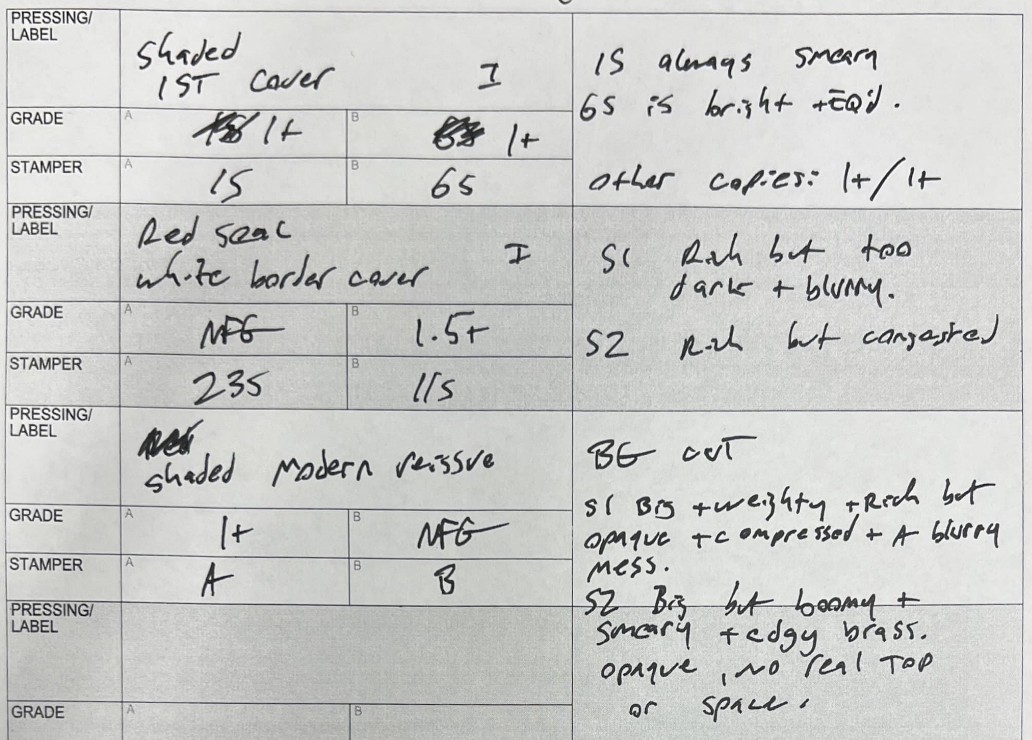
Side one of the Classic earned this 1+ grade. Our notes mention many of the faults we have heard on other Classic Records titles. That I thought this title was actually good is embarrassing, but I know what system it was playing on at the time, and that is the source of the problem: I was simply doing a poor job of reproducing the recording.
For starters, this was pre-Dynavector 17dx. Pre-EAR 324p. Pre-Townshend Super Tweeters. Pre-Legacy Focus mods and stands. Pre-Seismic platform under the turntable table and amp. Pre-many room tweaks and the like.
I still had a long way to go in 2005 and this record is all the evidence one would need to prove it.
Side One
- Big and weighty and rich but opaque and compressed and a blurry mess.
Side Two
- Big but boomy and smeary and edgy brass.
- Opaque, no real top end or space.
Side One
Capriccio Italien – Tchaikovsky
Side Two
Capriccio Espagnol – Rimsky-Korsakoff
[1] This commentary addresses the issue — or should I say the myth? — of the 1S stamper.
[2] Many Red Seal pressings have all the hallmarks of the transistory sound RCA seems to have preferred in the 70s.