euphonic-colorations

Euphonic colorations are antithetical to good sound.

Hi-Fi Beats My-Fi — If Better Sound Is Your Goal

Basic Audio Advice — These Are the Fundamentals of Good Sound

If by record collecting you mean collecting better sounding pressings of the albums you want to play. (If you just want to collect records because you like collecting records, you are definitely on the wrong site.)

Our system is fast, accurate and uncolored. We like to think of our speakers as the audiophile equivalent of studio monitors, showing us exactly what is on the record, nothing added, nothing taken away.

When we play a modern record, it should sound modern. When we play a vintage Tubey Magical Living Stereo pressing, we want to hear all the Tubey Magic, but we don’t want to hear more Tubey Magic than what is actually on the record.

We don’t want to do what some audiophiles like to do, which is to make all their records sound the way they like all their records to sound.

They do that by having their system add in all their favorite colorations. We call that “My-Fi,” not “Hi-Fi,” and we’re having none of it.

If our system were more colored, slower and tubier, a vintage Living Stereo record would not sound as good as it should. It’s already got plenty of richness, warmth, sweetness and Tubey Magic.

To take an obvious example, playing the average dry and grainy Joe Walsh record on our system is a fairly unpleasant experience. Some added warmth and richness, with maybe some smear and some upper-midrange suckout thrown in for good measure, would make it much more tolerable.

But then how would we know which Joe Walsh pressings aren’t too dry and grainy for our customers to play and enjoy on their systems?

How do you tell which ones have the least amount of smear when you’re playing them back through a system that has smear built into it? On some systems, every record is smeary!

(I know smear when I hear it. The Mac 30s I owned in the 90s taught me the pros and cons of tube colorations. More on that subject here.)

How do you tell which pressings have a present, tonally correct midrange when you’re playing records through a system with a sucked out, tonally incorrect midrange?

Enough with the rhetorical questions already.

There is only one approach that works. The first thing you need to get is good sound – then you can recognize and collect good records.

A White Hot copy should have a near-perfect blend of Tubey Magic and clarity, because that’s what we hear when we play it on our system.

We are convinced that the more time and energy you’ve put into your stereo over the years, decades even, the more likely it is that you will hear our Hot Stamper pressings sound the way they should.

(more…)

This Is the Heart of Our System’s Accuracy

Thoughts on Playback Accuracy

If you have a rich sounding cartridge, perhaps with that little dip in the upper midrange, the one that so many moving coils have these days, you may not notice some tonality issues we discuss on the blog and in our Hot Stamper listings quite as easily as we do.

Our Dynavector 17Dx Karat is ruler flat and very unforgiving in this regard. It makes our shootouts much easier, but brings out the flaws in all but the best pressings, exactly the job we require it to do.

We discussed the issue in a commentary entitled Hi-Fi beats My-Fi. (If you are serious about audio this is a must read.)


Further Reading

(more…)

Thoughts on MoFi’s Midrange Suckout

Our Favorite Roots Rock Albums with Hot Stampers Available Now

I was already a huge Mobile Fidelity fan in 1982 when they released Music from Big Pink, which, for some strange reason, was an album I knew practically nothing about.

I was 15 when the second album came out and I played that album all the time. For some reason the first album had eluded me. How it managed to do that I cannot understand, not at this late date anyway. A major malfunction on my part to be sure.

At some point in the early 90s I got hold of an early British pressing of the album.

Comparing it to my MoFi, I was shocked to hear the singers in the band so present and clear. Having only played MoFi’s remastered LP, I had never heard them sound like that.

The MoFi had them standing ten feet back.

The Brit put them front and center.

There was no question in my mind which presentation was right.

Around that time I was noticing that many Mobile Fidelity pressings seemed to be finding that same distant-midrange sound, and finding it on wildly different recordings. Recordings from different studios, by different engineers, in different eras.

The midrange suckout effect is easily reproducible in your very own listening room. Pull your speakers farther out into the room and farther apart and you can get that MoFi sound on every record you own. I’ve been hearing it in the various audiophile systems I’ve been exposed to for more than 40 years.

Nowadays I would place it under the general heading of My-Fi, not Hi-Fi. Our one goal for every tweak and upgrade we make is to increase the latter and reduce the former.

And note also that when you play your records too quietly, it creates an artificial sense of depth.

That’s one of the main reasons we play them loud; we want to hear the pressings that have real presence and immediacy, because they’re the ones that are most likely to win our shootouts.

(more…)

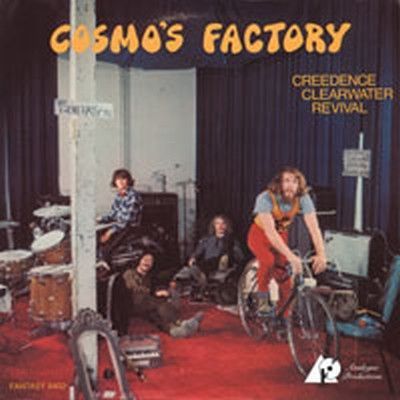
Why Would Anyone Want to Take All the Fun Out of CCR’s Music? Part Two

More of the Music of Creedence Clearwater Revival

UPDATE 2026

This commentary is at least ten years old. Still holds up though!


The last time I played one of Chad’s CCR pressings, which I confess was more than a decade ago, it had all the bad qualities of the Bonnie Raitt disc on DCC, a sound that I’ve grown to dislike more with each passing year.

But what the new AP version really gets wrong is the guitar sound.

Creedence’s music lives or dies by its grungy guitars, and the AP pressing presents us with guitars that sound nothing like the guitars on the original versions of the albums we all bought back in the day.


Latest Findings as of 2022

This commentary used to end this way:

The fat, smeary, overly-smooth guitars you hear on the record, lacking any semblance of the grungy energy that are the true hallmarks of this band’s recordings, probably means that some audiophile mastering engineer got hold of the tapes and tried to “fix” what he didn’t like about the sound.

You know, the sound that is all over the radio to this very day. Something was apparently wrong with it. So now that it’s been fixed, everything that’s good about CCR’s recordings is missing, and everything that has replaced those sonic elements has made the sound worse.

Nice job! Keep up the good work. Chad is proud of ya, no doubt about it.

It has now become clear that the various mastering engineers Chad hires are not the ones trying to fix what they don’t like about the sound. Chad is El Jefe, the one telling them what to fix and rejecting their work until these remastered albums sound the way he wants them to sound.

There is no use complaining about the awful work Doug Sax, Steve Hoffman, Kevin Gray, George Marino or anyone else did when hired to master for Analogue Productions. Their task was to please Chad. He is the customer, he is the one paying their fees, and he is the one getting the sound he wants.

He apparently thinks he is saving the world from bad sound, but we sure don’t see it that way. Just the opposite in fact.

If Chad wanted better sounding records — records that are more lively, more tonally accurate, less bloated down low and less smoothed-over up top — veteran engineers such as the gentlemen named above would surely have been able to master these titles more correctly than the evidence provided by the records might lead you to believe.

But Chad, like many other audiophiles, is a My-Fi guy, not a Hi-Fi guy, and he likes the sound he likes, regardless of what is on the master tapes or what other pressings — mastered by a number of different engineers, often over the course of many decades — might sound like.

(more…)