*Pressing Advice

The advice here should help you in your search for better sounding pressings.

At the very least it may help you avoid some of the worst ones.

On Trust, the Bass Is (Almost) All

Hot Stamper Pressings of Elvis’s Albums Available Now

Notes from a Hot Stamper shootout we did quite a while back.

There’s a TON of low-end on this record. Regrettably, most copies suffer from either a lack of bass or a lack of bass definition. I can’t tell you how much you’re missing when the bass isn’t right on this album. (Or if you have the typical bass-shy audiophile speaker, yuck.) 

It’s without a doubt THE SINGLE MOST IMPORTANT ASPECT of the sound on this album. When the bass is right, everything falls into place, and the music comes powerfully to life. When the bass is lacking or ill-defined, the music seems labored; the moment-to-moment rhythmic changes in the songs blur together, and the band just doesn’t swing the way it’s supposed to.

On the best pressings, you get the full-on bottom end WHOMP you paid for, with no loss in control. You can clearly follow Bruce Thomas’s bass lines throughout the songs, a real treat for any music lover. (He and Elvis don’t get along, hence the end of the Attractions as his backing band. I guess we should be thankful for the nine albums on which they were together; many of them are Desert Island Discs for me.)

Not only that, but the drums have real body and resonance, a far cry from the wimpy cardboard drum sound you’ll hear on most copies.

Hey, these are The Attractions: the pro’s pros. You can’t ask for better, and as expected they deliver big time on this album. But the mastering and pressing problems of most British copies typically make them sound half-hearted and uninspired, which is certainly nothing like what they sound like on the master tape. On the master tape, they play GREAT. You need a very special copy of the LP to hear them play that way, and that’s all there is to it. 

The better the pressing, the better the band.

A Must Own Title

This, along with My Aim Is True and Armed Forces, is as good as it gets for Elvis on LP.

All three are absolute Must Owns that belong in any serious rock collection. This is that rare breed of music that never sounds dated (especially considering the era in which it was produced). Music with real depth such as this only gets better with the passage of time. The more you play it, the more you appreciate it, and love it.

(more…)

Listening in Depth to Country Life

Hot Stamper Pressings of the Music of Roxy Music Available Now

The domestic, German, Japanese and Dutch pressings are not remotely competitive with the Brits on this album (which is not true for all Roxy’s albums but clearly true for this one, Siren being the obvious exception to the rule).

Now for those of you who are not big Roxy Music fans and don’t know this music, this album may take a bit of getting used to. We assure you it will be well worth your while. We think it’s brilliant.

And if you do consider yourself a fan of Art Rock, every Roxy album should be on your shelf, right up there with your Bowie, Pink Floyd, Supertramp, Eno, Peter Gabriel, 10cc and too many others to list. (Most are personal favorites of mine, albums I have played hundreds of times over the last 40 years and plan to keep playing until my ears give out.)

Side One

The Thrill of It All
Three and Nine

On the best copies this track is the very definition of Tubey Magical richness and smoothness.

All I Want Is You

A little thinner and brighter than the other tracks on this side as a rule.

Out of the Blue

The best guitar solo ever played on the violin. Go Eddie!

If It Takes All Night

Side Two

Bitter Sweet

The best copies have monstrous bass on this track, along with huge amounts of space. Again, the Tubey Magic can be off the charts here.

Triptych
Casanova

The vocals on this track will always spit to some degree. The cleanest, most tonally correct sibilance is what you are looking for on this track. That, and amazing rock energy!

A Really Good Time
Prairie Rose


Want to find your own top quality copy?

Consider taking our moderately helpful advice concerning the pressings that tend to win our shootouts.

(more…)

The True Test for Side Two (and How Wrong We Were about Domestic Pressings) of Backless

Hot Stamper Pressings of the Music of Eric Clapton Available Now

During our shootout we discovered that the true test for side two was the second track, the old blues song Early In The Morning.

It’s by far the best sounding track on the album, with huge space, rich bass, a fat snare and Tubey Magic to die for. This is the kind of sound that the likes of Glyn Johns gets down on tape, live in the studio no doubt, and it made it easy to do the shootout for side two.

The bigger, the richer, the tubier, the more transparent the better. It’s THE track to demo with. 

Both sides have rich, smooth, clear sound. Listen for the guitars on the first track on side one; the grungier the better. Punchy bass too.

Turn It Up and Let It Rock

The typical pressing of Backless, much like the typical pressing of Slowhand, is just too thick, dull, compressed and veiled to be much fun.

At the very least you need to turn this album up good and loud to get it to do anything.

The copies that are solid and weighty love getting loud; the copies that are thin and bright only get worse as the level goes up, a sign that they leave a lot to be desired. This is a rock album after all.

We Was Wrong

We used to note the following regarding the country that produced the best sounding pressings:

We had top quality copies on both domestic and British vinyl. Both were cut here in L.A.. It makes sense that either can be good.

This should have been corrected a long time ago, as far back as 2017, perhaps earlier. The domestic copies, thought cut at The Mastering Lab, are not competitive with the British LPs also cut there and then sent to England for pressing.

Live and learn is our motto, and progress in audio is a feature, not a bug, of record collecting at the most advanced levels.

We may have liked the domestic pressings a long time ago, but with changes to the system and many shootouts under our belts, the sonic superiority of the Brits cannot be denied.

(more…)

This Mud Slide Slim Rocked Like No Other Pressing We’d Ever Heard

Hot Stamper Pressings of the Music of James Taylor Available Now

This Shootout Winning copy from 2008 or thereabouts showed us a Mud Slide Slim we had no idea could exist.

We have a name for records like this. We call them breakthrough pressings. They are one of the reasons we play so many thousands of records every year. We’re looking for records that sound as good as this one does, even for titles that no one thinks are particularly well recorded.

Especially for those titles. Experience has taught us they can only be found by playing lots of pressings and looking for whatever needles might be hiding in the haystacks. (The haystack for One Man Dog can be seen at the bottom of this post.)

As you will see from our commentary, the first track on side one, Love Has Brought Me Around, is a great test for energy.

If your copy does not seem very energetic to you, then we recommend you keep buying every green label original you see until you find one that does.

Our commentary from the early days of shootouts can be seen below.

(more…)

A Killer Reissue Pressing of Jazz Samba Won Our Shootout

Hot Stamper Pressings of Bossa Nova Albums Available Now

A killer copy of Jazz Samba (the first to hit the site in over four years) with INSANELY GOOD Shootout Winning Triple Plus (A+++) sound from first note to last – exceptionally (and exceptionally rare) quiet vinyl too.

This is by far the best copy of the album we have ever played — we had no idea a copy could possibly sound this good and be pressed on vinyl this quiet.

Remarkably spacious and three-dimensional, as well as relaxed and full-bodied – this pressing was a big step up over all of the other pressings we played in our recent shootout.

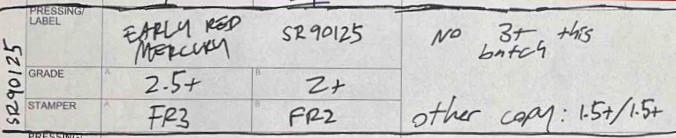
No other copy earned a better grade than 2+ on either side, and some of the originals were godawful (watch for the “wrong” stampers coming to the blog soon).

As you can see from the notes, both sides of our most recent White Hot stamper shootout winning copy were doing everything right. This copy was so good that it qualified to be in our Top Shelf section, for records with two shootout winning sides.

You know what’s unusual about these notes?

They’re the kind of notes we’ve never written for any Heavy Vinyl reissue, even for the one that won our shootout not long ago.

They are the kind of notes that make it clear to us what a sham the modern Heavy Vinyl pressing tends to be, even those that are done right.

No modern record we’ve ever played has ever had anything even approaching this kind of big as life sound, and we doubt one ever will.

Records like this vintage vinyl pressing are thrilling in a way that very, very few records ever are.

Once you hear sound like this, you are not likely to forget it.

It sets a standard that modern remastered records simply cannot meet.

Hey, want to find your own top quality copy?

Consider taking our moderately helpful advice concerning the pressings that consistently win our shootouts.

This record has been sounding its best for many years, in shootout after shootout, this way:

(more…)

Listening for a Bit Too Much Tubey Magic Down Low on Buffalo Springfield

Hot Stamper Pressings of Personal Favorites Available Now

Note to customers: We rarely have Hot Stamper pressings of Buffalo Springfield available on the site, so albums with Stephen Stills or Neil Young playing on them are about the best we can do these days. We regret we must go many years between shootouts for this seminal band’s albums, two of which are personal favorites of mine and have been since they were first released, 1968’s (Again) and 1969’s (Last Time Around) Thank god my older stepbrother had good taste in music. I doubt that many 14-year-olds were playing Buffalo Springfield albums, but I was, even though most of the time it was on 8-track tape.


On even the best copies I regret to say there’s a bit too much Tubey Magic in the bass. Tubbiness and bloat were par for the course. This may explain why so many copies have rolled off bass; the engineer cut the bass because he heard how tubby it was and figured no bass is better than bad bass. 

Which is just not true. Cutting the bass leans out and “modernizes” the sound, making the voices sound thinner and dryer. Less rich. This pretty much ruins everything on this album, just the way it ruins everything in many of the modern recordings I hear.

Having your bass under control on the playback side isn’t easy — in fact it’s probably the hardest thing to achieve in audio — but it can be done, and with good bass control the slightly wooly bass is just a part of the sound you learn to accept.

It doesn’t actually interfere much with your enjoyment of the music, mostly because all the other instruments and voices sounds so magical.


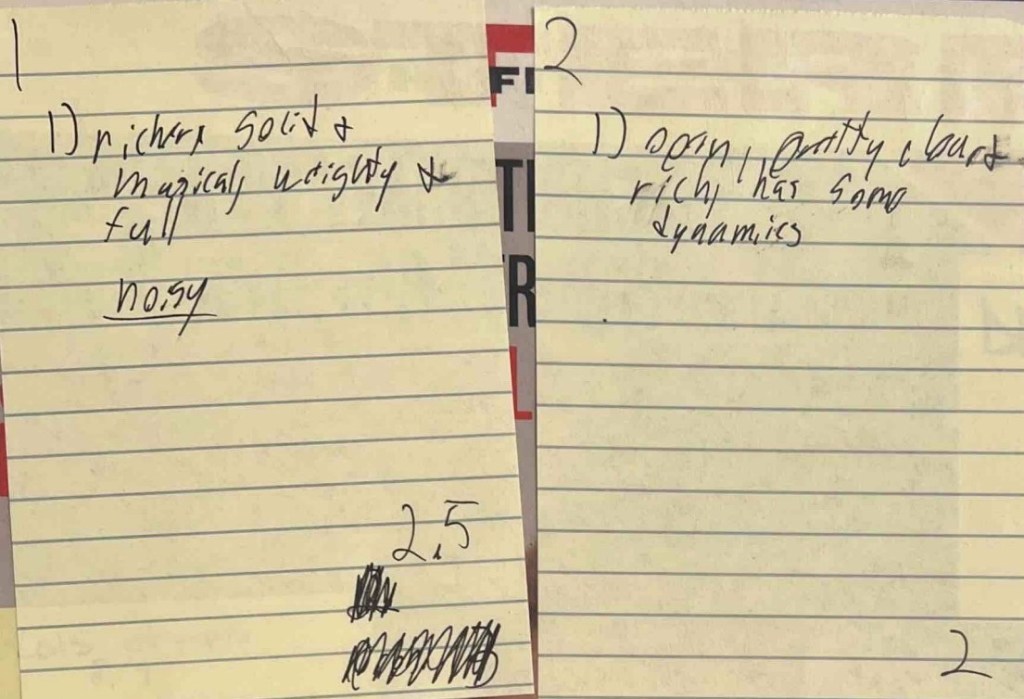
The post-it notes you see are very old, probably from the early 2000s.

Until we got our cleaning system sorted in 2007, shootouts for any of this band’s first three albums were going to be tough sledding, if not downright impossible.

In this commentary we describe what needed to change in order to make Buffalo Springfield shootouts a reality.


Want to find your own killer copy?

Consider taking our moderately helpful advice concerning the pressings that tend to win our shootouts. This album sounds its best:

(more…)

The Best Import Pressings of Picture Book Have Explosive Dynamics

Hot Stamper Pressings of the Music of Simply Red Available Now

This commentary was written about 15 years ago.

I actually used to demo my stereo with “Sad Old Red.”

At one point the sound really explodes, an effect which has always held a great deal of appeal for me.

That’s what live music can do, so that’s what I want my stereo to do.

For thirty [now 45+] years I’ve avoided little boxes and screens and gone straight for the big dynamic speaker systems that can really show you the life that’s hiding in your recordings.

That’s what the revolutionary changes in audio commentary is about — unlocking all the energy and excitement that a good LP has to offer.

Holding Back the Years” also boasts superb sound. It may be the best track the band ever recorded, and it’s probably the one most everyone knows, but there are many here that are nearly as good. The cover of The Talking Heads’ “Heaven” (from Fear of Music) is out of this world.

I still remember standing in a record store — I think it was Tower; I lived in San Diego at the time and went there often — when I heard a song I knew but could not quite place.

Eventually I realized it was “Heaven” from Fear of Music, an album I knew well, being a big Talking Heads fan at this time. This is the mid-80s, long after I had been knocked out by More Songs About Buildings and Food in 1979. But it wasn’t The Talking Heads singing it.

I bought the album, one I knew next to nothing about, on the spot. Any band that wants to cover The Talking Heads is a band with taste, and once I got the album home I knew this band had plenty of talent too.

Of course it would be many years until I managed to find a clean, early import pressing of the album — back then you had to luck into such things in used record stores, there was no Ebay or Discogs to make it possible.

The domestic pressings can be good, but the best imports will always be better. (I’m not even sure we buy the domestics anymore.)

Big Speakers Wanted

This is a big speaker record. It requires a pair of speakers that can move air with authority below 250 cycles and play at loud levels. If you don’t own speakers that can do that, this record will never really sound the way it should.

It demands to be played LOUD. It simply cannot come to life the way the producers, engineers and artists involved intended for it to if you play it at moderate levels.

For the longest time our motto has been “Records for Audiophiles, Not Audiophile Records,” and we see no reason to change it.  If anything, the current spate of manufacturers of Heavy Vinyl pressings are making records that get worse sounding by the day. Many of the most egregious offenders can be found here.

Want to find your own killer copy?

Consider taking our moderately helpful advice concerning the pressings that tend to win our shootouts.

As of 2024, shootouts for this album should be carried out:

How else can you expect to hear this record at its best?

Based on our experience, Picture Book sounds better:

(more…)

Greg Ladanyi’s Tubey Magical Analog Richness from 1978

Hot Stamper Pressings on the Asylum Label Available Now

The sound is anchored by an exceptionally fat, rich, punchy low end, and the best copies deliver that sound big time.

Much like The Pretender, this is a superb recording with the kind of Tubey Magical Analog Richness we go crazy for here.

Just listen to ‘Excitable Boy’ and ‘Werewolves Of London’ to hear how full-bodied the sound of this album can be — the louder you play it the better it gets!

That’s the big speaker quality we live for around here. You turn it up and it starts to really rock.

The Fleetwood Mac Connection

Speaking of Werewolves of London, some of you may not know that the rhythm section for that song is made up of John McVie and Mick Fleetwood, otherwise known as Fleetwood Mac. Over the years I have come to appreciate the fact that they are clearly one of the top rock rhythm sections in the history of popular music. One can listen to Fleetwood Mac’s albums for the sole purpose of hearing the bass and drums create the ideal support for the songs as well as to drive the music rhythmically forward. On Werewolves their contribution is every bit as important to the success of the song as Zevon’s, IMHO.

Want to find your own killer copy?

Consider taking our moderately helpful advice concerning the pressings that consistently win our shootouts.

As of 2025, shootouts for this album should be carried out:

How else can you expect to hear this record at its best?

Based on our experience, Excitable Boy sounds its best:

Which means the domestic Asylum pressings with the right stampers are practically guaranteed to win our shootouts.

(more…)

Uptown Girl Is Often Hard and Harsh in the Midrange

Hot Stamper Pressings of the Music of Billy Joel Available Now

Dynamic and open, with driving rhythmic energy – the best early pressings really bring this great batch of songs to life.

Jam packed with hits: An Innocent Man, The Longest Time, Tell Her About It, Uptown Girl, Leave a Tender Moment Alone, and more – seven singles in all.

The best sides have the huge soundstage and startling clarity and immediacy that characterizes this album, but they also add an ingredient missing from most of the copies we played — a full, rich, musical midrange!

On many pressings, the vocals can get hard and harsh on the more uptempo tracks.

Uptown Girl” is a notable offender in this regard, and never sounds quite as good as the other tracks.

A prime example of an album in which the hit sounds worse than the rest of the album.

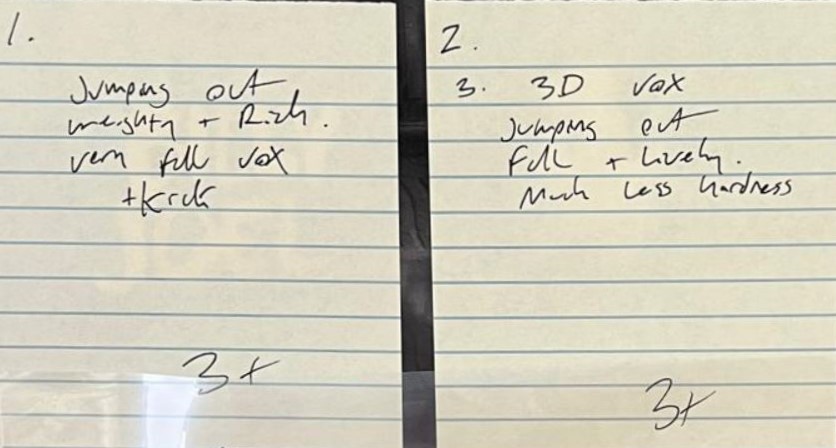
As you can see from the notes for our our most recent White Hot shootout winning copy, side one was doing everything right, and side two, where Uptown Girl can be found, was doing the best it could, all things considered.

Side One

Jumping out / weighty and rich / very full vocals and kick drum

Side Two

Three-dimensional vocals / jumping out / full and lively / much less hardness

The notes for side two point out that it less hard sounding than the typical pressing, and that, coupled with its many other desirable qualities, put it over the top and made it the winner for side two.

Other records that are good for testing midrange hardness can be found here.

Hey, want to find your own top quality copy?

Consider taking our moderately helpful advice concerning the pressings that consistently win our shootouts.

This record has been sounding its best for many years, in shootout after shootout, this way:

(more…)

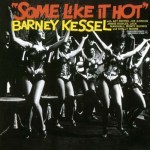
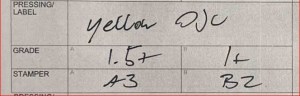
Skip the A3/B2 OJC on Some Like It Hot

Hot Stamper Pressings of the Music of Barney Kessel Available Now

Some Like It Hot badly needed to be made using tubes in the mastering chain, but that didn’t happen.

It’s another case of an OJC with zero Tubey Magic. You might as well be playing the CD. I would bet money it sounds just like this record. Maybe even better.

I suppose if you have a super-tubey phono stage, preamp or amp, you might be able to supply some of the Tubey Magic missing from this pressing, but then all your correctly mastered records wouldn’t sound right, now would they?

We had two copies of the OJC and one of them did better than this one. It earned a Super Hot grade for one side. If you see this OJC pressing in your local record store, avoid these stampers. The sound isn’t awful, but it’s not very good either, especially considering how amazing the tapes must be, based on the sound of our White Hot Stamper shootout winner.

The OJC pressing of this album is much better suited to the old school audio systems of the 60s and 70s than the modern systems of today. These kinds of reissues used to sound good on those older systems, and I should know, I had an old school stereo and some of the records I used to think sounded good back in the day don’t sound too good to me anymore (although this one never did).

The OJC pressings of Some Like It Hot are thinner and brighter than even the worst of the later pressings we’ve auditioned. That is decidedly not our sound. It’s not the sound Roy DuNann was famous for, and we don’t like it either, although we have to admit that we did find the sound of many of these OJC pressings more tolerable — even enjoyable — in the past.

Our old system from the 80s and 90s was tubier, tonally darker and dramatically less revealing, which strongly worked to the advantage of leaner, brighter, less Tubey Magical titles such as this one. Pretty much everybody I knew had a system that suffered from those same afflictions.

Like most audiophiles, I thought my stereo sounded great.

And the reality is that no matter how hard I worked or how much money I spent, I would never have been able to achieve top quality sound for one simple reason: most of the critically important revolutionary advances in audio had not yet come to pass.

It would take many technological improvements and decades of effort until I would have anything like the system I do now.

(more…)