More Hot Stamper Pressings Featuring the Violin
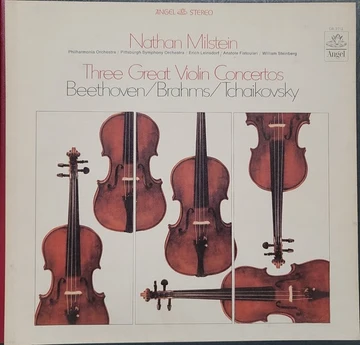
- Three Great Violin Concertos debuts on the site with roughly Nearly Triple Plus (A++ to A+++) grades on all SIX sides of these vintage Blue Angel Stereo pressings – just shy of our Shootout Winner (sides two and five actually won the shootout)
- Exceptionally spacious, rich and smooth – only vintage analog seems capable of reproducing all three of these qualities without sacrificing resolution, staging, imaging or presence
- The immediacy of Milstein’s violin is simply in a league of its own, with some of the sweetest, richest, most “rosiny” violin tone we’ve had the good fortune to hear
These vintage Angel pressings have the kind of Tubey Magical Midrange that modern records can barely BEGIN to reproduce. Folks, that sound is gone and it sure isn’t showing signs of coming back. If you love hearing INTO a recording, actually being able to “see” the performers, and feeling as if you are sitting in the studio with the band, these are the records for you. It’s what vintage all analog recordings are known for — this sound.
If you exclusively play modern repressings of vintage recordings, I can say without fear of contradiction that you have never heard this kind of sound on vinyl. Old records have it — not often, and certainly not always — but maybe one out of a hundred new records do, and those are some pretty long odds.
What The Best Sides Of Three Great Violin Concertos Have To Offer Is Not Hard To Hear
- The biggest, most immediate staging in the largest acoustic space
- The most Tubey Magic, without which you have almost nothing. CDs give you clean and clear. Only the best vintage vinyl pressings offer the kind of Tubey Magic that was on the tapes in 1967
- Tight, note-like, rich, full-bodied bass, with the correct amount of weight down low
- Natural tonality in the midrange — with all the instruments having the correct timbre
- Transparency and resolution, critical to hearing into the three-dimensional studio space
No doubt there’s more but we hope that should do for now. Playing these record is the only way to hear all of the qualities we discuss above, and playing the best pressings against a pile of other copies under rigorously controlled conditions is the only way to find pressing that sound as good as these three do.
Copies with rich lower mids and nice extension up top did the best in our shootout, assuming they weren’t veiled or smeary of course. So many things can go wrong on a record. We know, we’ve heard them all.
Top end extension is critical to the sound of the best copies. Lots of old records (and new ones) have no real top end; consequently, the studio or stage will be missing much of its natural air and space, and instruments will lack their full complement of harmonic information.
Tube smear is common to most vintage pressings. The copies that tend to do the best in a shootout will have the least (or none), yet are full-bodied, tubey and rich.
Size and Space
One of the qualities that we don’t talk about on the site nearly enough is the SIZE of the record’s presentation. Some copies of the album just sound small — they don’t extend all the way to the outside edges of the speakers, and they don’t seem to take up all the space from the floor to the ceiling. In addition, the sound can often be recessed, with a lack of presence and immediacy in the center.
Other copies — my notes for these copies often read “BIG and BOLD” — create a huge soundfield, with the music positively jumping out of the speakers. They’re not brighter, they’re not more aggressive, they’re not hyped-up in any way, they’re just bigger and clearer.
And most of the time those very special pressings are just plain more involving. When you hear a copy that does all that — a copy like this one — it’s an entirely different listening experience.
What We’re Listening For On Three Great Violin Concertos
- Energy for starters. What could be more important than the life of the music?
- The Big Sound comes next — wall to wall, lots of depth, huge space, three-dimensionality, all that sort of thing.
- Then transient information — fast, clear, sharp attacks, not the smear and thickness so common to these LPs.
- Powerful bass — which ties in with good transient information, also the issue of frequency extension further down.
- Next: transparency — the quality that allows you to hear deep into the soundfield, showing you the space and air around all the instruments.
- Extend the top and bottom and voila, you have The Real Thing — an honest to goodness Hot Stamper.
Side One
Concerto In D Major For Violin And Orchestra, Op. 61 (Beethoven)
Allegro Ma Non Troppo
Side Two
Concerto In D Major For Violin And Orchestra, Op. 61 (Beethoven)
Larghetto
Rondo
Side Three
Concerto In D Major For Violin And Orchestra, Op. 77 (Brahms)
Allegro Non Troppo
Side Four
Concerto In D Major For Violin And Orchestra, Op. 77 (Brahms)
Adagio
Allegro Giocoso, Ma Non Troppo Vivace
Side Five
Concerto In D Major For Violin And Orchestra, Op. 35 (Tchaikovsky)
Allegro Moderato
Side Six
Concerto In D Major For Violin And Orchestra, Op. 35 (Tchaikovsky)
Canzonetta — Andante
Finale — Allegro Vivacissimo
About these Pieces
Concerto In D Major For Violin And Orchestra, Op. 61 (Beethoven)
The first performance of Beethoven’s Violin Concerto in D major, December 23, 1806, was certainly an inauspicious occasion for what, at the time, seemed to be a risky work. As the story goes, the work was actually not complete until shortly before its premiere. During the first performance, violinist Franz Clement, to whom the Concerto was dedicated, practically had to play the notes at sight. Additionally, Clement inserted his own spontaneous cadenza – complete with upside-down violin playing – between the first and second movement. Such “showboating” might be expected by a 1990s audience at a rock concert, but certainly not by contemporary audiences at the world premiere of a classical concerto. (As a matter of fact, Viennese audiences in Beethoven’s day probably wouldn’t have been so shocked. They might even have demanded a spontaneous encore if they liked what they heard!)
The “riskiness” of this Concerto had little to do with the performance atmosphere of its premiere. Rather, it was, at the time of its writing, risky as a concerto. The work is considerably longer than any preceding violin concerto of Mozart, for example, by almost 15 minutes. In addition, Beethoven (1770-1827) wrote for a much larger orchestra than previous concerto composers – another chancy venture to the minds of his musical contemporaries.
Perhaps most importantly, the solo violin part is exceedingly difficult. Beethoven demanded a level of virtuosity that few violinists of the era, save for Clement, could come close to. And it was also a very fussy work, with frequent changes in dynamics, sometimes from moment to moment. Critics deemed it unplayable. It would be nearly 50 years, in fact, before the Concerto would begin to join the standard concert hall repertory (thanks in great part to the efforts of Joseph Joachim, whose remarkable performance of the work at age 13, under conductor Felix Mendelssohn, brought it to greater attention in 1844, and eventually brought it into the standard repertory).
The Concerto is vintage Beethoven. The first movement, Allegro ma non troppo, opens with four strokes on the timpani, a gesture which, like the “Fate” motive opening his Symphony No. 5, is reinterpreted and recast – the rhythmic mortar of the entire movement’s musical structure. A long orchestral introduction, summarizing the entire thematic content of the movement, precedes the violin entrance. In sure Beethovenian style, the themes are reinterpreted, restructured, and reworked.
In the second movement, the Larghetto, the orchestra also introduces a theme, stating the principal idea in muted strings. After much embellishing on the first theme by the soloist, the second theme subject is announced by both orchestra and similarly commented on by the violin. After a recap of the themes, a serene coda closes out the movement.
The final movement, a spirited Rondo, begins immediately. Beethoven saves the best for last, as the flashiest, and most virtuosic passagework for the violin soloist come in this country-dance-like movement.
The Violin Concerto in D was a turning point for the violin concerto, perhaps even for the concerto itself; it was surely the first “Romantic” concerto, an expressive work that pushed the limits of the form. And clearly, despite the doomsday chorus that speculated this could mean the death of the concerto as they knew it, it only invigorated the form and showed the way for generations of composers to come.
— Dave Kopplin, hollywoodbowl.com
Concerto In D Major For Violin And Orchestra, Op. 77 (Brahms)
Brahms was a great pianist, but he would never have wanted to be identified with the armies of piano virtuosos who toured Europe and composed flashy variations on tunes from Mozart’s and Verdi’s operas. His two piano concertos are stern and serious works, and when it came to writing a violin concerto his model was unquestionably going to be Beethoven, not Paganini. He made that doubly plain by choosing Beethoven’s key, D major, and by following Beethoven’s precedent with a long, lyrical first movement in full classical sonata form.
Perhaps we should be surprised that he composed a violin concerto at all. Joseph Joachim, for whom it was written, was the first important musician he met when he left his Hamburg home at the age of 20 to seek fame and fortune. Joachim, almost the same age, was already an international star at that time, and the two struck up a firm friendship that lasted over 40 years. In composing a concerto for Joachim 25 years after their first meeting, Brahms worked closely with him in fashioning the solo part; he clearly intended the Concerto to be a test of the player’s technique and musicianship and to be free of any suspicion of unmotivated display. Display itself is, of course perfectly legitimate, in fact desirable, in a concerto, so it remains for us only to judge whether the soloist’s leaps, arpeggios, double stops, and passage-work are intrinsic to the work or not. The earliest critics were in some doubt, although the violin writing now strikes us as a model of good taste and sensitive musicianship. Others, such as the great Spanish virtuoso Sarasate, felt it had no tunes. “Would I stand there,” he said, “violin in hand, while the oboe plays the only melody in the whole work?”
The Concerto was first performed in Leipzig on New Year’s Day 1879 by Joachim, the dedicatee, who composed the cadenza that is still played by many violinists today. Never fond of waste, Brahms presents his first movement’s main theme as a bare unison at the very start of the work, based on a D-major triad. Eight measures later the oboe offers something nearer to a scale; eight measures further on the full orchestra dwells on leaping octaves. Gradually the thematic material finds its place, some presented by the orchestra, more provided by the soloist after he has flexed his muscles (46 measures of – yes – display). Eventually we reach a gloriously lyrical second subject, which seems to express the very soul of the violin. The finest moment is reserved for the coda, after the cadenza, when the soloist soars higher and higher in dreamy flight before a final resumption of the main tempo.
The slow movement, in F major, opens with a long theme for the oboe with wind accompaniment. When the soloist takes it up, the strings accompany, and the textures and harmonies become gradually more adventurous, only brought back to earth for the return of the main theme and the main key.
The finale’s boisterous lilt is a tribute to Joachim’s Hungarian birth. But as in Joachim himself, who never returned to Hungary or sympathized with its nationalist causes, other themes of a quite un-Hungarian character intervene, including a dynamic rising scale in octaves and a beautifully lyrical episode where the meter changes briefly from a stamping 2/4 to a gentle 3/4. The final switch to a 6/8 pulse with heavy off-beats is one of Brahms’ stranger inventions, and the dying decline of the last few bars is stranger still.
— Hugh Macdonald, laphil.com
Concerto In D Major For Violin And Orchestra, Op. 35 (Tchaikovsky)
Tchaikovsky composed his Violin Concerto during a stay in Switzerland in 1878. Inspired by the presence of the young violinist Josef Kotek in his circle there, the composer completed the entire concerto in less than a month. During the work’s composition, Kotek and Tchaikovsky collaborated closely, but almost as soon as the ink on the manuscript had dried, Kotek began to cool toward the work. This, added to Tchaikovsky’s need for a famous name on the work’s title page to guarantee performances in Western Europe and America, meant that the dedication was offered to the Hungarian violinist Leopold Auer. Auer declined it, declaring the work too long and the solo part unplayable, something Tchaikovsky had heard before and a reminder that the composer’s music wasn’t always considered comfortable for listeners and performers.
Russian-born violinist Adolf Brodsky eventually mastered the concerto’s technical challenges well enough to premiere it in Vienna, where it was not well received. The critic Eduard Hanslick, whose staunch support of Brahms helped—perhaps a bit unfairly—to brand Brahms as a conservative, heaped abuse on the work’s innovative layout and Tchaikovsky’s composition of the solo part in his review of the first performance.
“For a while, it moves along well enough, musical and not lacking in spirit, but soon the roughness gets the upper hand and remains in charge until the end of the first movement. It is no longer a question of whether the violin is being played, but of being yanked about and torn to tatters. Whether it is at all possible to extract a pure sound out of these hair-raising acrobatics I do not know, but I do know that in making the attempt Mr. Brodsky tortured his audience no less than he did himself.” Hanslick would further elaborate, claiming the concerto “stank to the ear.”
Tchaikovsky’s concerto appears unconventional when placed alongside stalwarts of the genre by other composers (not least the Brahms concerto, which premiered two years before Tchaikovsky’s and no doubt was fresh in Hanslick’s mind). The first movement combines lyricism with nobility, as the violin spins out the movement’s two themes over an ever-shifting accompaniment. The slow movement, which Tchaikovsky labeled “Canzonetta” (Little Song), opens with a delicate woodwind introduction, before the violin’s melancholy entry. The movement leads without pause to the rondo-finale, a movement with rhythmic abandon and a folk-like flavor. The rondo, which alternates a main theme with contrasting episodes, gives the violinist a chance for reckless bravura display. In a sense, Tchaikovsky’s concerto is guilty of some of the charges made by Hanslick, but what good concerto doesn’t benefit from some “hair-raising acrobatics”?
— John Mangum, laphil.com