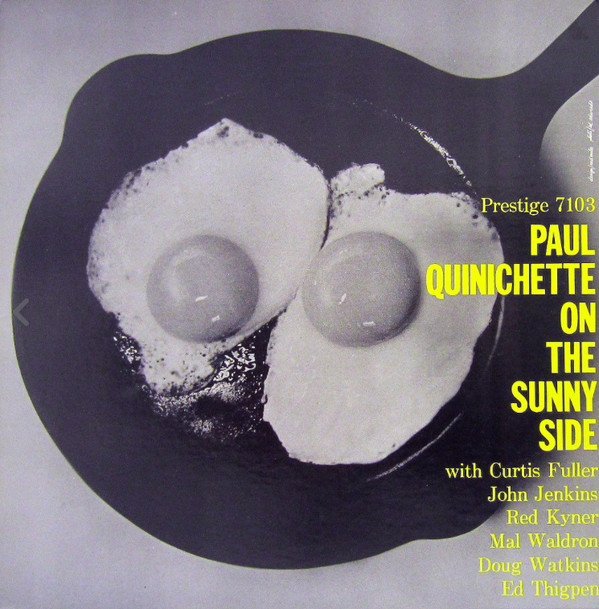
- Both sides of this long out-of-print OJC title boast lively, big and clear Shootout Winning Triple Plus (A+++) MONO sound or close to it from first note to last
- With three saxophones and a trombone, this is a fresh combination that really brings out the best in all the players during this Prestige jam session, a format for which they are justly famous
- I raved about this album when it was in print many years ago – it’s solidly swinging jazz that belongs in your collection
- 4 stars: “Waldron’s three originals (highlighted by ‘Cool-Lypso’) allow plenty of room for swinging, and Quinichette (who also performs ‘On the Sunny Side of the Street’) sounds comfortable interacting with the younger musicians. An enjoyable and underrated release.”
As I wrote years ago, back in the days when we regularly sent out catalog mailings:
When we discover a record like this, a record with no reputation either in the jazz world or the audiophile world, we try to bring it to people’s attention, usually with some success. Some of my customers called me up to tell me what a great record this is.
Based on what I’m hearing, my feeling is that most of the lively, natural, full-bodied, sound of the album is on the master tape, and that all that was needed to get that vintage sound correctly on to disc was simply to thread up that tape on a reasonably good machine and hit “play.”
The fact that nobody seems to be able to make an especially good sounding record — certainly not as good sounding as this one — these days tells me that in fact I’m wrong to think that such an approach would work. Somebody should have been able to figure out how to do it by now. In our experience that is simply not the case today, and has not been for many years.
George Horn was doing brilliant work for Fantasy all through the 80s. This album is proof that his sound is the right sound for this music.
What The Best Sides Of On The Sunny Side Have To Offer Is Not Hard To Hear
- The biggest, most immediate staging in the largest acoustic space
- The most Tubey Magic, without which you have almost nothing. CDs give you clean and clear. Only the best vintage vinyl pressings offer the kind of Tubey Magic that was on the tapes in 1957
- Tight, note-like, rich, full-bodied bass, with the correct amount of weight down low
- Natural tonality in the midrange — with all the instruments having the correct timbre
- Transparency and resolution, critical to hearing into the three-dimensional studio space
No doubt there’s more but we hope that should do for now. Playing the record is the only way to hear all of the qualities we discuss above, and playing the best pressings against a pile of other copies under rigorously controlled conditions is the only way to find a pressing that sounds as good as this one does.
Copies with rich lower mids and nice extension up top did the best in our shootout, assuming they weren’t veiled or smeary of course. So many things can go wrong on a record. We know, we’ve heard them all.
Top end extension is critical to the sound of the best copies. Lots of old records (and new ones) have no real top end; consequently, the studio or stage will be missing much of its natural air and space, and instruments will lack their full complement of harmonic information.
Tube smear is common to most vintage pressings. The copies that tend to do the best in a shootout will have the least (or none), yet are full-bodied, tubey and rich.
What We’re Listening For On On The Sunny Side
- Energy for starters. What could be more important than the life of the music?
- The Big Sound comes next — wall to wall, lots of depth, huge space, three-dimensionality, all that sort of thing.
- Then transient information — fast, clear, sharp attacks, not the smear and thickness so common to these LPs.
- Tight, full-bodied bass — which ties in with good transient information, also the issue of frequency extension further down.
- Next: transparency — the quality that allows you to hear deep into the soundfield, showing you the space and air around all the instruments.
- Extend the top and bottom and voila, you have The Real Thing — an honest to goodness Hot Stamper.
Old and New Work Well Together
This reissue is spacious, open, transparent, rich and sweet. It’s yet another remarkable disc from the Golden Age of Vacuum Tube Recording Technology, with the added benefit of mastering using the more modern cutting equipment of the 70s and 80s. We are of course here referring to the good modern mastering of 40+ years ago, not the generally opaque, veiled and lifeless mastering of the records produced today.
The combination of old and new works wonders on this title as you will surely hear for yourself on both of these superb sides.
We were impressed with the fact that these pressings excel in so many areas of reproduction. What was odd about it — odd to most audiophiles but not necessarily to us — was just how rich and Tubey Magical the reissue can be on the right pressing.
A Jazz Masterpiece
We consider this Paul Quinichette album a Masterpiece. Others that belong in that category can be found here.
Side One
Blue Dots
Circles
Side Two
On The Sunny Side Of The Street
Cool-Lypso
AMG 4-Star Review
The swing-based tenor Paul Quinichette is heard with a more modern group of players than usual: trombonist Curtis Fuller, both Sonny Red and John Jenkins on altos, pianist Mal Waldron, bassist Doug Watkins and drummer Ed Thigpen.
Waldron’s three originals (highlighted by “Cool-Lypso”) allow plenty of room for swinging, and Quinichette (who also performs “On the Sunny Side of the Street”) sounds comfortable interacting with the younger musicians.
An enjoyable and underrated release.
Further Reading