More Exotica Recordings
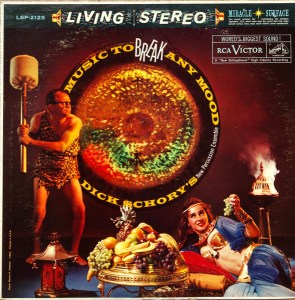
- Music To Break Any Mood appears on the site for only the second time ever, here with solid Double Plus (A++) Living Stereo sound throughout this original RCA pressing
- Spacious, rich and smooth – only vintage analog seems capable of reproducing all three of these qualities without sacrificing resolution, staging, imaging or presence
- You won’t believe how natural, rich, tonally correct and Tubey Magical this copy is – until you play it, of course
- So transparent, dynamic and real, this copy raises the bar for the sound of this kind of percussion-based music on vinyl
This vintage RCA pressing has the kind of Tubey Magical Midrange that modern records can barely BEGIN to reproduce. Folks, that sound is gone and it sure isn’t showing signs of coming back. If you love hearing INTO a recording, actually being able to “see” the performers, and feeling as if you are sitting in the studio with the band, this is the record for you. It’s what vintage all analog recordings are known for — this sound.
If you exclusively play modern repressings of vintage recordings, I can say without fear of contradiction that you have never heard this kind of sound on vinyl. Old records have it — not often, and certainly not always — but maybe one out of a hundred new records do, and those are some pretty long odds.
What The Best Sides Of Music To Break Any Mood Have To Offer Is Not Hard To Hear
- The biggest, most immediate staging in the largest acoustic space
- The most Tubey Magic, without which you have almost nothing. CDs give you clean and clear. Only the best vintage vinyl pressings offer the kind of Tubey Magic that was on the tapes in 1960
- Tight, note-like, rich, full-bodied bass, with the correct amount of weight down low
- Natural tonality in the midrange — with all the instruments having the correct timbre
- Transparency and resolution, critical to hearing into the three-dimensional studio space
No doubt there’s more but we hope that should do for now. Playing the record is the only way to hear all of the qualities we discuss above, and playing the best pressings against a pile of other copies under rigorously controlled conditions is the only way to find a pressing that sounds as good as this one does.
Copies with rich lower mids and nice extension up top did the best in our shootout, assuming they weren’t veiled or smeary of course. So many things can go wrong on a record. We know, we’ve heard them all.
Top end extension is critical to the sound of the best copies. Lots of old records (and new ones) have no real top end; consequently, the studio or stage will be missing much of its natural air and space, and instruments will lack their full complement of harmonic information.
Tube smear is common to most vintage pressings. The copies that tend to do the best in a shootout will have the least (or none), yet are full-bodied, tubey and rich.
What We’re Listening For On Music To Break Any Mood
- Energy for starters. What could be more important than the life of the music?
- The Big Sound comes next — wall to wall, lots of depth, huge space, three-dimensionality, all that sort of thing.
- Then transient information — fast, clear, sharp attacks, not the smear and thickness so common to these LPs.
- Tight, full-bodied bass — which ties in with good transient information, also the issue of frequency extension further down.
- Next: transparency — the quality that allows you to hear deep into the soundfield, showing you the space and air around all the instruments.
- Extend the top and bottom and voila, you have The Real Thing — an honest to goodness Hot Stamper.
Hi-Fidelity
What do we love about these Living Stereo Hot Stamper pressings? The timbre of every instrument is Hi-Fi in the best sense of the word. The instruments here are reproduced with remarkable fidelity. Now that’s what we at Better Records mean by “Hi-Fi,” not the kind of audiophile phony BS sound that passes for Hi-Fidelity these days. There’s no boosted top, there’s no bloated bottom, there’s no sucked-out midrange. There’s no added digital reverb (Patricia Barber, Diana Krall, et al.). The microphones are not fifty feet away from the musicians (Water Lily) nor are they inches away (Three Blind Mice).
This is Hi-Fidelity for those who recognize the real thing when they hear it. I’m pretty sure our customers do, and whoever picks this one up is guaranteed to get a real kick out of it.
Side One
Caravan
Speak Low
South Rampart Street Parade
Walkin’ My Baby Back Home
Fascinating Rhythm
Safari Anyone?
Side Two
A Foggy Day
Autumn In New York
Fly Now, Pay Later
I’ll Remember April
Tortilla
Stranger In Paradise
AMG Review
Dick Schory’s second major outing for RCA is more self-assured, from the preposterous jacket art and liner notes to more upbeat tunes. One assumes Schory handled all or most of the arrangements; Schory’s musical ideas are always fresher than those of Bobby Christian and Mike Simpson, who helped on the previous album. All but two tracks are good to great. It may help that several are indestructible standards: “Caravan,” “Fascinating Rhythm,” and “Stranger in Paradise.” Other titles, also mostly standards, are typical of the Schory style: “Safari, Anyone,” “Tortilla,” and “Fly Now, Pay Later.”
Further Reading