More Classical Recordings Featuring the Violin
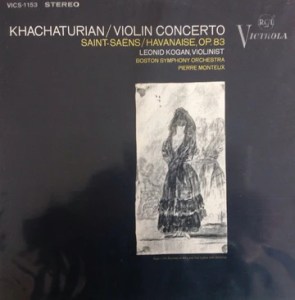
- A vintage Maroon Label Victrola stereo pressing of Khachaturian’s Violin Concerto (only the second copy to ever hit the site), here with solid Double Plus (A++) grades or close to them from first note to last
- It’s also fairly quiet at Mint Minus Minus, a grade that even our most well-cared-for vintage classical titles have trouble playing at
- This copy of VICS 1153 showed us the balance of clarity and sweetness we were looking for in the violin (particularly on side two) – not many recordings from this era can do that
- Side two is simply bigger, more transparent, less distorted, more three-dimensional and more real than most of what we played, and side one is not far behind in all those areas
This vintage RCA Victrola pressing has the kind of Tubey Magical Midrange that modern records can barely BEGIN to reproduce. Folks, that sound is gone and it sure isn’t showing signs of coming back. If you love hearing INTO a recording, actually being able to “see” the performers, and feeling as if you are sitting in the studio with the band, this is the record for you. It’s what vintage all analog recordings are known for — this sound.
If you exclusively play modern repressings of vintage recordings, I can say without fear of contradiction that you have never heard this kind of sound on vinyl. Old records have it — not often, and certainly not always — but maybe one out of a hundred new records do, and those are some pretty long odds.
What The Best Sides Of Khachaturian’s Violin Concerto and Saint-Saens’s Havanaise Have To Offer Is Not Hard To Hear
- The biggest, most immediate staging in the largest acoustic space
- The most Tubey Magic, without which you have almost nothing. CDs give you clean and clear. Only the best vintage vinyl pressings offer the kind of Tubey Magic that was on the tapes in 1958
- Tight, note-like, rich, full-bodied bass, with the correct amount of weight down low
- Natural tonality in the midrange — with all the instruments having the correct timbre
- Transparency and resolution, critical to hearing into the three-dimensional studio space
No doubt there’s more but we hope that should do for now. Playing the record is the only way to hear all of the qualities we discuss above, and playing the best pressings against a pile of other copies under rigorously controlled conditions is the only way to find a pressing that sounds as good as this one does.
Copies with rich lower mids and nice extension up top did the best in our shootout, assuming they weren’t veiled or smeary of course. So many things can go wrong on a record. We know, we’ve heard them all.
Top end extension is critical to the sound of the best copies. Lots of old records (and new ones) have no real top end; consequently, the studio or stage will be missing much of its natural air and space, and instruments will lack their full complement of harmonic information.
Tube smear is common to most vintage pressings. The copies that tend to do the best in a shootout will have the least (or none), yet are full-bodied, tubey and rich.
Size and Space
One of the qualities that we don’t talk about on the site nearly enough is the SIZE of the record’s presentation. Some copies of the album just sound small — they don’t extend all the way to the outside edges of the speakers, and they don’t seem to take up all the space from the floor to the ceiling. In addition, the sound can often be recessed, with a lack of presence and immediacy in the center.
Other copies — my notes for these copies often read “BIG and BOLD” — create a huge soundfield, with the music positively jumping out of the speakers. They’re not brighter, they’re not more aggressive, they’re not hyped-up in any way, they’re just bigger and clearer.
And most of the time those very special pressings are just plain more involving. When you hear a copy that does all that — a copy like this one — it’s an entirely different listening experience.
What We’re Listening For On Khachaturian’s Violin Concerto
- Energy for starters. What could be more important than the life of the music?
- The Big Sound comes next — wall to wall, lots of depth, huge space, three-dimensionality, all that sort of thing.
- Then transient information — fast, clear, sharp attacks, not the smear and thickness so common to these LPs.
- Next: transparency — the quality that allows you to hear deep into the soundfield, showing you the space and air around all the instruments.
- Extend the top and bottom and voila, you have The Real Thing — an honest to goodness Hot Stamper.
Side One
Violin Concerto – Khachaturian
Allegro Con Fermezza
Andante Sostenuto
Side Two
Violin Concerto – Khachaturian
Allegro Vivace
Havanaise, Op. 83 – Saint-Saens
Violin Concerto (Khachaturian)
Aram Khachaturian’s Violin Concerto in D minor is a violin concerto in three movements composed in 1940. [H]e said of the composition that he “worked without effort … Themes came to me in such abundance that I had a hard time putting them in order.” Many sections of the concerto are reminiscent of the folk music of Khachaturian’s native Armenia—while he never directly quotes a specific folk melody, “the exotic Oriental flavor of Armenian scales and melodies and the captivating rhythmic diversity of dances” are throughout the work. The work has been charactered by “an exhilarating rhythmic drive and vitality, and a penchant for intoxicating, highly flavored, languorous melody owing much to the inflections of his native Armenian folk music.”
Structure
A movement in sonata form, the Allegro con fermezza opens with a melody that has been described as “energetic” a “rollicking dance-like theme,” and this yields to a “more lyrical” secondary melody.
The Andante sostenuto has been described as “a rhapsodic slow movement that sweeps one into a brooding wintry landscape.” Geoffrey Norris wrote, “The ease and spontaneity, pungency and flexibility of Khachaturian’s melodic inventions are most clearly laid out in the Andante sostenuto of the central movement, cast in a free-flowing, quasi-improvisatory manner redolent of the art of Armenian folk music.” The second movement is a free-flowing rondo.
The concluding Allegro vivace has been called “a whirlwind of motion and virtuosity.” In this movement, “the folks element is specially pronounced in the dance-like vigor of the main melody and in the repetitive, insistent, wild virtuosity of the solo instrument.”
-Wikipedia