More Frank Sinatra
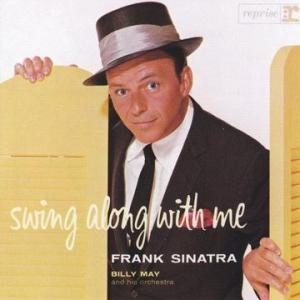
- With INCREDIBLE Shootout Winning Triple Plus (A+++) grades or close to them throughout, this original Reprise pressing (only the second copy to hit the site in over three years) is doing practically everything right
- Both of these vintage stereo sides are superb — rich, smooth and full-bodied with wonderfully present vocals and all of the Tubey Magic that’s missing from most copies
- This album is very tough to come by in stereo in anything but beat condition, let alone with this kind of sound
- Such is the trade-off here, with some bad marks on “Falling in Love With Love” and scattered stitches throughout “I Never Knew” and “Don’t Be That Way,” but once you hear how incredible sounding this copy is, you may be inclined, as we were, to stop counting ticks and stitches and just be swept away by the music
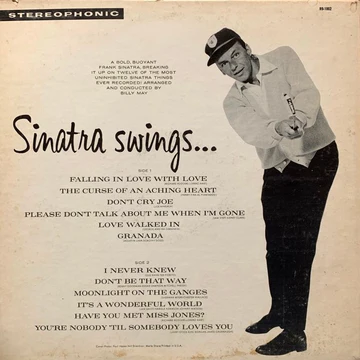
- “Twelve of the most uninhibited Sinatra things ever recorded!”
- “Recorded with Billy May, Sinatra Swings was Frank Sinatra’s first straight swing album for Reprise Records. In terms of content and approach, the record is remarkably similar to his final Capitol swing effort, Come Swing with Me.”
Also known as Sinatra Swings.
Five for Five in 1961
Of the five records Sinatra released in 1961 (Sinatra’s Swingin’ Session!!!; Come Swing with Me!; Ring-a-Ding-Ding!; Swing Along with Me; and I Remember Tommy), this is clearly one of our favorites. (And by the way, what’s with all the exclamation marks?)
 Billy May deserves much of the credit for the “swing” that’s all over the album. His band is jumpin’, and on the better pressings — such as this one — the sound conveys the energy with virtually none of the grit and hardness you hear on so many of Sinatra’s other albums (Sinatra at the Sands comes immediately to mind, but there are far too many others). You may recall that Billy May was the arranger for some of Sinatra’s best Capitol work, and certainly the three swingingest: Come Fly with Me, Come Dance with Me and Come Swing with Me.
This is 1961, and tubes and ribbon mics are in charge of the live-in-the-studio proceedings. With a vintage original pressing such as this one, you hear the kind of sound they heard. (And if you play the record at ear-splitting levels you will hear even more of that sound. Can you imagine how loud this band was playing?)
We were especially impressed with the large dynamic swings of the arrangements.
And the fact that the best pressings never get aggressive even during their most dynamic passages.
What the best sides of Swing Along With Me have to offer is not hard to hear
- The biggest, most immediate staging in the largest acoustic space
- The most Tubey Magic, without which you have almost nothing. CDs give you clean and clear. Only the best vintage vinyl pressings offer the kind of Tubey Magic that was on the tapes in 1961
- Tight, note-like, rich, full-bodied bass, with the correct amount of weight down low
- Natural tonality in the midrange — with all the instruments having the correct timbre
- Transparency and resolution, critical to hearing into the three-dimensional studio space
No doubt there’s more but we hope that should do for now. Playing the record is the only way to hear all of the qualities we discuss above, and playing the best pressings against a pile of other copies under rigorously controlled conditions is the only way to find a pressing that sounds as good as this one does.
What We’re Listening For On Swing Along With Me
- Energy for starters. What could be more important than the life of the music?
- The Big Sound comes next — wall to wall, lots of depth, huge space, three-dimensionality, all that sort of thing.
- Then transient information — fast, clear, sharp attacks, not the smear and thickness common to most LPs.
- Tight, note-like bass with clear fingering — which ties in with good transient information, as well as the issue of frequency extension further down.
- Next: transparency — the quality that allows you to hear deep into the soundfield, showing you the space and air around all the players.
- Then: presence and immediacy. The vocals aren’t “back there” somewhere, way behind the speakers. They’re front and center where any recording engineer worth his salt would have put them.
- Extend the top and bottom and voila, you have The Real Thing — an honest to goodness Hot Stamper.
A Must Own Vocal Album
This Demo Disc quality recording should be part of any serious Popular and Jazz Vocal Collection.
Others that belong in that category can be found here.
Side One
Falling in Love With Love
The Curse of an Aching Heart
Don’t Cry Joe
Please Don’t Talk About Me When I’m Gone
Love Walked In
Granada
Side Two
I Never Knew
Don’t Be That Way
Moonlight on the Ganges
It’s a Wonderful World
Have You Met Miss Jones?
You’re Nobody ’til Somebody Loves You
AMG Review
Recorded with Billy May, Sinatra Swings was Frank Sinatra’s first straight swing album for Reprise Records. In terms of content and approach, the record is remarkably similar to his final Capitol swing effort, Come Swing with Me. In fact, Capitol thought the album, originally titled Swing Along with Me, was so close in its sound and title that they sued Sinatra. The record label won the suit, and the singer had to change the name of his Reprise album to Sinatra Swings.
Of course, that didn’t change the actual content of the record. Even though the tone was similar, there were some differences from Come Swing with Me — the ballads have strings, there are saxophones on the record, and the material is more lighthearted on Sinatra Swings, much like the songs on Come Fly with Me.
The restored sense of humor makes Sinatra Swings preferable to Come Swing with Me, even if it doesn’t have the concentrated precision of the first two Sinatra/May sets.