More of the Music of Frank Sinatra
Reviews and Commentaries for the Music of Frank Sinatra
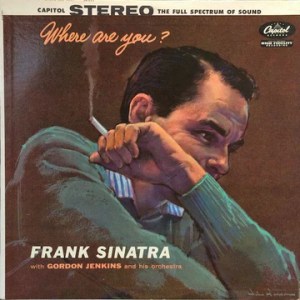
- An outstanding copy of Where Are You? with solid Double Plus (A++) sound from start to finish
- Not an easy record to find in audiophile playing condition, but here’s one, and it’s about as quiet a copy as we can find
- The spaciousness, and more importantly the presence and warmth in the all-important midrange are key to the right sound for any Sinatra record, and on this early stereo pressing you will find plenty of all three
- 5 stars: “Throughout the record, Sinatra blends with Jenkins’ sumptuous strings, making his voice sound rich, relaxed and regretful. It doesn’t have the stark despair of In the Wee Small Hours, but its luxurious sadness makes Where Are You? a majestic experience of its own.”
This late-’50s LP has the kind of Tubey Magical Midrange that modern pressings cannot BEGIN to reproduce. Folks, that sound is gone and it sure isn’t showing any sign of coming back.
Having done this for so long, we understand and appreciate that rich, full, solid, Tubey Magical sound is key to the presentation of this primarily vocal music. We rate these qualities higher than others we might be listening for (e.g., bass definition, soundstage, depth, etc.). The music is not so much about the details in the recording, but rather in trying to recreate a solid, palpable, real Frank Sinatra singing live in your listening room. The best copies have an uncanny way of doing just that.
If you exclusively play modern repressings of older recordings (this one is now 62 years old), I can say without fear of contradiction that you have never heard this kind of sound on vinyl. Old records have it — not often, and certainly not always — but less than one out of 100 new records do, if our experience with the hundreds we’ve played can serve as a guide.
What the best sides of Where Are You? have to offer is not hard to hear:
- The biggest, most immediate staging in the largest acoustic space
- The most Tubey Magic, without which you have almost nothing. CDs give you clean and clear. Only the best vintage vinyl pressings offer the kind of Tubey Magic that was on the tapes in 1957
- Tight, note-like, rich, full-bodied bass, with the correct amount of weight down low
- Natural tonality in the midrange — with all the instruments having the correct timbre
- Transparency and resolution, critical to hearing into the three-dimensional studio space
No doubt there’s more but we hope that should do for now. Playing the record is the only way to hear all of the qualities we discuss above, and playing the best pressings against a pile of other copies under rigorously controlled conditions is the only way to find a pressing that sounds as good as this one does.
Finding The Best Copies
Most copies suffer from a serious lack of immediacy, and what fun is that? Hot Stamper copies put Frank right up front, with the presence needed to carry his vocals out in front of the orchestra. Even the copies that get the voice right often run into problems with the strings of the orchestra, but the Hot Stamper sides do a much better job of dealing with the various issues presented by the recording.
Copies with rich lower mids and nice extension up top (to keep the strings from becoming shrill) did the best in our shootout, assuming they weren’t veiled or smeary of course. So many things can go wrong on a record! We know, we heard them all.
And we know a fair bit about the man’s recordings at this point. As of today, we’ve done commentaries for more than 20 or so different Sinatra shootouts, and that’s not counting at least another ten titles that either bombed or were sold off years ago.
What We’re Listening For on Where Are You?
- Energy for starters. What could be more important than the life of the music?
- Then: presence and immediacy. The vocals aren’t “back there” somewhere, lost in the mix. They’re front and center where any recording engineer worth his salt would put them.
- The Big Sound comes next — wall to wall, lots of depth, huge space, three-dimensionality, all that sort of thing.
- Then transient information — fast, clear, sharp attacks, not the smear and thickness so common to these LPs.
- Tight punchy bass — which ties in with good transient information, also the issue of frequency extension further down.
- Next: transparency — the quality that allows you to hear deep into the soundfield, showing you the space and air around all the instruments.
- Extend the top and bottom and voila, you have The Real Thing — an honest to goodness Hot Stamper.
Gordon Jenkins
We want to give a special shoutout here to conductor/arranger Gordon Jenkins, who also handled the same duties very capably on Nilsson’s great A Little Touch Of Schmillson In The Night, another male vocal album that can sound amazing and deserves a place in any audiophile record collection.
TRACK LISTING
Side One
Where Are You?
The Night We Called It A Day
Maybe You’ll Be There
Laura
Lonely Town
Side Two
Autumn Leaves
I’m A Fool To Want You
I Think Of You
Where Is The One
There’s No You
Baby Won’t You Please Come Home
AMG 5 Star Rave Review
Following the hard-driving A Swingin’ Affair, Frank Sinatra released another all-ballads record, Where Are You? The album was the first he recorded at Capitol without Nelson Riddle, as well as the first he recorded in stereo. Where Riddle’s down beat albums are stately and sullen, Jenkins favors lush, melancholy arrangements played by large, string-dominated orchestras. Jenkins’ arrangements suggested classical textures, although the tempos alluded to Billie Holiday’s ballad style. Where Are You? primarily consists of torch songs, including “The Night We Called It a Day,” “I Cover the Waterfront,” and “Lonely Town.” Throughout the record, Sinatra blends with Jenkins’ sumptuous strings, making his voice sound rich, relaxed and regretful. It doesn’t have the stark despair of In the Wee Small Hours, but its luxurious sadness makes Where Are You? a majestic experience of its own.