

More Jimi Hendrix

- A Band of Gypsys like you’ve never heard, with solid Double Plus (A++) grades or BETTER throughout this original pressing – fairly quiet vinyl too
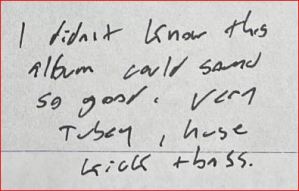
- Huge amounts of bass; rich, smooth vocals; here is the big, bold sound that we’re pretty sure you had no idea the album could have
- Wonderful clarity and freedom from distortion characterize the overall sound of both sides, and that’s unusual because there are a lot of dreadful sounding copies floating around
- These Robert Ludwig-mastered Capitol pressings are the only ones good enough to be called Hot Stampers – accept no substitutes!
- Trust us on this one – you’re going to have a difficult (and expensive!) adventure finding a copy that sounds as good as this one on your own
- We have a staff of ten and even we have a hard time with Classic Rock titles like these — people loved this album and played it to death on their shitty turntables, leaving few copies in clean condition for us audiophiles to enjoy 54 years later [see below]
- 4 1/2 stars: “Although he could be an erratic live performer, for these shows, Hendrix was on — perhaps his finest performances… not only an important part of the Hendrix legacy, but one of the greatest live albums ever.”
- If you’re a fan of Jimi’s, this 1970 release belongs in your collection.
- When it comes to rock and pop music in 1970, our picks for the best of the best, numbering less than 30 titles, can be found here.

If you exclusively play modern repressings of vintage recordings, I can say without fear of contradiction that you have never heard this kind of sound on vinyl. Old records have it — not often, and certainly not always — but maybe one out of a hundred new records do, and those are some pretty long odds.
What the Best Sides of Band of Gypsys Have to Offer Is Not Hard to Hear
- The biggest, most immediate staging in the largest acoustic space
- The most Tubey Magic, without which you have almost nothing. CDs give you clean and clear. Only the best vintage vinyl pressings offer the kind of Tubey Magic that was on the tapes in 1970
- Tight, note-like, rich, full-bodied bass, with the correct amount of weight down low
- Natural tonality in the midrange — with all the instruments having the correct timbre
- Transparency and resolution, critical to hearing into the three-dimensional studio space
No doubt there’s more but we hope that should do for now. Playing the record is the only way to hear all of the qualities we discuss above, and playing the best pressings against a pile of other copies under rigorously controlled conditions is the only way to find a pressing that sounds as good as this one does.
What We’re Listening For on Band of Gypsys
- Energy for starters. What could be more important than the life of the music?
- Then: presence and immediacy. The vocals aren’t “back there” somewhere, lost in the mix. They’re front and center where any recording engineer worth his salt — engineering legend Eddie Kramer in this case — would put them.
- The Big Sound comes next — wall to wall, lots of depth, huge space, three-dimensionality, all that sort of thing.
- Then transient information — fast, clear, sharp attacks, not the smear and thickness so common to these LPs.
- Tight punchy bass — which ties in with good transient information, also the issue of frequency extension further down.
- Next: transparency — the quality that allows you to hear deep into the soundfield, showing you the space and air around all the instruments.
- Extend the top and bottom and voila, you have The Real Thing — an honest to goodness Hot Stamper.
Side One
Who Knows
Machine Gun
Side Two
Changes
Power to Love
Message to Love
We Gotta Live Together
AMG 4 1/2 Star Rave Review
The music was a seamless melding of rock, funk, and R&B, and tunes like “Message to Love” and “Power to Love” showed a new lyrical direction as well. Although he could be an erratic live performer, for these shows, Hendrix was on — perhaps his finest performances. His playing was focused and precise.
In fact, for most of the set, Hendrix stood motionless, a far cry from the stage antics that helped establish his reputation as a performer. Equipment problems had plagued him in past live shows as well, but everything was perfect for the Fillmore shows…
Band of Gypsys is not only an important part of the Hendrix legacy, but one of the greatest live albums ever.


I think I bought it in 1973 and I probably paid about $69 for it.
I recall this was their entry-level model. If any table had been cheaper I would have bought it, which shows you what my starving-college-student budget must have been.
Sounded just fine to me, though. What did I know about sound in 1973?
I had an early AR table after that, the basic model with no anti-skate. You could buy a kit and add it and I think I added it, and I might have paid $99 for that one. Onward and upward!
Further Reading
- New to the Blog? Start here
- Record collecting for audiophiles from A to Z
- How to get the most out of your records – a step by step guide


If you’re searching for the perfect sound, you came to the right place.