

More Dave Brubeck
Mono or Stereo? Both Can Be Good


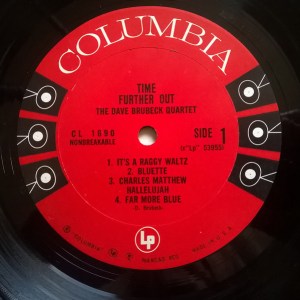
- With superb Double Plus (A++) sound throughout, this vintage 6-Eye Mono pressing will be very hard to beat – fairly quiet vinyl too
- It’s extremely unlikely that any mono pressing will win a shootout, but just to keep us on our toes, we like to put some monos of famous albums in our shootouts from time to time to see how they measure up
- This 2+ early pressing was the best of the bunch, and it’s guaranteed to beat the pants off any modern Heavy Vinyl pressing ever made
- These sides are Tubey Magical, rich, full-bodied and warm, yet clear, lively and dynamic
- This copy demonstrates the big-as-life Fred Plaut Columbia Sound at its best – better even than Time Out(!)
- 4 1/2 stars: “The selections, which range in time signatures from 5/4 to 9/8, are handled with apparent ease (or at least not too much difficulty) by pianist Brubeck, altoist Paul Desmond, bassist Eugene Wright, and drummer Joe Morello on this near-classic.”
- Mono or stereo? Both can be good
Time Further Out is consistently more varied and, dare we say, more musically interesting than Time Out.
If you want to hear big drums in a big room, these Brubeck recordings will show you that sound better than practically any record we know of. These vintage recordings are full-bodied, spacious, three-dimensional, rich, sweet and warm in the best tradition of an All Tube Analog recording.
This vintage Columbia 6-Eye Mono pressing has the kind of Tubey Magical Midrange that modern records can barely BEGIN to reproduce. Folks, that sound is gone and it sure isn’t showing signs of coming back. If you love hearing INTO a recording, actually being able to “see” the performers, and feeling as if you are sitting in the studio with the band, this is the record for you. It’s what vintage all analog recordings are known for —this sound.
If you exclusively play modern repressings of vintage recordings, I can say without fear of contradiction that you have never heard this kind of sound on vinyl. Old records have it — not often, and certainly not always — but maybe one out of a hundred new records do, and those are some pretty long odds.
What The Best Sides Of Time Further Out Have To Offer Is Not Hard To Hear
- The biggest, most immediate staging in the largest acoustic space
- The most Tubey Magic, without which you have almost nothing. CDs give you clean and clear. Only the best vintage vinyl pressings offer the kind of Tubey Magic that was on the tapes in 1961
- Tight, note-like, rich, full-bodied bass, with the correct amount of weight down low
- Natural tonality in the midrange — with all the instruments having the correct timbre
- Transparency and resolution, critical to hearing into the three-dimensional studio space
No doubt there’s more but we hope that should do for now. Playing the record is the only way to hear all of the qualities we discuss above, and playing the best pressings against a pile of other copies under rigorously controlled conditions is the only way to find a pressing that sounds as good as this one does.
If you have full-range speakers, some of the qualities you may recognize in the sound of the piano are WEIGHT and WARMTH. The piano is not hard, brittle or tinkly. Instead the best copies show you a wonderfully full-bodied, warm, rich, smooth piano, one which sounds remarkably like the ones we’ve all heard countless times in piano bars and restaurants.
In other words like a real piano, not a recorded one. This is what we look for in a good piano recording. Bad mastering can ruin the sound, and often does, along with worn out stampers and bad vinyl and five gram needles that scrape off the high frequencies. But a few — a very few — copies survive all such hazards. They manage to reproduce the full spectrum sound of the piano (and of course the wonderful performances of the musicians) on vintage vinyl, showing us the kind of sound we expect from a top quality early Brubeck album.
Real Handclaps
The one standout track on this album for audiophiles is surely “Unsquare Dance,” what with its uncannily real sounding handclaps in 7/4. The copies that did the best job of reproducing that ‘flesh on flesh’ sound of actual human hands clapping scored very well in our shootout.
Production and Engineering
Teo Macero was the producer, and the superbly talented Fred Plaut the engineer.
What We’re Listening For On Time Further Out
- Energy for starters. What could be more important than the life of the music?
- The Big Sound comes next — wall to wall, lots of depth, huge space, three-dimensionality, all that sort of thing.
- Then transient information — fast, clear, sharp attacks, not the smear and thickness so common to these LPs.
- Tight punchy bass — which ties in with good transient information, also the issue of frequency extension further down.
- Next: transparency — the quality that allows you to hear deep into the soundfield, showing you the space and air around all the instruments.
- Extend the top and bottom and voila, you have The Real Thing — an honest to goodness Hot Stamper.
More to Listen For
For starters listen for a fat snare and rich piano on the first track of side one. When you hear that, assuming you do, you should know you are in for a treat. Our best copies captured those two sounds brilliantly.
On the second track, the clarity of the brushed snare is key to how resolving and transparent any copy is. The rich, smooth sound of Desmond’s sax balanced against the clarity of the brushes will help you make sure that the overall sound is tonally correct from top to bottom.
On side two, the first track has the Wall to Wall Big Drums in a Big Room sound that positively blows our minds.
Note that in some places it sounds like the piano is overdriving its mic. We heard that sound on practically every copy we played, so we’re pretty sure it’s on the tape that way.
Impex
If you own the Impex pressing from 2011 and would like to hear precisely what you’ve been missing all these years, we would love to send you one of our Hot Stampers. It has the spatial and musical information that no Impex reissue we’ve ever heard is capable of reproducing.
Their LP will surely be quieter, but that’s small consolation in our book. The sense that you are in the studio with Brubeck, Desmond, Morello, and Wright is something that the best vintage records such as ours do surprisingly well. In our experience, modern records such as theirs do a much poorer job of conveying you into that space.
If you own their LP we encourage you to give one of ours a try. The difference may shock you.
TRACK LISTING
Side One
It’s a Raggy Waltz
Bluette
Charles Matthew Hallelujah
Far More Blue
Side Two
Far More Drums
Maori Blues
Unsquare Dance
Bru’s Boogie Woogie
Blue Shadows in the Street
AMG 4 1/2 Star Rave Review
The selections, which range in time signatures from 5/4 to 9/8, are handled with apparent ease (or at least not too much difficulty) by pianist Brubeck, altoist Paul Desmond, bassist Eugene Wright and drummer Joe Morello on this near-classic.
Amazon Rave Review
Time Further Out extends upon the concepts first enunciated on the Brubeck Quartet’s surprise hit Time Out, but in this case with the organizing principles involving the leader’s varied compositional treatments of the blues — traditional and otherwise.
Thus a darkly ruminative tune such as “Bluette” treats a fairly standard 12-bar form in a very non-standard manner, interpolating a variety of classical devices that suggest the melodic influence of Chopin and the contrapuntal devices of Bach in its treatment, with a yearning alto solo from saxophonist Paul Desmond that suggests the emotional content of a blues, without specifically referring to standard devices.
As if to italicize his band’s mastery of polymeter, pianist Brubeck treats the fifth, sixth, seventh, eighth, and ninth tunes in corresponding meters, to particular effect on the 7/4 hoedown of “Unsquare Dance,” the 8/8 barrelhouse changes of “Bru’s Boogie Woogie” and the engaging dissonances of his 9/8 mood piece “Blue Shadows in the Street.”
And on “Far More Drums,” drummer Joe Morello displays a mastery of 5/4 metric variations and African-styled polyrhythms that was unheard of for that time, save for percussive grandmasters such as Max Roach.
— Chip Stern