

More of the Music of John Coltrane

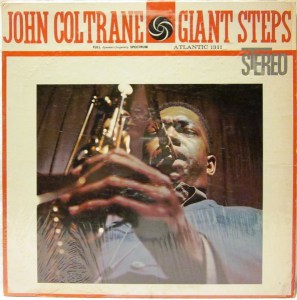
- Coltrane’s Atlantic debut, here with very good Hot Stamper sound from first note to the last – remarkably quiet vinyl too
- We guarantee there is more space, richness, presence, and performance energy on this copy than others you’ve heard or you get your money back – it’s as simple as that
- Credit superb engineering from Phil Iehle and Tom Dowd, who would work on some of Coltrane’s most iconic albums at the label
- 5 stars: “[Coltrane] was…beginning to rewrite the jazz canon with material that would be centered on solos — the 180-degree antithesis of the art form up to that point. These arrangements would create a place for the solo to become infinitely more compelling.”
As you would expect, the original Blue and Green label pressings have (potentially) superb sound on Giant Steps. Somewhat surprisingly, at least to some, the best Red and Green label pressings are almost as good. They are also much more likely to have better surfaces.
At least on the best copies of this title, much of the Tubey Magical richness and warmth carried over into the 70s, and we’re very glad they did. Finding clean original Coltrane albums in stereo from the early 60s is not easy these days.
If you know anything about this music, you know that Coltrane builds up a head of steam on practically every track on the album. He is blasting away here and it is a thrill to be sure. The soundfield opens up naturally, with real depth.
The clarity most of the time does not come at the expense of brightness or thinness of any kind. In fact, just the opposite is the case — the sound is so rich and tubey you will be practically bowled over by it.
There are Blue and Green Label pressings with certain stampers that can be bright on side two. We played one in this shootout. It’s still a good sounding record, but it is somewhat bright and veiled. It earned our minimum Hot Stamper grade of 1.5+ on that side.
The extension on both ends of the frequency spectrum is one of the qualities that often sets the better copies apart from the pack. All the top end and the deep bottom end weight and fullness that are so essential to the sound are simply not to be found on most pressings — but here they are.
This vintage Atlantic stereo pressing has the kind of Tubey Magical Midrange that modern records can barely BEGIN to reproduce. Folks, that sound is gone and it sure isn’t showing signs of coming back. If you love hearing INTO a recording, actually being able to “see” the performers, and feeling as if you are sitting in the studio with the band, this is the record for you. It’s what vintage all analog recordings are known for — this sound.
If you exclusively play modern repressings of vintage recordings, I can say without fear of contradiction that you have never heard this kind of sound on vinyl. Old records have it — not often, and certainly not always — but maybe one out of a hundred new records do, and those are some pretty long odds.
What the Best Sides Of Giant Steps Have To Offer Is Not Hard To Hear
- The biggest, most immediate staging in the largest acoustic space
- The most Tubey Magic, without which you have almost nothing. CDs give you clean and clear. Only the best vintage vinyl pressings offer the kind of Tubey Magic that was on the tapes in 1960
- Tight, note-like, rich, full-bodied bass, with the correct amount of weight down low
- Natural tonality in the midrange — with all the instruments having the correct timbre
- Transparency and resolution, critical to hearing into the three-dimensional studio space
No doubt there’s more but we hope that should do for now. Playing the record is the only way to hear all of the qualities we discuss above, and playing the best pressings against a pile of other copies under rigorously controlled conditions is the only way to find a pressing that sounds as good as this one does.
Copies with rich lower mids and nice extension up top did the best in our shootout, assuming they weren’t veiled or smeary of course. So many things can go wrong on a record. We know, we’ve heard them all.
Top end extension is critical to the sound of the best copies. Lots of old records (and new ones) have no real top end; consequently, the studio or stage will be missing much of its natural air and space, and instruments will lack their full complement of harmonic information.
Tube smear is common to most vintage pressings. The copies that tend to do the best in a shootout will have the least (or none), yet are full-bodied, tubey and rich.
What We’re Listening For On Giant Steps
- Energy for starters. What could be more important than the life of the music?
- The Big Sound comes next — wall to wall, lots of depth, huge space, three-dimensionality, all that sort of thing.
- Then transient information — fast, clear, sharp attacks, not the smear and thickness so common to these LPs.
- Tight, full-bodied bass — which ties in with good transient information, also the issue of frequency extension further down.
- Next: transparency — the quality that allows you to hear deep into the soundfield, showing you the space and air around all the instruments.
- Extend the top and bottom and voila, you have The Real Thing — an honest to goodness Hot Stamper.
Superb Engineering
The engineering duties were handled by Phil Iehle, a man who went on to record a few of Coltrane’s most iconic albums for Atlantic (My Favorite Things, Coltrane Jazz) and the venerable Tom Dowd, who also did Coltrane Jazz in 1961, Coltrane’s Sound in 1964 and many others.
Phil Iehle also helped engineer Buffalo Springfield’s Last Time Around, as well as albums by Mose Allison, Jerry Jeff Walker, Charles Mingus, the MJQ, Herbie Mann, Eddie Harris, Hank Crawford and dozens of others. Staff engineer at Atlantic? That’s my guess. But a supremely talented one nonetheless.
Side One
Giant Steps
Cousin Mary
Countdown
Spiral
Side Two
Syeeda’s Song Flute
Naima
Mr. P.C
AMG 5 Star Rave Review
Giant Steps bore the double-edged sword of furthering the cause of the music as well as delivering it to an increasingly mainstream audience. Although this was John Coltrane’s debut for Atlantic, he was concurrently performing and recording with Miles Davis… He was, in essence, beginning to rewrite the jazz canon with material that would be centered on solos — the 180-degree antithesis of the art form up to that point. These arrangements would create a place for the solo to become infinitely more compelling. This would culminate in a frenetic performance style that noted jazz journalist Ira Gitler accurately dubbed “sheets of sound.” Coltrane’s polytonal torrents extricate the amicable and otherwise cordial solos that had begun decaying the very exigency of the genre — turning it into the equivalent of easy listening.