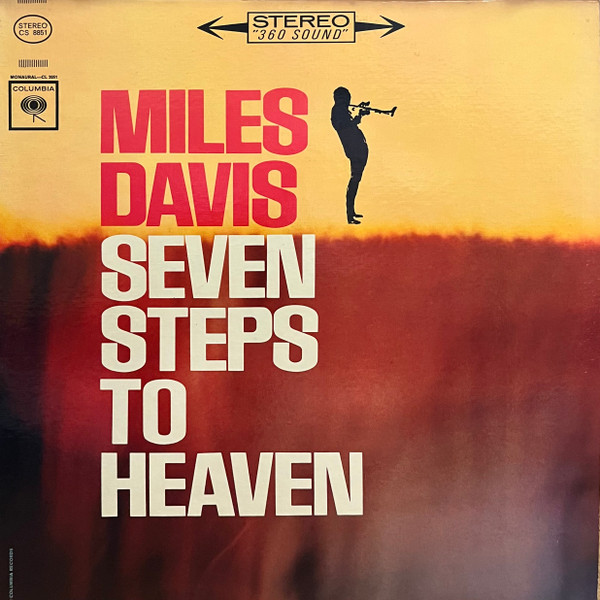
More of the Music of Miles Davis

- This original black print 360 Stereo label pressing was doing most everything right, with both sides earning solid Double Plus (A++) grades or BETTER
- The Demo Disc sound throughout these sides is rich, full, sweet, tonally right on the money, and lively as can be
- Columbia jazz records from this period are some of the best sounding jazz records ever made, and this is a perfect example of what is right with their recordings
- When you drop the needle at the beginning of side one and hear Miles’s muted trumpet come jumping out of your speakers, we guarantee you will be amazed or your money back
- 4 1/2 stars: “Seven Steps to Heaven finds Miles Davis standing yet again on the fault line between stylistic epochs.”
This is an interesting album: half of it is recorded in Hollywood and half of it in New York, with the songs in each location interspersed on the sides. Victor Feldman handles the piano duties in California; Herbie Hancock in New York. I actually prefer Victor Feldman’s playing on this record. We don’t get to hear his piano work often — he’s really quite good. (Cal Tjader started out on the drums but it’s tough to find records with him drumming.)
The Question Before the House
One of the thoughts that occurred to me when I was playing this record is this: Why is there no audiophile reissue on any label that sounds like this? There’s something about the sound of these old records, these original pressings, that’s impossible to recapture with modern equipment. It may not be impossible, but until somebody manages to do it, it might as well be.
If you exclusively play modern repressings of vintage recordings, I can say without fear of contradiction that you have never heard this kind of sound on vinyl. Old records have it — not often, and certainly not always — but maybe one out of a hundred new records do, and those are some pretty long odds.
What the Best Sides of Seven Steps to Heaven Have to Offer Is Not Hard to Hear
- The biggest, most immediate staging in the largest acoustic space
- The most Tubey Magic, without which you have almost nothing. CDs give you clean and clear. Only the best vintage vinyl pressings offer the kind of Tubey Magic that was on the tapes in 1963
- Tight, note-like, rich, full-bodied bass, with the correct amount of weight down low
- Natural tonality in the midrange — with all the instruments having the correct timbre
- Transparency and resolution, critical to hearing into the three-dimensional studio space
No doubt there’s more but we hope that should do for now. Playing the record is the only way to hear all of the qualities we discuss above, and playing the best pressings against a pile of other copies under rigorously controlled conditions is the only way to find a pressing that sounds as good as this one does.
Copies with rich lower mids and nice extension up top did the best in our shootout, assuming they weren’t veiled or smeary of course. So many things can go wrong on a record! We know, we’ve heard them all.
Top end extension is critical to the sound of the best copies. Lots of old records (and new ones) have no real top end; consequently, the studio or stage will be missing much of its natural air and space, and instruments will lack their full complement of harmonic information.
Tube smear is common to most vintage pressings. The copies that tend to do the best in a shootout will have the least (or none), yet are full-bodied, tubey and rich.
What We’re Listening For On Seven Steps to Heaven
- Energy for starters. What could be more important than the life of the music?
- The Big Sound comes next — wall to wall, lots of depth, huge space, three-dimensionality, all that sort of thing.
- Then transient information — fast, clear, sharp attacks, not the smear and thickness so common to these LPs.
- Tight, full-bodied bass — which ties in with good transient information, also the issue of frequency extension further down.
- Next: transparency — the quality that allows you to hear deep into the soundfield, showing you the space and air around all the instruments.
- Extend the top and bottom and voila, you have The Real Thing — an honest to goodness Hot Stamper.
The Players and Personnel
- Bass – Ron Carter
- Drums – Anthony Williams (tracks: “Seven Steps To Heaven,” “So Near, So Far,” “Joshua”)
- Drums – Frank Butler (tracks: “Basin Street Blues,” “I Fall In Love Too Easily,” “Baby Won’t You Please Come Home”)
- Piano – Herbie Hancock (tracks: “Seven Steps To Heaven,” “So Near, So Far,” “Joshua”)
- Piano – Victor Feldman (tracks: “Basin Street Blues,” “I Fall In Love Too Easily,” “Baby Won’t You Please Come Home”)
- Producer – Teo Macero
- Tenor Saxophone – George Coleman
- Trumpet – Miles Davis
Side One
Basin Street Blues
Seven Steps To Heaven
I Fall In Love Too Easily
Side Two
So Near, So Far
Baby Won’t You Please Come Home
Joshua
AMG 4 1/2 Star Review
Seven Steps to Heaven finds Miles Davis standing yet again on the fault line between stylistic epochs. In early 1963, pianist Wynton Kelly, bassist Paul Chambers, and drummer Jimmy Cobb left to form their own trio, and Davis was forced to form a new band, which included Memphis tenor player George Coleman and bassist Ron Carter. When Davis next entered the studio in Hollywood, he added local drummer Frank Butler and British studio ace Victor Feldman, who ultimately decided not to go on the road with Davis.
It’s easy to see why Davis liked Feldman, who contributed the dancing title tune and “Joshua” to the session. On three mellifluous standards — particularly a cerebral “Basin Street Blues” and a broken-hearted “I Fall in Love Too Easily” — the pianist plays with an elegant, refined touch, and the kind of rarefied voicings that suggest Ahmad Jamal. Davis responds with some of his most introspective, romantic ballad playing.
When Davis returned to New York he finally succeeded in spiriting away a brilliantly gifted 17-year-old drummer from Jackie McLean: Tony Williams. On the title tune you can already hear the difference, as his crisp, driving cymbal beat and jittery, aggressive syncopations propel Davis into the upper reaches of his horn. On “So Near, So Far” the drummer combines with Carter and new pianist Herbie Hancock to expand on a light Afro-Cuban beat with a series of telepathic changes in tempo, texture, and dynamics.
Meanwhile, Feldman’s “Joshua” (with its overtones of “So What” and “All Blues”) portends the kind of expressive variations on the basic 4/4 pulse that would become the band’s trademark, as Davis and Coleman ascend into bebop heaven.