



For Mercury classical and orchestral recordings, the original FR pressings on the plum labels are the way to go, right?
In some cases, yes. We talk about how much better the FR pressings for The Firebird are compared to the much more common, and still quite good, M2 reissue pressings here.
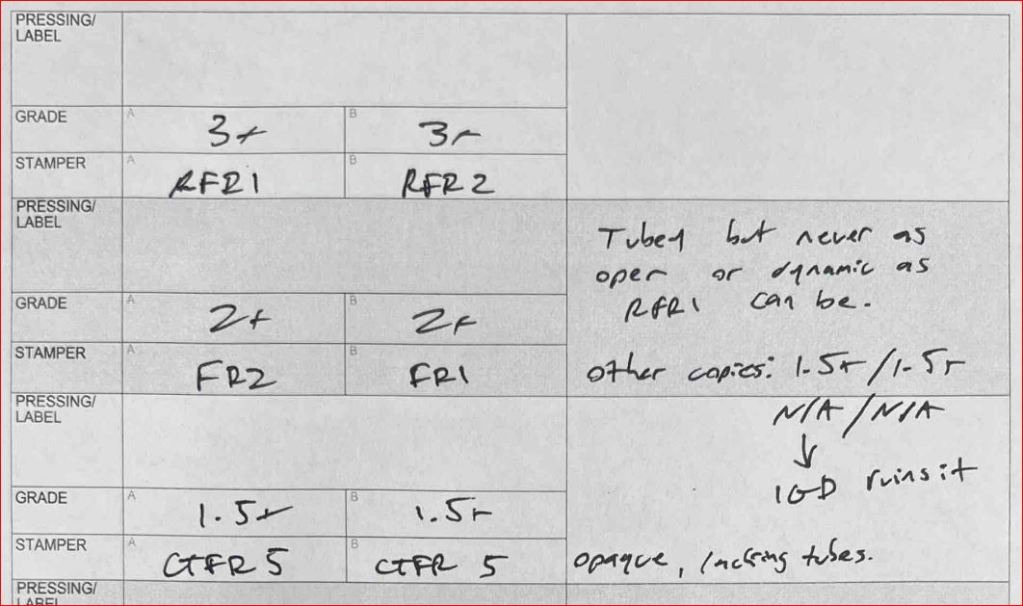
The stamper numbers you see below belong to a different album.
The notes for the FR originals we played read:
- Tubey but never as open or dynamic as RFR-1 can be.
The better of the three FR pressings we played was not a bad sounding record, earning a grade of 2+. They’re just not as good sounding as the RFR reissues, which, of course, are the ones that win shootouts.

Something to keep in mind: A Super Hot Stamper Mercury orchestral record is guaranteed to be dramatically better than any Heavy Vinyl reissue ever made.
Those pressings set a low bar, and if you doubt that they do, we are happy to send you the Hot Stamper that will set you straight and may in fact change your musical life. It’s happened for others and it can happen for you.
Note that one of the originals with the same FR stampers did even worse at 1.5+/1.5+, which would put it in our section for good, not great sounding LPs. It’s the rare Heavy Vinyl pressing that earns a place in that section. Most of the ones we’ve played recently have been just awful.
The same would be true for the CTFR pressings we played.
We had another FR-2/1 copy that had such bad inner groove distortion we didn’t bother to grade it. Vintage classical records often suffer from this problem, along with a number of others we have grouped together under the heading of IGD prone.
Reissue Demo Discs
This mystery album, whatever it is, is a great sounding LP, but only on the RFR pressings. As a matter of fact, it would easily qualify as an orchestral Demo Disc. If you are looking for records with sound of that quality, we have many to choose from.
We’ve lately been giving out much more stamper information than we used to, but for now we are keeping the name of this title close to the vest.
It’s just another one of a number of rules of thumb collectors use (“A method or procedure derived entirely from practice or experience, without any basis in scientific knowledge; a roughly practical method.”), one that will sometimes lead you astray if what you are trying to find are not just good sounding pressings of albums, but the best sounding pressings of albums.
Same with reissue versus original. Nice rule of thumb, but it only works, to the extent that it works at all, if you have enough copies of the title to know that you’re not just assuming the original is better. You actually have the data — gathered from the other LPs you have played — to back it up.
Who knew the recording would sound so much better on the right reissue pressings?
Certainly not us, not until we had done the shootout.
The difference between the way we do things and the way others do them boils down to this: We assumed that the original could be the best, and then we tested that assumption and found out we were wrong.
But the right reissue of this Mercury — again not the ones you see pictured — is indeed an exceptionally good sounding record.
This is why we do shootouts, and why you must do them too, assuming that owning the highest quality pressings is important to you.
Fortunately for readers of this blog, our methods are explained in great detail, free of charge.
Have You Noticed…
If you’re a fan of Mercury Living Presence records — and what right-thinking audiophile wouldn’t be? — have you noticed that many of them don’t sound very good?
If you’re an audiophile with good equipment, you should have.
But did you? Or did you buy into the hoopla surrounding these rare pressings and just ignore the problems with the sound? Perhaps you made the same mistake with Heavy Vinyl.
There is more than enough hype surrounding the hundreds of Heavy Vinyl pressings currently in print. I read a lot about how wonderful their sound is, but when I actually play them, I rarely find them to be any better than mediocre, and some of them are downright awful.
It seems as if the audiophile public has bought completely into the idea that these modern Heavy Vinyl pressings offer superior sound quality. Audiophiles seem to have made the mistake of approaching these records without the slightest trace of skepticism. How could so many be fooled so badly?
Surely some of these people have good enough equipment to allow them to hear the shortcomings of Blue, Aja and Thriller, just to mention off the top of my head three badly remastered albums with single word titles. (A more complete list can be found here.)
Back to Mercury
I would say Mercury’s track record during the 50s and 60s is a pretty good one, offering (potentially) excellent sound for roughly one out of every three titles or so. (Here’s an absolutely amazing one.)
But that means that the odds are in favor of a lot of dogs in their catalog.
The big takeaway: there are a lot of dogs in every label’s catalog.
To see the 50+ Living Presence classical titles we’ve reviewed to date, click here.
Further Reading
- More on the uses and abuses of rules of thumb
- Records that sound best on the right reissue pressing
- Big speakers and loud levels bring out the power of the orchestra