

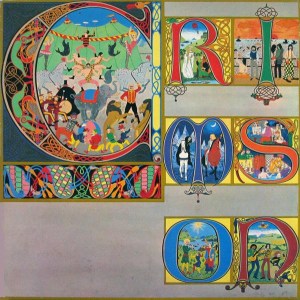

- Stunning sound throughout for this vintage Island Sunray pressing with both sides earning Shootout Winning Triple Plus (A+++) grades or very close to them
- Every bit the sonic equal of the first album – if colorful Big Production Jazzy Prog Rock (with mellotron!) is your thing, you can’t go wrong here
- 4 stars: “Lizard is very consciously jazz-oriented — the influence of Miles Davis (particularly Sketches of Spain) being especially prominent — and very progressive, even compared with the two preceding albums.”
This early Island UK pressing has the kind of Tubey Magical Midrange that modern records rarely even BEGIN to reproduce. Folks, that sound is gone and it sure isn’t showing signs of coming back. If you love hearing INTO a recording, actually being able to “see” the performers, and feeling as if you are sitting in the studio with the band, this is the record for you. It’s what vintage all analog recordings are known for — this sound.
If you exclusively play modern repressings of vintage recordings, I can say without fear of contradiction that you have never heard this kind of sound on vinyl. Old records have it — not often, and certainly not always — but maybe one out of a hundred new records do, and those are some pretty long odds.
What the best sides of Lizard have to offer is not hard to hear:
- The biggest, most immediate staging in the largest acoustic space
- The most Tubey Magic, without which you have almost nothing. CDs give you clean and clear. Only the best vintage vinyl pressings offer the kind of Tubey Magic that was on the tapes in 1970
- Tight, note-like, rich, full-bodied bass, with the correct amount of weight down low
- Natural tonality in the midrange — with all the instruments (and effects!) having the correct timbre
- Transparency and resolution, critical to hearing into the three-dimensional studio space
No doubt there’s more but we hope that should do for now. Playing the record is of course the only way to hear all of the above.
Finding the Right Sound for Lizard
For Big Production Prog Rock Albums such as Lizard there are some obvious problem areas that are often heard on at least one or two sides of practically any copy of the album.
With so many heavily-produced instruments crammed into the soundfield, if the overall sound is at all veiled, recessed or smeared — problems common to 90+% of the records we play in our shootouts — the mix quickly becomes opaque, forcing the listener to work too hard to separate out the elements of interest. Exhaustion, especially on this album, soon follows.
Transparency, clarity and presence are key. Note that none of the British copies we played was thin and anemic. (The domestic copies are made from dubs and can’t begin to compete.) Almost all had plenty of Tubey Magic and bottom end, so thankfully that was almost never a problem. They did however tend to lack top end extension and transparency, and many were overly compressed.
The sides that had sound that jumped out of the speakers, with driving rhythmic energy, worked the best for us. They really brought this complex music to life and allowed us to make sense of it. This is yet another definition of a Hot Stamper — it’s the copy that lets the music work as music.
What We’re Listening For on Lizard
- Energy for starters. What could be more important than the life of the music?
- The Big Sound comes next — wall to wall, lots of depth, huge space, three-dimensionality, all that sort of thing.
- Then transient information — fast, clear, sharp attacks for the guitars, horns and drums, not the smear and thickness common to most LPs.
- Tight, note-like bass with clear fingering — which ties in with good transient information, as well as the issue of frequency extension further down.
- Next: transparency — the quality that allows you to hear deep into the soundfield, showing you the space and air around all the players.
- Then: presence and immediacy. The musicians aren’t “back there” somewhere, way behind the speakers. They’re front and center where any recording engineer worth his salt would have put them.
- Extend the top and bottom and voila, you have The Real Thing — an honest to goodness Hot Stamper.
Size and Space
Some copies of the album just sound small — they don’t extend all the way to the outside edges of the speakers, and they don’t seem to take up all the space from the floor to the ceiling. In addition, the sound can often be recessed, with a lack of presence and immediacy in the center of the soundfield.
Other copies — my notes for these copies often read “BIG and BOLD” — create a huge soundfield, with the music positively jumping out of the speakers. They’re not brighter, they’re not more aggressive, they’re not hyped-up in any way, they’re just bigger and clearer.
We often have to go back and downgrade the copies that we were initially impressed with in light of such a standout pressing. Who knew the recording could be that huge, spacious and three dimensional? We sure didn’t, not until we played the copy that had those qualities, and that copy might have been number 8 or 9 in the rotation.
Think about it: if you had only seven copies, you might not have ever gotten to hear a copy that sounded that open and clear. And how many even dedicated audiophiles would have more than one of two clean British original copies with which to do a shootout? These records are expensive and hard to come by in good shape. Believe us, we know whereof we speak when it comes to getting hold of original British pressings of Classic Rock albums.
One further point needs to be made: most of the time these very special pressings just plain rock harder. When you hear a copy do what this copy can, it’s an entirely different – and dare I say unforgettable — listening experience.
TRACK LISTING
Side One
Cirkus (Including: Entry Of The Chameleons)
Indoor Games
Happy Family
Lady Of The Dancing Water
Side Two
Lizard
Prince Rupert Awakes
Bolero – The Peacock’s Tale
The Battle Of Glass Tears (Including: Dawn Song / Last Skirmish / Prince Rupert’s Lament)
Big Top
AMG 4 Star Review
Lizard is very consciously jazz-oriented — the influence of Miles Davis (particularly Sketches of Spain) being especially prominent — and very progressive, even compared with the two preceding albums. The pieces are longer and have extensive developmental sections, reminiscent of classical music, and the lyrics are more ornate, while the subject matter is more exotic and rarified — epic, Ragnarok-like battles between good and evil that run cyclically.
The doom-laden mood of the first two albums is just as strong, except that the music is prettier; the only thing missing is a sense of humor… At the time of its release, some critics praised Lizard for finally breaking with the formula and structure that shaped the two preceding albums, but overall it’s an acquired taste.