

TAS List Records Available Now
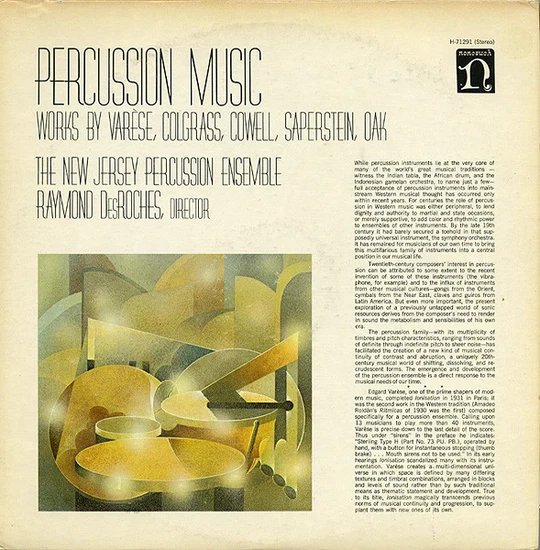
- This crazy fun 20th Century Percussion Music album featuring classical works which rely almost exclusively on percussion (piano and voice also make appearances) boasts INSANELY GOOD Shootout Winning Triple Plus (A+++) grades throughout
- A tough shootout, as no other copy earned a 3+ grade on either side, which simply means that when you find a top copy, it sets such a high standard that everything else ends up getting marked down
- Both of these TAS-approved sides are clear and spacious with sound that is positively jumping out of the speakers
- This copy is transparent, speedy, and tonally correct from top to bottom like nothing else we played
- Problems in the vinyl are sometimes the nature of the beast with these vintage LPs, but once you hear how amazing sounding this copy is, you might be inclined, as we were, to stop counting stitches and just be swept away by the music
My favorite piece here may be “Ionisation,” which uses real sirens (the Old School ones cranked by hand) as part of Varese’s uniquely specialized instrumental array.
But the main reason audiophiles will love this album is not the music, but the sound. “Ionisation” has amazing depth, soundstaging, dynamics, three-dimensionality and absolutely dead-on tonality — it’s hard to imagine a recording that allows your speakers to disappear more completely than this one. And the bottom end is big and powerful, probably the main reason the album has been on the list of TAS Super Discs for decades. If you’ve got full range speakers with big woofers and like to play your music loud, this record will give your system quite a workout.
This vintage Nonesuch pressing has the kind of Tubey Magical Midrange that modern records can barely BEGIN to reproduce. Folks, that sound is gone and it sure isn’t showing signs of coming back. If you love hearing INTO a recording, actually being able to “see” the performers, and feeling as if you are sitting in the studio with the band, this is the record for you. It’s what vintage all analog recordings are known for — this sound.
If you exclusively play modern repressings of vintage recordings, I can say without fear of contradiction that you have never heard this kind of sound on vinyl. Old records have it — not often, and certainly not always — but maybe one out of a hundred new records do, and those are some pretty long odds.
What The Best Sides Of Percussion Music Have To Offer Is Not Hard To Hear
- The biggest, most immediate staging in the largest acoustic space
- The most Tubey Magic, without which you have almost nothing. CDs give you clean and clear. Only the best vintage vinyl pressings offer the kind of Tubey Magic that was on the tapes in 1974
- Tight, note-like, rich, full-bodied bass, with the correct amount of weight down low
- Natural tonality in the midrange — with all the instruments having the correct timbre
- Transparency and resolution, critical to hearing into the three-dimensional studio space
No doubt there’s more but we hope that should do for now. Playing the record is the only way to hear all of the qualities we discuss above, and playing the best pressings against a pile of other copies under rigorously controlled conditions is the only way to find a pressing that sounds as good as this one does.
Copies with rich lower mids and nice extension up top did the best in our shootout, assuming they weren’t veiled or smeary of course. So many things can go wrong on a record. We know, we’ve heard them all.
Top end extension is critical to the sound of the best copies. Lots of old records (and new ones) have no real top end; consequently, the studio or stage will be missing much of its natural air and space, and instruments will lack their full complement of harmonic information.
Tube smear is common to most vintage pressings. The copies that tend to do the best in a shootout will have the least (or none), yet are full-bodied, tubey and rich.
With the invention of new instruments and increased cross-cultural exchange in the 20th century, composers’ interest in writing for percussion exploded, creating a uniquely modern genre that embraced both the future and the ancient past. The New Jersey Percussion Ensemble was founded in 1968 to perform this new literature, here performing works by Varèse, Cowell, and others.
It also makes a superb test disc. Subtle changes in your equipment can have a big effect on recordings like this. The instrumental palette is large and colorful, giving the critical listener plenty to work with.
And this copy is perfect for testing because is is flawless in its sound on both sides. No other copy could touch it. Many copies are not especially transparent, spacious or three-dimensional, and lack extension on both ends of the frequency spectrum.
The speed of the percussion is also critical to its accurate reproduction. No two pieces of electronics will get this record to sound the same, and some will fail miserably. If vintage tube gear is your idea of good sound, this record may help you to better understand where its shortcomings lie.
What We’re Listening For On Percussion Music
- Energy for starters. What could be more important than the life of the music?
- The Big Sound comes next — wall to wall, lots of depth, huge space, three-dimensionality, all that sort of thing.
- Then transient information — fast, clear, sharp attacks, not the smear and thickness so common to these LPs.
- Powerful bass — which ties in with good transient information, also the issue of frequency extension further down.
- Next: transparency — the quality that allows you to hear deep into the soundfield, showing you the space and air around all the instruments.
- Extend the top and bottom and voila, you have The Real Thing — an honest to goodness Hot Stamper.
Side One
Varese – Ionisation
Colgrass – Fantasy: Variations
Side Two
Cowell – Ostinato Pianissimo
Saperstein – Antiphonies for Percussion
Oak – Amorphosis
Edgard Victor Achille Charles Varèse
Edgard Victor Achille Charles Varèse (December 22, 1883 – November 6, 1965) was an innovative French-born composer who spent the greater part of his career in the United States.
Varèse’s music emphasizes timbre and rhythm. He was the inventor of the term “organized sound”, a phrase meaning that certain timbres and rhythms can be grouped together, sublimating into a whole new definition of music. Although his complete surviving works only last about three hours, he has been recognised as an influence by several major composers of the late 20th century. His use of new instruments and electronic resources led to his being known as the “Father of Electronic Music” while Henry Miller described him as “The stratospheric Colossus of Sound”.
Varèse’s emphasis on timbre, rhythm, and new technologies inspired a generation of musicians who came of age during the 1960s and 1970s. One of Varèse’s biggest fans was the American guitarist and composer Frank Zappa, who, upon hearing a copy of The Complete Works of Edgard Varèse, Vol. 1, which included Intégrales, Density 21.5, Ionisation, and Octandre, became obsessed with the composer’s music.
On his 15th birthday, December 21, 1955, Zappa’s mother, Rosemarie, allowed him a call to Varèse as a present. At the time Varèse was in Brussels, Belgium, so Zappa spoke to Varèse’s wife Louise instead. Eventually Zappa and Varèse spoke on the phone, and they discussed the possibility of meeting each other. Although this meeting never took place, Zappa did receive a letter from Varèse.
Varèse’s spirit of experimentation with which he redefined the bounds of what was possible in music lived on in Zappa’s long and prolific career. Zappa’s final project was The Rage and the Fury, a recording of the works of Varèse. In the liner notes of his early albums, he quoted the ICG manifesto, “The present day composer refuses to die.”
In 1981, Zappa produced and hosted “A Tribute to Edgard Varèse” at the Palladium in New York City, an event at which Louise was an honored guest.