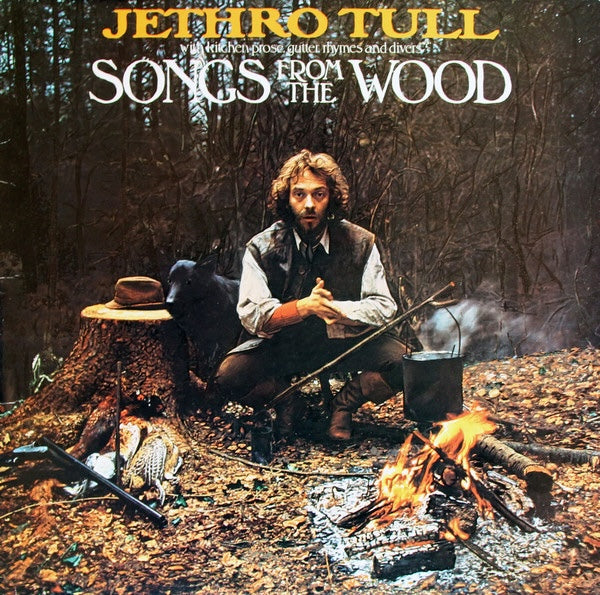
More Folk Rock

- This original UK pressing of Tull’s tenth studio album boasts INSANELY GOOD Shootout Winning Triple Plus (A+++) grades from top to bottom – exceptionally quiet vinyl too
- Both of these sides are amazingly big and full with wonderfully breathy vocals and deep punchy bass
- No other copy in the shootout earned 3 pluses on any side other than this killer copy right here — this was a tough shootout!
- Forget the domestic originals and reissues, they’re medicore at best and more than likely awful
- Forget whatever dead-as-a-doornail Heavy Vinyl record they’re making these days too – if you want to hear Tubey Magic, huge size and powerful energy, a vintage UK pressing like this one is the only way to go
- 4 stars: “Far and away the prettiest record Jethro Tull released at least since Thick as a Brick and a special treat for anyone with a fondness for the group’s more folk-oriented material.”
This vintage Chrysalis pressing has the kind of Tubey Magical Midrange that modern records can barely BEGIN to reproduce. Folks, that sound is gone and it sure isn’t showing signs of coming back. If you love hearing INTO a recording, actually being able to “see” the performers, and feeling as if you are sitting in the studio with the band, this is the record for you. It’s what vintage all analog recordings are known for — this sound.
If you exclusively play modern repressings of vintage recordings, I can say without fear of contradiction that you have never heard this kind of sound on vinyl. Old records have it — not often, and certainly not always — but maybe one out of a hundred new records do, and those are some pretty long odds.
What The Best Sides Of Songs From The Wood Have To Offer Is Not Hard To Hear
- The biggest, most immediate staging in the largest acoustic space
- The most Tubey Magic, without which you have almost nothing. CDs give you clean and clear. Only the best vintage vinyl pressings offer the kind of Tubey Magic that was on the tapes in 1977
- Tight, note-like, rich, full-bodied bass, with the correct amount of weight down low
- Natural tonality in the midrange — with all the instruments having the correct timbre
- Transparency and resolution, critical to hearing into the three-dimensional studio space
No doubt there’s more but we hope that should do for now. Playing the record is the only way to hear all of the qualities we discuss above, and playing the best pressings against a pile of other copies under rigorously controlled conditions is the only way to find a pressing that sounds as good as this one does.
Standard Operating Procedures
What are sonic qualities by which a record — any record — should be judged? Pretty much the ones we discuss in most of our Hot Stamper listings: energy, vocal presence, frequency extension (on both ends), transparency, spaciousness, harmonic textures (freedom from smear is key), rhythmic drive, tonal correctness, fullness, richness, three-dimensionality, and on and on down the list.
When we can get a number of these qualities to come together on the side we’re playing, we provisionally give it a ballpark Hot Stamper grade, a grade that is often revised during the shootout as we hear what the other copies are doing, both good and bad.
Once we’ve been through all the side ones, we play the best of the best against each other and arrive at a winner for that side. Other copies from earlier in the shootout will frequently have their grades raised or lowered based on how they sounded compared to the eventual shootout winner. If we’re not sure about any pressing, perhaps because we played it early on in the shootout before we had learned what to listen for, we take the time to play it again.
Repeat the process for side two and the shootout is officially over. All that’s left is to see how the sides of each pressing match up.
It may not be rocket science, but it’s a science of a kind, one with strict protocols that we’ve developed over the course of many years to insure that the results we arrive at are as accurate as we can make them.
The result of all our work speaks for itself, on this very record in fact. We guarantee you have never heard this music sound better than it does on our Hot Stamper pressing — or your money back.
What We’re Listening For On Songs From The Wood
- Energy for starters. What could be more important than the life of the music?
- Then: presence and immediacy. The vocals aren’t “back there” somewhere, lost in the mix. They’re front and center where any recording engineer worth his salt would put them.
- The Big Sound comes next — wall to wall, lots of depth, huge space, three-dimensionality, all that sort of thing.
- Then transient information — fast, clear, sharp attacks, not the smear and thickness so common to these LPs.
- Tight punchy bass — which ties in with good transient information, also the issue of frequency extension further down.
- Next: transparency — the quality that allows you to hear deep into the soundfield, showing you the space and air around all the instruments.
- Extend the top and bottom and voila, you have The Real Thing — an honest to goodness Hot Stamper.
Side One
Songs From The Wood
Jack-In-The-Green
Cup Of Wonder
Hunting Girl
Ring Out, Solstice Bells
Side Two
Velvet Green
The Whistler
Pibroch (Cap In Hand)
Fire At Midnight
AMG 4 Star Review
Far and away the prettiest record Jethro Tull released at least since Thick as a Brick and a special treat for anyone with a fondness for the group’s more folk-oriented material. Ian Anderson had moved to the countryside sometime earlier, and it showed in his choice of source material. The band’s aggressive rock interplay and Anderson’s fascination with early British folk melodies produce a particularly appealing collection of songs — the seriousness with which the group took this effort can be discerned by the album’s unofficial “full” title on the original LP: “Jethro Tull With Kitchen Prose, Gutter Rhymes, and Divers Songs from the Wood.”
The group’s sound was never more carefully balanced between acoustic folk and hard rock — the result is an album that sounds a great deal like the work of Tull’s Chrysalis Records labelmates Steeleye Span (though Nigel Pegrum never attacked his cymbals — or his entire drum kit — with Barriemore Barlow’s ferocity). The harmonizing on “Songs From the Wood” fulfills the promise shown in some of the singing on Thick as a Brick, and the delicacy of much of the rest, including “Ring Out, Solstice Bells” (where the group plays full out, but with wonderful elegance), “Hunting Girl,” and “Velvet Green,” set a new standard for the group’s sound.
“Pibroch (Cap in Hand),” which is dominated by Martin Barre’s electric guitar — in a stunning array of overlapping flourishes at full volume — is the only concession to the group’s usual hard rock rave-ups, and even it has some lovely singing to counterbalance the bulk of the song.
Further Reading for Jethro Tull
- More albums engineered by Robin Black
- Chad has served poor Jethro Tull most barbarously
- Why have audiophile labels done such a poor job when remastering Aqualung?