More Classical and Orchestral Pressings

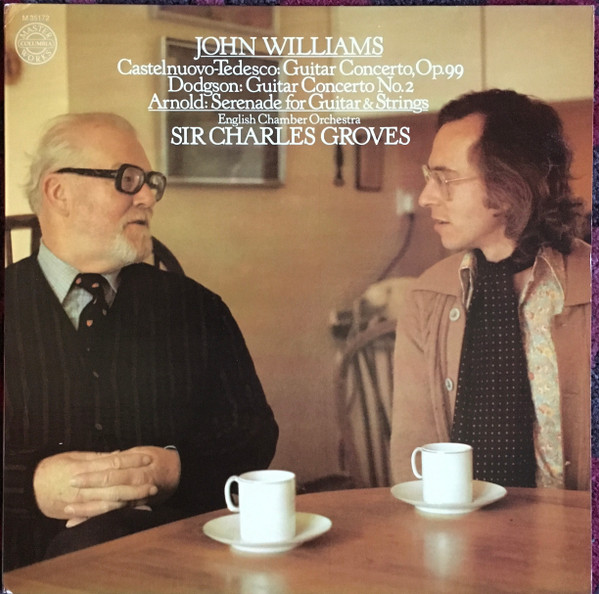
- Amazing sound throughout this Columbia Masterworks pressing, with both sides earning superb Shootout Winning Triple Plus (A+++) grades or very close to them
- It’s also fairly quiet at Mint Minus Minus, a grade that even our most well-cared-for vintage classical titles have trouble playing at
- These sides are wonderfully rich, full-bodied and Tubey Magical, with a present guitar and tons of space around all of the instruments in this lovely chamber orchestra recording
- A friend played me this record more than twenty years ago and I was knocked out by the beauty of the sound at the time, especially considering it was recorded in 1979, long after great classical recordings had become so rare as to be practically nonexistent
- With top quality cleaning and the ability to find even better sounding pressings in our shootouts, you can be sure the copies we offer are a big step up from what I heard all those years ago
- There’s a very good chance that you have never heard a better guitar concerto record, let alone owned one of such quality
If I could have only one guitar concerto recording in my collection, there’s a very good chance I would choose this one — that’s of course assuming I could have a copy that sounds as good as this one does on side one. It’s spacious and open and three-dimensional in a way that few classical recordings we play are, and we play an awful lot of top quality classical records.
Although it may not be from the Golden Age or on London, it sounds to these ears every bit as good as any guitar concerto record I can remember hearing from that era or that label.
And the music is sublime. I heard this piece at a customer’s home in a very large room with a high ceiling, the speakers pulled well out from the walls. The speakers disappeared, leaving sound that was nothing less than glorious, as big as the room and as natural as any I had heard up until that time. That was about twenty years ago.
What The Best Sides Of Guitar Concertos / Serenade For Guitar And Strings Have To Offer Is Not Hard To Hear
- The biggest, most immediate staging in the largest acoustic space
- The most Tubey Magic, without which you have almost nothing. CDs give you clean and clear. Only the best vintage vinyl pressings offer the kind of Tubey Magic that was on the tapes in 1979
- Tight, note-like, rich, full-bodied bass, with the correct amount of weight down low
- Natural tonality in the midrange — with all the instruments having the correct timbre
- Transparency and resolution, critical to hearing into the three-dimensional studio space
No doubt there’s more but we hope that should do for now. Playing the record is the only way to hear all of the qualities we discuss above, and playing the best pressings against a pile of other copies under rigorously controlled conditions is the only way to find a pressing that sounds as good as this one does.
Copies with rich lower mids and nice extension up top did the best in our shootout, assuming they weren’t veiled or smeary of course. So many things can go wrong on a record. We know, we’ve heard them all.
Top end extension is critical to the sound of the best copies. Lots of old records (and new ones) have no real top end; consequently, the studio or stage will be missing much of its natural air and space, and instruments will lack their full complement of harmonic information.
Tube smear is common to most vintage pressings. The copies that tend to do the best in a shootout will have the least (or none), yet are full-bodied, tubey and rich.
What We’re Listening For On Guitar Concertos / Serenade For Guitar And Strings
- Energy for starters. What could be more important than the life of the music?
- The Big Sound comes next — wall to wall, lots of depth, huge space, three-dimensionality, all that sort of thing.
- Then transient information — fast, clear, sharp attacks, not the smear and thickness so common to these LPs.
- Next: transparency — the quality that allows you to hear deep into the soundfield, showing you the space and air around all the instruments.
- Extend the top and bottom and voila, you have The Real Thing — an honest to goodness Hot Stamper.
Wikipedia Background
Mario Castelnuovo-Tedesco (April 3, 1895 – March 16, 1968) was an Italian composer. He was known as one of the foremost guitar composers in the twentieth century with almost one hundred compositions for that instrument. In 1939 he migrated to the United States and became a film composer for MGM Studios for some 200 Hollywood movies for the next fifteen years. He also wrote concertos for such soloists as Jascha Heifetz and Gregor Piatigorsky.
Like many artists who fled fascism, Castelnuovo-Tedesco ended up in Hollywood, where, with the help of Jascha Heifetz, he landed a contract with Metro-Goldwyn-Mayer as a film composer. Over the next fifteen years, he worked on scores for some 200 films there and at the other major film studios.
He was a significant influence on other major film composers, including Henry Mancini, Nelson Riddle, Herman Stein and André Previn. Jerry Goldsmith, Marty Paich and John Williams are all his pupils.
From the Milken Archive
He is often associated most prominently with his works for classical guitar and his contributions to that repertoire, and it is probably upon that medium that his chief fame rests. His association with Andres Segovia resulted in his unintentionally neo-Classical Concerto in D for guitar (op. 99, 1939), and eventually in a catalogue of nearly 100 guitar works.
Castelnuovo-Tedesco wrote later in his career that he “never believed in modernism, nor in neo-Classicism, nor in any other ‘isms’”; that he found all means of expression valid and useful. He rejected the highly analytic and theoretical style that was in vogue among many 20th-century composers, and in general his musical approach was informed not by abstract concepts and procedures, but by extramusical ideas—literary or visual.
Side One
Mario Castelnuovo-Tedesco – Concerto No. 1 in D for Guitar
Malcolm Arnold – Serenade for Guitar and String Orchestra
Side Two
Stephen Dodgson – Concerto No. 2 for Guitar and Chamber Orchestra