

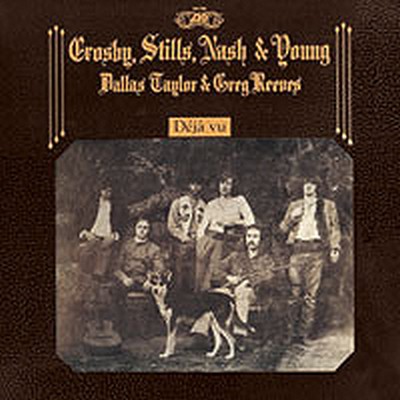
A testimonial from a customer for his Hot Stamper Deja Vu discusses what it takes to get good sound from your stereo. (Hint: it starts with a good sounding record, or two as in this case.)
An excerpt. (Emphasis added.)
Tom:
I received my Deja Vu 2 Pack yesterday. Even though I have not yet listened to all of the mother load that I got on Marathon week, I had to take a listen to this tonight.
Whew – Mother of God!
I have never heard even a semi-decent copy of this album before on either LP or CD – although the music is outstanding and chock full of memories for anyone my age. This white hot stamper is transcendental nirvana. Tom was not kidding when he said master tape sound. The vocals and instrumentals were so alive it was unbelievable. Some of the songs were so good that I just tilted my head back and opened my mouth real wide and just zoned out. Crosby’s vocal on Almost Cut My Hair is masterful. I took your advice and played it twice at even louder volumes. Yikes – better than acapulco gold. Neil Young’s Country Girl was so huge – a vast wall of sound with every single voice and instrument standing out.
This album is even better than I ever thought it was.
I was just not prepared to hear how it really sounds after all that crap I had been listening to for 30 years.
I have come to a conclusion – no matter whether I had the best $50,000 amps in the world or a $29,000 phono supply or the $150,000 Wilson Alexandria speakers or all that other incredible stuff that audiophiles lust for – not one of those items can make a shit record sound anything but like a shit record.
There is no overcoming the original source material that you play on your stereo system.
Buying a hot stamper for what can seem like a lot of money – especially if you want a whole lot of them – is really a bargain for those who have invested in a super audio system (with analog capability of course). It is true that the better your system is the more you will get out of hot stampers – but at some point in the process it is more effective to spend available resources on the LPs rather than on more better mega equipment.
I just don’t believe an additional $20,000 spent on a better amplifier can deliver as much as $20,000 spent on Super or White Hot Stampers played with my current amplifier. Additionally, I do believe that even a modest analogue system will sound fabulous when you have master tape sound coming out of it.
Bless Tom and all the folks at Better Records. My system enjoyment quotient has increased dramatically this year since I have been buying the good stuff to play on it. Keep up the good work.
Regards,
John
John,
So glad to hear you loved that Deja Vu as much as your enthusiastic letter indicates you did. When we come across a copy as good as the one we sent you, it is indeed a cause for celebration here at Better Records: We know someone is very likely going to have their mind blown, and soon. Obviously, in this case the mind that was blown was yours.
As far as megabuck equipment is concerned, we discussed the subject in a commentary entitled Money Can’t Buy You (Audio) Happiness [since removed] in which we noted that a certain reviewer’s very, very expensive equipment did not seem to be helping him tell the difference between good sounding records and bad. From our perspective, there’s little difference in the sound of the Heavy Vinyl pressings he seems to like so much from Classic, Sundazed, Speakers Corner and the like. To us almost all of them leave a lot to be desired.
Play Them? Why?
It’s hard for us to get motivated to play any of these records. The vast majority are barely even passable and more often than not they’re just downright awful, so what’s the point?
John brings up a related point: No matter how expensive your equipment, you just can’t make your stereo sound good unless you are playing a good sounding record.
Placing a Sundazed or Classic record on a $100,000 turntable is — to our way of thinking — audio insanity.
If that turntable is any good — and I certainly would not assume it is based on its price tag; that’s not how audio works — it’s simply going to make the shortcomings that exist in the mastering of these two famously badly-mastered label’s records even more obvious.
If, on the other hand, it’s hiding those flaws, that’s strong evidence that someone may very well have figuratively flushed a hundred grand down the toilet.
Cost Effective
Good turntables aren’t cheap, but you don’t need to spend six figures to hear good sound. What will sound good is a good sounding pressing, and that’s where John hits the nail right on the head.
Putting twenty more grand in an amp that’s going to be used to play modern pressings is not a cost-effective way to achieve higher quality sound.
The amp may actually have no effect on the sound, or even a bad effect on the sound.
There is one obvious exception to that rule however: money spent on good sounding records can buy you plenty of audio happiness. When you hear one of our Hot Stampers go head to head with the best pressing you own, it will not take you long to recognize that, for some set of recordings at least, a world of sound exists that you were never aware of before.
Thirty years’ worth of crappy Deja Vu’s wiped away in an instant? Yes, it can be done.
Few audiophiles have the opportunity to experience such a revelation — it comes at a price, to be sure, we would never pretend otherwise — but for those few it may indeed be described truthfully as “transcendental nirvana.” That’s the way we feel when we stumble upon these amazing pressings in our shootouts, and there’s simply no good reason why your experience should be any different.
That “nirvana” feeling exists in the grooves of the record. You can write your local audio shop twenty thousand dollar checks until you’re blue in the face, you’ll never have that experience until you play the record that has that kind of sound in its grooves. (We have a catchy name for such records. We call them Hot Stampers.)
Thanks for your letter.
TP
Further Reading