



Below you will see the complete stamper sheet for a shootout we did in 2024.
Note that the album you see pictured is not the record we did the shootout for.
For RCA classical and orchestral recordings, many collectors think that the earliest pressings on the Shaded Dog label, in stereo, pressed in Indianapolis, tend to be the best sounding.
More often than not, a rule of thumb like that one turns out to be right, which is how it got to be a rule of thumb in the first place. In this shootout, it turned out to be as right as rain.
The best pressingss with 1s stampers beat the 2s which beat the3s. Indianapolis was once again the pressing plant that produced the best sounding copies.
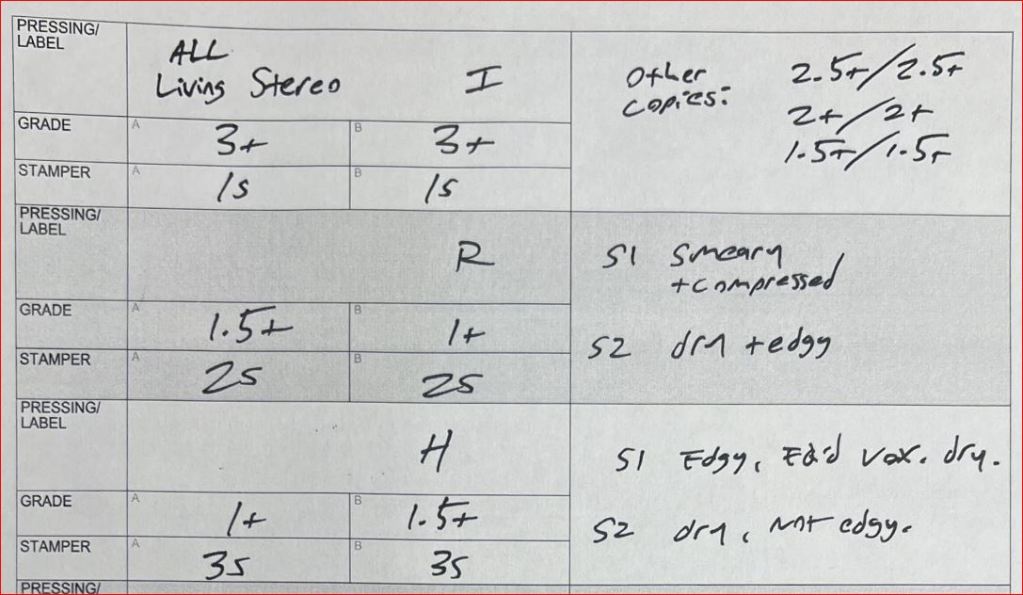

In fact, in this case the differences were even starker than we would have imagined going in. No copy not pressed in Indianapolis was even saleable, since a record that does not earn a grade of at least 1.5+ on both sides can qualify as a Hot Stamper pressing.
Fortunately, even though we were buying them randomly, we managed to luck out to some degree by finding many more 1s pressings than later-numbered ones.
Key Takeaways
- 1s/1s is by far the best stamper for this mystery title, as collector wisdom would have predicted.
- Indianapolis produced the best sounding pressings in this shootout, again, as predicted.
- At some point collector wisdom fails us, as the Shootout Winning stampers (3+) and the good, not great stampers (1.5+) turned out to be the same stampers. This means that:
- 1s is no guarantee of top quality sound. It follows that:
- 1s might be the hot ticket, the 3/3 winner, but the odds, four to one, are against it. Again, it follows that:
- As is almost always the case, the 1s pressing is most likely to be one of a bunch of potentially hot tickets.
You can be sure, based on our most recent shootout for this mystery RCA title, that in future we will focus our efforts on the Indianapolis pressings and avoid the Richmond and Hollywood pressings. The cost of dealing with the pressings that are often not saleable — figuring, say, $50 per record for cleaning and studio auditioning, plus the cost of finding and buying the record itself, adding up to something in the range of $100 per copy of the album — is much more than we could ever gain from the sale of the third-tier copies that would be produced.
Correct, In This Case
When the conventional wisdom turns out to be correct — in other words, when it comports with reality, at least for the six copies of this album that we played — we are happy to temporarily put aside our skepticism and learn the lessons this title has taught us.
Why? Because the experimental evidence supports it.
When rules of thumb work, they’re very handy for the amateur record collector looking for better than average sound. It’s all the times that they don’t work that are the problem — the exceptions to the rule, especially if one of those exceptions just happens to be a favorite album of yours.
Then you’re really up a creek. You followed a general rule that usually works, but in this case failed, and now you really don’t know of any other way to find a solution to your problem.
Fortunately for readers of this blog, we do, and we share that knowledge with you out of the goodness of our hearts.
As of 2024, we’ve even started to reveal a great deal of stamper and pressing information, the kind you are reading about in this very listing.
Predicting
The reality is that most of the time we are not able to predict which stampers will win a shootout before we actually sit down to play all our copies.
Although it’s true that there are many pressings in which one set of stampers always wins, the odds are greater that any particular pressing with those stampers may do well but won’t win, and it sometimes happens that some pressings with those stampers won’t do well at all.
This is why we have to do shootouts, and why you have to do them too, if finding the highest quality pressings is important to you.
Fortunately for readers of this blog, our methods are explained in detail, free of charge.
I implore everyone who wants to make progress in this hobby to learn from the mistakes we’ve made. There are close to 200 “we were wrong” listings on the site as of this writing, and we learned something from every damn one of them, painful and costly as those experiences may have been.