

More Deep Purple
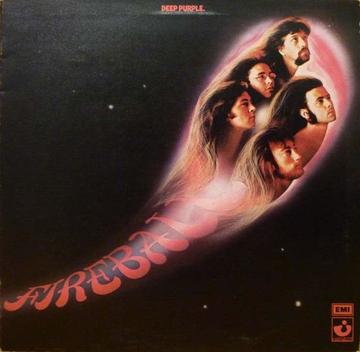
- An early Harvest UK pressing with solid Double Plus (A++) sound on both sides – exceptionally quiet vinyl too
- This copy was simply bigger, richer and clearer, with more Tubey Magic, less smear and less congestion than most of the others we played
- One of Ian Gillian’s favorite albums, “… it was really the beginning of tremendous possibilities of expression.”
- 4 1/2 stars: “One of Deep Purple’s four indispensable albums (the others being In Rock, Machine Head, and Burn), 1971’s Fireball saw the band broadening out from the no-holds-barred hard rock direction of the previous year’s cacophonous In Rock.”
This vintage Harvest pressing has the kind of Tubey Magical Midrange that modern records rarely even BEGIN to reproduce. Folks, that sound is gone and it sure isn’t showing signs of coming back. If you love hearing INTO a recording, actually being able to “see” the performers, and feeling as if you are sitting in the studio with the band, this is the record for you. It’s what vintage all analog recordings are known for — this sound.
If you exclusively play modern repressings of vintage recordings, I can say without fear of contradiction that you have never heard this kind of sound on vinyl. Old records have it — not often, and certainly not always — but maybe one out of a hundred new records do, and those are some pretty long odds.
What The Best Sides Of Fireball Have To Offer Is Not Hard To Hear
- The biggest, most immediate staging in the largest acoustic space
- The most Tubey Magic, without which you have almost nothing. CDs give you clean and clear. Only the best vintage vinyl pressings offer the kind of Tubey Magic that was on the tapes in 1971
- Tight, note-like, rich, full-bodied bass, with the correct amount of weight down low
- Natural tonality in the midrange — with all the instruments having the correct timbre
- Transparency and resolution, critical to hearing into the three-dimensional space of the studio
No doubt there’s more but we hope that should do for now. Playing the record is the only way to hear all of the qualities we discuss above, and playing the best pressings against a pile of other copies under rigorously controlled conditions is the only way to find a pressing that sounds as good as this one does.
What We’re Listening For On Fireball
- Energy for starters. What could be more important than the life of the music?
- Then: presence and immediacy. The vocals aren’t “back there” somewhere, lost in the mix. They’re front and center where any recording engineer worth his salt — Martin Birch in this case — would have put them.
- The Big Sound comes next — wall to wall, lots of depth, huge space, three-dimensionality, all that sort of thing.
- Then transient information — fast, clear, sharp attacks, not the smear and thickness common to most LPs.
- Tight, note-like bass with clear fingering — which ties in with good transient information, as well as the issue of frequency extension further down.
- Next: transparency — the quality that allows you to hear deep into the soundfield, showing you the space and air around all the players.
- Then: presence and immediacy. The musicians aren’t “back there” somewhere, way behind the speakers. They’re front and center where any recording engineer worth his salt — Martin Birch, Lou Austin and Alan O’Duffy in the case — would have put them.
- Extend the top and bottom and voila, you have The Real Thing — an honest to goodness Hot Stamper.
Side One
Fireball
No No No
Demon’s Eye
Anyone’s Daughter
Side Two
The Mule
Fools
No One Came
AMG 4 1/2 Star Review
One of Deep Purple’s four indispensable albums (the others being In Rock, Machine Head, and Burn), 1971’s Fireball saw the band broadening out from the no-holds-barred hard rock direction of the previous year’s cacophonous In Rock. Metal machine noises introduced the sizzling title track — an unusually compact but explosively tight group effort on which Jon Lord’s organ truly shined…
“The Mule” opened the vinyl album’s second side with what is perhaps Purple’s finest instrumental, and on the hyper-extended “Fools,” the bandmembers proved they could flirt with progressive rock without plunging off its cliff… And closing the album was the exceptional “No One Came,” where intertwining instrumental lines locked together beautifully, Gillan wove another entertaining yarn that was part autobiography and part Monty Python, and the often underrated skills of drummer Ian Paice helped the song sound so unreservedly fresh and intuitive that one could almost be convinced the band had winged it on the spot.
Sure, the following year’s Machine Head would provide Deep Purple with their commercial peak, but on Fireball, the formidable quintet was already firing on all cylinders.