

More Classical and Orchestral Recordings
More Living Stereo Recordings

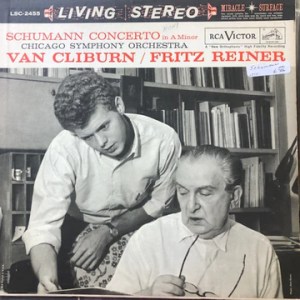
- Solid Double Plus (A++) Living Stereo sound brings Van Cliburn and the Chicago Symphony’s performance of Schumann’s Concerto in A Minor to life on this original Shaded Dog pressing (the first copy to hit the site in years)
- Both of these sides are remarkably transparent, high-rez, and open – all signs that the cutting was done on very high quality equipment, properly EQ’d and not bandwidth limited or overly compressed
- Lewis Layton engineered this recording and he nailed it, perfectly capturing the rich, textured sheen on the strings, the hallmark of Living Stereo sound in the 50s and 60s
- Problems in the vinyl are sometimes the nature of the beast with these early pressings, but this particular title had so many condition problems that, as good as the music and sound might have been, we may not be able to do a shootout for it again
This vintage Living Stereo pressing has the kind of Tubey Magical Midrange that modern records can barely BEGIN to reproduce. Folks, that sound is gone and it sure isn’t showing signs of coming back. If you love hearing INTO a recording, actually being able to “see” the performers, and feeling as if you are sitting in the studio with the band, this is the record for you. It’s what vintage all analog recordings are known for — this sound.
If you exclusively play modern repressings of vintage recordings, I can say without fear of contradiction that you have never heard this kind of sound on vinyl. Old records have it — not often, and certainly not always — but maybe one out of a hundred new records do, and those are some pretty long odds.
What The Best Sides Of Concerto In A Minor Have To Offer Is Not Hard To Hear
- The biggest, most immediate staging in the largest acoustic space
- The most Tubey Magic, without which you have almost nothing. CDs give you clean and clear. Only the best vintage vinyl pressings offer the kind of Tubey Magic that was on the tapes in 1960
- Tight, note-like, rich, full-bodied bass, with the correct amount of weight down low
- Natural tonality in the midrange — with all the instruments having the correct timbre
- Transparency and resolution, critical to hearing into the three-dimensional studio space
No doubt there’s more but we hope that should do for now. Playing the record is the only way to hear all of the qualities we discuss above, and playing the best pressings against a pile of other copies under rigorously controlled conditions is the only way to find a pressing that sounds as good as this one does.
Copies with rich lower mids and nice extension up top did the best in our shootout, assuming they weren’t veiled or smeary of course. So many things can go wrong on a record. We know, we’ve heard them all.
Top end extension is critical to the sound of the best copies. Lots of old records (and new ones) have no real top end; consequently, the studio or stage will be missing much of its natural air and space, and instruments will lack their full complement of harmonic information.
Tube smear is common to most vintage pressings. The copies that tend to do the best in a shootout will have the least (or none), yet are full-bodied, tubey and rich.
What We’re Listening For On Concerto In A Minor
- Energy for starters. What could be more important than the life of the music?
- The Big Sound comes next — wall to wall, lots of depth, huge space, three-dimensionality, all that sort of thing.
- Then transient information — fast, clear, sharp attacks, not the smear and thickness so common to these LPs.
- Powerful bass — which ties in with good transient information, also the issue of frequency extension further down.
- Next: transparency — the quality that allows you to hear deep into the soundfield, showing you the space and air around all the instruments.
- Extend the top and bottom and voila, you have The Real Thing — an honest to goodness Hot Stamper.
Side One
First Movement: Allegro Affettuoso
Side Two
Second Movement: Intermezzo Andantino Grazioso
Third Movement: Allegro Vivace
Wikipedia on Concerto in A Minor
The Piano Concerto in A minor, Op. 54, by the German Romantic composer Robert Schumann was completed in 1845 and is the composer’s only piano concerto. The complete work was premiered in Dresden on 4 December 1845. It is one of the most widely performed and recorded piano concertos from the Romantic period.
The piece, as marked in the score, is in three movements:
- Allegro affettuoso (A minor)
- Intermezzo: Andantino grazioso (F major)
- Allegro vivace (A major)
I. Allegro affettuoso
The main movement of the concerto is marked Allegro affettuoso; its origin lay in the one-movement fantasy written by Schumann in 1841, at whose core is the musical development of the conflict between the boisterous Florestan and the dreamy Eusebius, two characters Schumann often used to express the duality of being. The movement is set in 4/4 rhythm.
II. Intermezzo – Andantino grazioso
This movement is in ABA form keyed in F major. The piano and strings open up the piece with a small, delicate tune, which is heard throughout the A section. In the B section in the dominant the cellos and later the other strings and wind instruments display a singing theme which is derived from the piano flourish in bar 7. The piano accompanies the singing theme and interjects but never takes the lead. After a shortened reprise of the A section the movement closes with small glimpses of the first movement’s theme before moving straight into the third movement.
III. Allegro vivace
The movement opens with a huge run up the strings while the piano takes the main A major theme. Schumann shows great color and variety in this movement. Though the nominal time signature is 3/4, the movement in reality alternates between 6/4 and 3/2. The piece is cast in a hybrid sonata-rondo form with an extended and exciting coda, ending with a long timpani roll and a huge chord from the orchestra.
Further Reading


If you’re searching for the perfect sound, you came to the right place.