

Living Stereo Classical and Orchestral Titles Available Now
200+ Reviews of Living Stereo Records
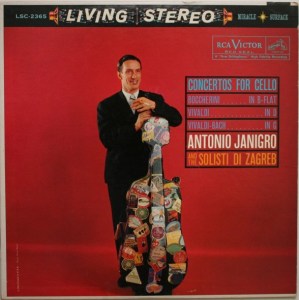

- Glorious Living Stereo sound throughout this early Shaded Dog pressing of these wonderful cello concertos, with both sides earning STUNNING Shootout Winning Triple Plus (A+++) grades or close to them
- Janigro’s cello is immediate, real and lively here – you are in the presence of greatness with this copy
- This record will have you asking why so few Living Stereo pressings actually do what this one does. The more critical listeners among you will recognize that this is a very special copy indeed. Everyone else will just enjoy the hell out of it.
This vintage Shaded Dog pressing has the kind of Tubey Magical Midrange that modern records can barely BEGIN to reproduce. Folks, that sound is gone and it sure isn’t showing signs of coming back. If you love hearing INTO a recording, actually being able to “see” the performers, and feeling as if you are sitting in the studio with the band, this is the record for you. It’s what vintage all analog recordings are known for — this sound.
If you exclusively play modern repressings of vintage recordings, I can say without fear of contradiction that you have never heard this kind of sound on vinyl. Old records have it — not often, and certainly not always — but maybe one out of a hundred new records do, and those are some pretty long odds.
What The Best Sides Of Concertos For Cello Have To Offer Is Not Hard To Hear
- The biggest, most immediate staging in the largest acoustic space
- The most Tubey Magic, without which you have almost nothing. CDs give you clean and clear. Only the best vintage vinyl pressings offer the kind of Tubey Magic that was on the tapes in 1960
- Tight, note-like, rich, full-bodied bass, with the correct amount of weight down low
- Natural tonality in the midrange — with all the instruments having the correct timbre
- Transparency and resolution, critical to hearing into the three-dimensional studio space
No doubt there’s more but we hope that should do for now. Playing the record is the only way to hear all of the qualities we discuss above, and playing the best pressings against a pile of other copies under rigorously controlled conditions is the only way to find a pressing that sounds as good as this one does.
Copies with rich lower mids and nice extension up top did the best in our shootout, assuming they weren’t veiled or smeary of course. So many things can go wrong on a record! We know, we’ve heard them all.
Top end extension is critical to the sound of the best copies. Lots of old records (and new ones) have no real top end; consequently, the studio or stage will be missing much of its natural air and space, and instruments will lack their full complement of harmonic information.
Tube smear is common to most vintage pressings and this is no exception. The copies that tend to do the best in a shootout will have the least (or none), yet are full-bodied, tubey and rich.
What We’re Listening For On Concertos For Cello
- Energy for starters. What could be more important than the life of the music?
- The Big Sound comes next — wall to wall, lots of depth, huge space, three-dimensionality, all that sort of thing.
- Then transient information — fast, clear, sharp attacks, not the smear and thickness so common to these LPs.
- Tight punchy bass — which ties in with good transient information, also the issue of frequency extension further down.
- Next: transparency — the quality that allows you to hear deep into the soundfield, showing you the space and air around all the instruments.
- Extend the top and bottom and voila, you have The Real Thing — an honest to goodness Hot Stamper.
Side One
Boccherini
Concerto For Cello In B-Flat
Side Two
Vivaldi
Concerto For Cello In D
Vivaldi / Bach
Concerto For Cello In G
Antonio Janigro
Antonio Janigro (21 January 1918 – 1 May 1989) was an Italian cellist and conductor.
Born in Milan, he began studying piano when he was six and cello when he was eight. Initially taught by Giovanni Berti, Janigro enrolled in the Verdi Conservatory of Milan, where he was instructed by Gilberto Crepax. By 1934 Janigro was studying under Diran Alexanian and Pablo Casals at the École Normale in Paris. He graduated from the school in 1934 and began performing solo and in recitals with Dinu Lipatti, Paul Badura-Skoda and Alfredo Rossi.
An unfortunately timed vacation in Yugoslavia left Janigro stranded in that country for the duration of World War II. He became a professor of cello and chamber music at the Zagreb Conservatory, where his influence developed modern cello playing in Yugoslavia. He also performed as part of the Maček-Šulek-Janigro Trio. At war’s end Janigro travelled throughout South America and the Far East as a soloist. In 1949, he started his career as a conductor. In 1959, he was Fritz Reiner’s soloist, along with Milton Preves and John Weicher, in a renowned Chicago Symphony Orchestra recording of Strauss’s Don Quixote.
An extraordinarily gifted teacher, Janigro educated many cellists around the world. Most of them studied at the Staatliche Hochschule für Musik und Darstellende Kunst Stuttgart and the Mozarteum Salzburg. Among his students were Julius Berger, Mario Brunello, Thomas Demenga, Michael Flaksman , Michael Groß, Antonio Meneses, Andrej Petrac, Mario de Secondi, Giovanni Sollima, Gustavo Tavares, Enrico Dindo and Christoph Theinert.
Janigro was a highly regarded conductor who led a symphony orchestra for Radio Zagreb and guest-conducted throughout Europe. The chamber orchestra I Solisti di Zagreb was created by Janigro and Dragutin Hrdjok in 1954 and was led by Janigro until he left the ensemble in 1968.
— Wikipedia