

More of the Music of Igor Stravinsky
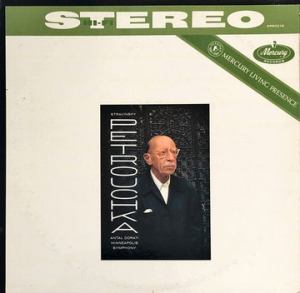

- Excellent sound for this superb recording of Stravinsky’s ballet, with Double Plus (A++) grades on both sides of this vintage pressing (only the second copy to hit the site in nearly three years)
- It’s also remarkably quiet at the high end of Mint Minus Minus, a grade that even our most well-cared-for vintage classical titles have trouble playing at
- This spectacular Demo Disc recording is big, clear, rich, dynamic, transparent and energetic – here is the Mercury sound we love, and that is so hard to find
- “Petrushka brings music, dance, and design together in a unified whole. It is one of the most popular of the Ballets Russes productions.”
- 1960 was a great year for classical recordings – other Must Own orchestral releases can be found here.
This vintage Mercury pressing has the kind of Tubey Magical Midrange that modern records can barely BEGIN to reproduce. Folks, that sound is gone and it sure isn’t showing signs of coming back. If you love hearing INTO a recording, actually being able to “see” the performers, and feeling as if you are sitting in the studio with the band, this is the record for you. It’s what vintage all analog recordings are known for — this sound.
If you exclusively play modern repressings of vintage recordings, I can say without fear of contradiction that you have never heard this kind of sound on vinyl. Old records have it — not often, and certainly not always — but maybe one out of a hundred new records do, and those are some pretty long odds.
What The Best Sides Of Petroushka Have To Offer Is Not Hard To Hear
- The biggest, most immediate staging in the largest acoustic space
- The most Tubey Magic, without which you have almost nothing. CDs give you clean and clear. Only the best vintage vinyl pressings offer the kind of Tubey Magic that was on the tapes in 1960
- Tight, note-like, rich, full-bodied bass, with the correct amount of weight down low
- Natural tonality in the midrange — with all the instruments having the correct timbre
- Transparency and resolution, critical to hearing into the three-dimensional studio space
No doubt there’s more but we hope that should do for now. Playing the record is the only way to hear all of the qualities we discuss above, and playing the best pressings against a pile of other copies under rigorously controlled conditions is the only way to find a pressing that sounds as good as this one does.
Size and Space
One of the qualities that we don’t talk about on the site nearly enough is the SIZE of the record’s presentation. Some copies of the album just sound small — they don’t extend all the way to the outside edges of the speakers, and they don’t seem to take up all the space from the floor to the ceiling. In addition, the sound can often be recessed, with a lack of presence and immediacy in the center.
Other copies — my notes for these copies often read “BIG and BOLD” — create a huge soundfield, with the music positively jumping out of the speakers. They’re not brighter, they’re not more aggressive, they’re not hyped-up in any way, they’re just bigger and clearer.
And most of the time those very special pressings are just plain more involving. When you hear a copy that does all that — a copy like this one — it’s an entirely different listening experience.
What We’re Listening For on This Superb Stravinsky Ballet
- Energy for starters. What could be more important than the life of the music?
- The Big Sound comes next — wall to wall, lots of depth, huge space, three-dimensionality, all that sort of thing.
- Then transient information — fast, clear, sharp attacks, not the smear and thickness so common to these LPs.
- Next: transparency — the quality that allows you to hear deep into the soundfield, showing you the space and air around all the instruments.
- Extend the top and bottom and voila, you have The Real Thing — an honest to goodness Hot Stamper.
A Must Own Record
Petroushka is a masterpiece that belongs in any serious Classical Collection. Others that belong in that category can be found here.
It also ranks fairly high on our difficulty of reproduction scale. Do not attempt to play it using any but the best equipment.
Side One
Petrushka: Burlesque Scenes In Four Tableaux
Scene I: The Shrove-Tide Fair – Russian Dance
Scene II: In Petrushka’s Room
Scene III: In The Moor’s Room
Side Two
Scene III: (Concluded) Dance Of The Ballerina And The Moor
Scene IV: The Shrove-Tide Fair – Wet-Nurses’ Dance – Peasant With Bear – Dance Of The Gypsies And Rake Vendor
Coachmen’s Dance – The Maskers. The Scuffle Between The Moor And The Petrouchka. The Death Of Petrouchka.
Petrushka
Petrushka is a ballet and orchestral concert work by Russian composer Igor Stravinsky. It was written for the 1911 Paris season of Sergei Diaghilev’s Ballets Russes company; the original choreography was by Michel Fokine and stage designs and costumes by Alexandre Benois, who assisted Stravinsky with the libretto. The ballet premiered at the Théâtre du Châtelet on 13 June 1911 with Vaslav Nijinsky as Petrushka, Tamara Karsavina as the lead ballerina, Alexander Orlov as the Moor, and Enrico Cecchetti the charlatan.
Petrushka tells the story of the loves and jealousies of three puppets. The three are brought to life by the Charlatan during the 1830 Shrovetide Fair (Maslenitsa) in Saint Petersburg, Russia. Petrushka loves the Ballerina, but she rejects him. She prefers the Moor. Petrushka is angry and hurt, and challenges the Moor. The Moor kills him with his scimitar. Petrushka’s ghost rises above the puppet theatre as night falls. He shakes his fist at the Charlatan, then collapses in a second death.
Petrushka brings music, dance, and design together in a unified whole. It is one of the most popular of the Ballets Russes productions. It is usually performed today using the original designs and choreography. Grace Robert wrote in 1946, “Although more than thirty years have elapsed since Petrushka was first performed, its position as one of the greatest ballets remains unassailed. Its perfect fusion of music, choreography, and décor and its theme—the timeless tragedy of the human spirit—unite to make its appeal universal”.
