

More Nat “King” Cole
More Pop and Jazz Vocals
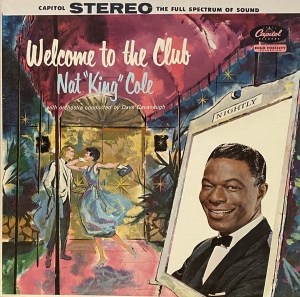

- Nat King Cole’s wonderful 1959 release finally makes its Hot Stamper debut with outstanding Double Plus (A++) grades on both sides
- The sound on this superb pressing is full-bodied and lively, with solid and present vocals, as well as excellent clarity all around
- With Cole’s smooth vocals, superb arrangements by Dave Cavanaugh, and accompaniment by the legendary Count Basie Orchestra, this album is a sheer delight
- 4 stars: “… one of Cole’s most powerful collections supported by a big band. In fact, it is Cole’s unmistakable ultra-cool intonations that flawlessly reign in the fiery… ensemble arrangements.”
This vintage Rainbow Label Capitol stereo pressing has the kind of Tubey Magical Midrange that modern records rarely begin to reproduce. Folks, that sound is gone and it sure isn’t showing any sign of coming back.
Having done this for so long, we understand and appreciate that rich, full, solid, Tubey Magical sound is key to the presentation of this primarily vocal music. We rate these qualities higher than others we might be listening for (e.g., bass definition, soundstage, depth, etc.).
Hot Stamper sound is rarely about the details of a given recording. In the case of this album, more than anything else a Hot Stamper must succeed at recreating a solid, palpable, real Nat King Cole singing live in your listening room. The better copies have an uncanny way of doing just that.
If you exclusively play modern repressings of vintage recordings, I can say without fear of contradiction that you have never heard this kind of sound on vinyl. Old records have it — not often, and certainly not always — but less than one out of 100 new records do, if our experience with the hundreds we’ve played over the years can serve as a guide.
What the best sides of Welcome To The Club have to offer is not hard to hear:
- The biggest, most immediate staging in the largest acoustic space
- The most Tubey Magic, without which you have almost nothing. CDs give you clean and clear. Only the best vintage vinyl pressings offer the kind of Tubey Magic that was on the tapes in 1959
- Tight, note-like, rich, full-bodied bass, with the correct amount of weight down low
- Natural tonality in the midrange — with all the instruments having the correct timbre
- Transparency and resolution, critical to hearing into the three-dimensional space of the studio
No doubt there’s more but we hope that should do for now. Playing the record is the only way to hear all of the qualities we discuss above, and playing the best pressings against a pile of other copies under rigorously controlled conditions is the only way to find a pressing that sounds as good as this one does.
Copies with rich lower mids and nice extension up top did the best in our shootout, assuming they weren’t veiled or smeary of course. So many things can go wrong on a record! We know, we’ve heard them all.
Top end extension is critical to the sound of the best copies. Lots of old records (and new ones) have no real top end; consequently, the studio or stage will be missing much of its natural air and space, and instruments will lack their full complement of harmonic information.
Tube smear is common to most vintage pressings and this is no exception. The copies that tend to do the best in a shootout will have the least (or none), yet are full-bodied, tubey and rich.
What We’re Listening For on Welcome To The Club
- Energy for starters. What could be more important than the life of the music?
- The Big Sound comes next — wall to wall, lots of depth, huge space, three-dimensionality, all that sort of thing.
- Then transient information — fast, clear, sharp attacks, not the smear and thickness common to most LPs.
- Tight, note-like bass with clear fingering — which ties in with good transient information, as well as the issue of frequency extension further down.
- Next: transparency — the quality that allows you to hear deep into the soundfield, showing you the space and air around all the players.
- Then: presence and immediacy. The vocals aren’t “back there” somewhere, way behind the speakers. They’re front and center where any recording engineer worth his salt would have put them.
- Extend the top and bottom and voila, you have The Real Thing — an honest to goodness Hot Stamper.
TRACK LISTING
Side One
Welcome To The Club
Anytime, Anyday, Anywhere
The Blues Don’t Care
Mood Indigo
Baby Won’t You Please Come Home
The Late Late Show
Side Two
Avalon
She’s Funny That Way
I Want A Little Girl
Wee Baby Blues
Look Out For Love
AMG 4 Star Review
As the 1950s came to a close, Nat King Cole (vocals/piano) continued creating stylish renditions of pop and jazz flavored standards. On Welcome to the Club (1959) the artist teams up with Dave Cavanaugh and the Count Basie combo — minus the maestro himself due to contractual restraints — for one of Cole’s most powerful collections supported by a big band. In fact, it is Cole’s unmistakable ultra-cool intonations that flawlessly reign in the fiery — and at times overbearing — ensemble arrangements.
Right from the start, the vocalist proves that he can swing on the refined and syncopated opening title track “Welcome to the Club.” Cole effortlessly bops with a beat so catchy that toe-tappin’ and finger-snappin’ feel practically obligatory. The bluesy “Anytime, Anyday, Anywhere” adopts a slightly melancholy torch feel that Cole ably milks with his unblemished and supple delivery.
The same holds true for the definitive take of Duke Ellington’s “Mood Indigo.” The number is swaddled with a suitably subdued score that Cole dutifully conveys to tremendous effect, making it one of the unmitigated zeniths of his association with Cavanaugh.
While on the subject, “Wee Baby Blues” follows a bit later revealing another spot-on example of his expressive technique. The tempo picks back up on the rousing, well-heeled “Late, Late Show” that again re-establishes Nat King Cole as one of the premiere voices of mid-20th century jazz. His ability to reel off lyrics as if they were conversational is nowhere as evident as it is here. The pace picks up steam with the full-speed-ahead frenzy of “Avalon” and again, Cole exudes nothing but soul throughout this compact, yet unhurried rendition.