

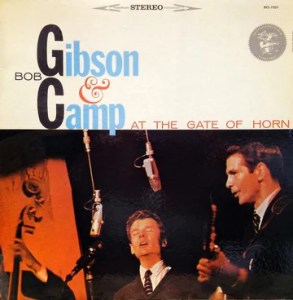

- This wonderful 1961 folk gem makes its Hot Stamper debut with Shootout Winning Triple Plus (A+++) sound or close to it from start to finish
- Tubey Magical, rich, smooth, sweet – everything that we listen for in a great record is on display for everyone to hear (everyone with audiophile equipment that is)
- If you want to know just how good Elektra’s All Tube recording system was in 1961, this amazing sounding disc will show you like no other
- 4 stars: “Recorded in 1961 at Chicago’s legendary folk club, the Gate of Horn, Gibson and Camp’s live set was really one of the opening volleys in the coming folk revival, and while neither of these guys got much of the credit, they should have.”
This vintage Electra pressing has the kind of Tubey Magical Midrange that modern records can barely BEGIN to reproduce. Folks, that sound is gone and it sure isn’t showing signs of coming back. If you love hearing INTO a recording, actually being able to “see” the performers, and feeling as if you are sitting in the studio with the band, this is the record for you. It’s what vintage all analog recordings are known for — this sound.
If you exclusively play modern repressings of vintage recordings, I can say without fear of contradiction that you have never heard this kind of sound on vinyl. Old records have it — not often, and certainly not always — but maybe one out of a hundred new records do, and those are some pretty long odds.
What Amazing Sides Such as These Have to Offer Is Not Hard to Hear
- The biggest, most immediate staging in the largest acoustic space
- The most Tubey Magic, without which you have almost nothing. CDs give you clean and clear. Only the best vintage vinyl pressings offer the kind of Tubey Magic that was on the tapes in 1961
- Tight, note-like, rich, full-bodied bass, with the correct amount of weight down low
- Natural tonality in the midrange — with all the instruments having the correct timbre
- Transparency and resolution, critical to hearing into the three-dimensional studio space
No doubt there’s more but we hope that should do for now. Playing the record is the only way to hear all of the qualities we discuss above, and playing the best pressings against a pile of other copies under rigorously controlled conditions is the only way to find a pressing that sounds as good as this one does.
What We’re Listening For on At The Gate of Horn
- Energy for starters. What could be more important than the life of the music?
- Then: presence and immediacy. The vocals aren’t “back there” somewhere, lost in the mix. They’re front and center where any recording engineer worth his salt would put them.
- The Big Sound comes next — wall to wall, lots of depth, huge space, three-dimensionality, all that sort of thing.
- Then transient information — fast, clear, sharp attacks, not the smear and thickness so common to these LPs.
- Tight punchy bass — which ties in with good transient information, also the issue of frequency extension further down.
- Next: transparency — the quality that allows you to hear deep into the soundfield, showing you the space and air around all the instruments.
- Extend the top and bottom and voila, you have The Real Thing — an honest to goodness Hot Stamper.
Side One
Skillet Good And Greasy
Old Blue
St. Claire’s Defeat
I’m Gonna Tell God
Two In The Middle
Civil War Trilogy
Side Two
Daddy Roll ‘Em
The Thinking Man
Wayfaring Stranger
Chicago Cops
Betty And Dupree
AMG Review
Bob Gibson & Bob Camp at the Gate of Horn isn’t an important album because of the music it contains (which will sound to most listeners like just another couple of white college guys singing old folk songs), but because of the possibilities it suggested to future artists like Bob Dylan, Phil Ochs, and Roger McGuinn.
Recorded in 1961 at Chicago’s legendary folk club, the Gate of Horn, Gibson and Camp’s live set was really one of the opening volleys in the coming folk revival, and while neither of these guys got much of the credit, they should have. Gibson, in particular, was instrumental in introducing the idea that traditional songs had a lively and prosperous pop potential when presented in semi-sanitized versions to upscale audiences, and when he backed it up with a solid and skillful acoustic 12-string guitar style, a template was born, one that was adapted in some degree by the Kingston Trio, Peter, Paul & Mary and even Simon & Garfunkel and the Smothers Brothers in the coming years.
Nothing here is startling in retrospect, but at the time these smooth and energetic re-workings of old traditional tunes was damn near radical. Listeners who value albums for their historical importance and consequent influence may want to check this one out. Watch out, though, because the goofy energy on display here will grow on you if you play it three times in a row.