

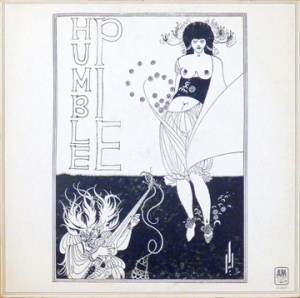

- Incredible sound for this classic Humble Pie album from 1970 with both sides earning Shootout Winning Triple Plus (A+++) grades
- A classic Glyn Johns British Blues Rock recording from 1970 – man, he was really on a roll back then
- “Alternating hard-driving blues-rockers with country-folk numbers, Humble Pie neatly showcases the two sides of this band’s personality on their first release for a major American label and third album overall.”
This, their third album and first for A&M (which probably explains the master tape sound on domestic vinyl), is one of the few Humble Pie titles we’ve found that can offer honest-to-goodness Hot Stamper sound. Performance – Rockin’ The Fillmore is one of the best sounding live rock albums we have played, and Rock On can also be quite good, but after that it’s slim pickins for audiophiles.
The great sound is no mystery in this case; it comes courtesy of none other than Glyn Johns. He knows Heavy British Rock like nobody else on the planet, or did at the time anyway. If you want fat, meaty drums and grungy guitars — think Who’s Next, Sticky Fingers or A Nod Is As Good As A Wink — Glyn is your man.
Listen to how big and how far forward the drums are in the mix on the first track. That is a sound one rarely hears on a studio recording, and that’s a shame because the drum sound on this record is awesome.
What the Best Sides of Humble Pie Have to Offer Is Not Hard to Hear
- The biggest, most immediate staging in the largest acoustic space
- The most Tubey Magic, without which you have almost nothing. CDs give you clean and clear. Only the best vintage vinyl pressings offer the kind of Tubey Magic that was on the tapes in 1970
- Tight, note-like, rich, full-bodied bass, with the correct amount of weight down low
- Natural tonality in the midrange — with all the instruments having the correct timbre
- Transparency and resolution, critical to hearing into the three-dimensional studio space
No doubt there’s more but we hope that should do for now. Playing the record is the only way to hear all of the qualities we discuss above, and playing the best pressings against a pile of other copies under rigorously controlled conditions is the only way to find a pressing that sounds as good as this one does.
What We’re Listening For on Humble Pie
- Energy for starters. What could be more important than the life of the music?
- Then: presence and immediacy. The vocals aren’t “back there” somewhere, lost in the mix. They’re front and center where any recording engineer worth his salt would put them.
- The Big Sound comes next — wall to wall, lots of depth, huge space, three-dimensionality, all that sort of thing.
- Then transient information — fast, clear, sharp attacks, not the smear and thickness so common to these LPs.
- Tight punchy bass — which ties in with good transient information, also the issue of frequency extension further down.
- Next: transparency — the quality that allows you to hear deep into the soundfield, showing you the space and air around all the instruments.
- Extend the top and bottom and voila, you have The Real Thing — an honest to goodness Hot Stamper.
Vinyl Condition
Mint Minus Minus is about as quiet as any vintage pressing will play, and since only the right vintage pressings have any hope of sounding good on this album, that will most often be the playing condition of the copies we sell. (The copies that are even a bit noisier get listed on the site are seriously reduced prices or traded back in to the local record stores we shop at.)
Those of you looking for quiet vinyl will have to settle for the sound of other pressings and Heavy Vinyl reissues, purchased elsewhere of course as we have no interest in selling records that don’t have the vintage analog magic of these wonderful recordings.
If you want to make the trade-off between bad sound and quiet surfaces with whatever Heavy Vinyl pressing might be available, well, that’s certainly your prerogative, but we can’t imagine losing what’s good about this music — the size, the energy, the presence, the clarity, the weight — just to hear it with less background noise.
TRACK LISTING
Side One
Live With Me
Only a Roach
One-Eyed Trouser-Snake Rumba
Earth and Water Song
Side Two
I’m Ready
Theme from Skint (See You Later…)
Red Light Mama, Red Hot!
Sucking on the Sweet Vine
AMG Review
Alternating hard-driving blues-rockers with country-folk numbers, Humble Pie neatly showcases the two sides of this band’s personality on their first release for a major American label and third album overall.
Wikipedia Background
Humble Pie was a transitional album and a harbinger of the band’s new, heavier direction. The material was darker than their previous two efforts, with striking contrasts in volume and style — Peter Frampton’s gentle “Earth and Water Song” is buttressed between two of the heaviest tracks on the record, the band composed “One Eyed Trouser Snake Rumba,” and a cover of Willie Dixon’s “I’m Ready”.
Drummer Jerry Shirley contributed a rare lead vocal on his song “Only a Roach,” a country-twinged ode to cannabis that also appeared as the B-side of the summer 1970 single “Big Black Dog”. This was their first release under the auspices of new American manager Dee Anthony — who’d pushed for a louder, tighter sound both live and in the studio — and for their new label, A&M Records. At the end of 1969, the Pie’s old label, Immediate, owned by Andrew Loog Oldham, went bankrupt — a saga chronicled by Marriott on the satirical ballad “Theme from Skint (See You Later Liquidator)”.
Artist Biography by Jason Ankeny
A showcase for former Small Faces’ frontman Steve Marriott and one-time Herd guitar virtuoso Peter Frampton, the hard rock outfit Humble Pie formed in Essex, England in 1969.
Signed to the Immediate label, Humble Pie soon issued their debut single “Natural Born Boogie,” which hit the British Top Ten and paved the way for the group’s premiere LP, As Safe as Yesterday Is.
After touring the U.S. in support of 1969’s Town and Country, Humble Pie returned home only to discover that Immediate had declared bankruptcy. The band recruited a new manager, Dee Anthony, who helped land them a new deal with A&M; behind closed doors, Anthony encouraged Marriott to direct the group towards a harder-edged, grittier sound far removed from the acoustic melodies favored by Frampton.
As Marriott’s raw blues shouting began to dominate subsequent LPs like 1970’s eponymous effort and 1971’s Rock On, Frampton’s role in the band he co-founded gradually diminished; finally, after a highly charged U.S. tour which yielded 1971’s commercial breakthrough Performance: Rockin’ the Fillmore, Frampton exited Humble Pie to embark on a solo career.