



A GUIDE FOR THE DEDICATED ANALOG AUDIOPHILE
We know of none better, outside of our own humble attempt to enlighten that portion of the audiophile community who love hearing music reproduced with higher fidelity and are willing to go the extra mile to make that happen.
Here is Robert’s latest posting.
An excerpt:
Every so often I make a point of visiting the WAM Engineering website to check out J.R. Boisclair’s latest videos. J.R. is producing the most informative and useful content on turntable / tonearm setup I’ve run across, and as near as I can tell he’s at the cutting edge of advancements in analog transcription.
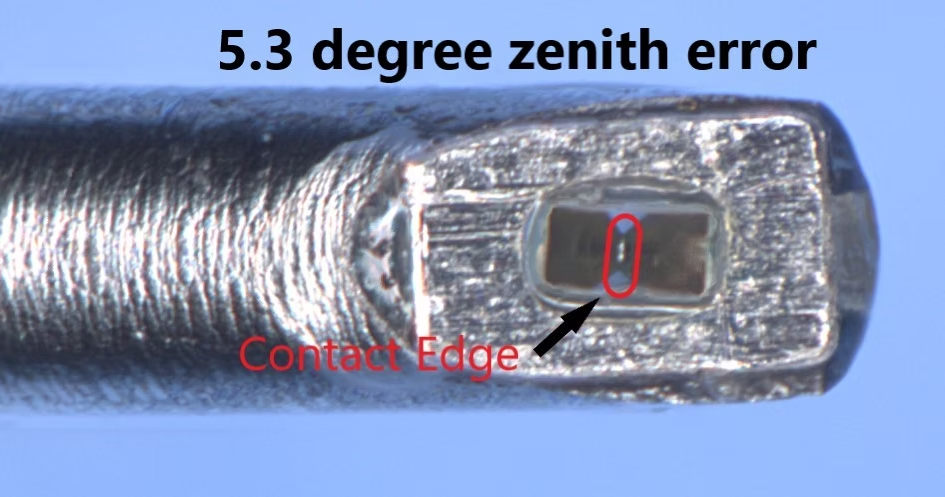
On my last visit to their website, I was reminded of a tonearm setup parameter that J.R. discusses at length but that myself and many other audiophiles are either unfamiliar with or know very little about – zenith error. Zenith error, also known as stylus yaw, refers to a manufacturing flaw that many cartridges suffer from where the stylus is not aligned precisely with the cantilever.
WAM Engineering offers a service using microscopy to analyze cartridges, and this has afforded them the opportunity to take a very close look at a fairly high number of a wide variety of cartridges. What they’ve learned doing this is that the majority of those fitted with fine-line contact styli, which are directional, have stylus yaw.
This flaw is not directly the fault of the cartridge manufacturers themselves. The cantilever assemblies that companies like Dynavector and Audio-Technica use to build their cartridges are made by other companies that specialize in making those assemblies. Dynavector, for instance, uses cantilever assemblies made by a company called Ogura. Audio-Technica buy theirs from Orbray, formerly Namiki.
From the standpoint of these manufacturers, this zenith error is not actually considered a flaw as it generally falls within their own manufacturing tolerances of 5 degrees. J.R. confirms in his video on zenith error that the average among the cartridges he’s analyzed is just 2.5 percent, well within that tolerance. But he also mentions that this error can in some cases reach above 17%.
After analysis, J.R. returns customer’s cartridges with shims that correct for VTA, SRA and azimuth, but he also provides us with the direction and the number of degrees by which our stylus is rotated off the axis of the cantilever. This way, with the help of a tool that WAM Engineering also sells called the WallyZenith, we can adjust for stylus yaw as part of our installation process.
We are in the process of testing this aspect of cartridge alignment and should be able to report our findings soon.
Until then we would encourage you to try adjusting the angle of the cartridge’s body in the headshell to see if any improvement is possible. My intuition is that it will be.
Nothing will bring you as much joy as when you manage — by whatever means, seemingly against all odds — to make significant audio progress.
The more progress you make, the more you will enjoy the music you play.
Robert’s Approach
Robert has methodically and carefully — one might even say scientifically — approached the various problems he’s encountered in this hobby by doing the following:
- Improving his equipment,
- Teaching himself how to do a better job of dialing in his turntable setup.
- Learning how to do controlled shootouts for his favorite albums, and, most importantly of all:
- Carefully testing every aspect of audio and records empirically, using his ears — and nothing else — to guide him.
- In addition, Robert often has an interesting take on some aspect of records or audio. We have found well worth reading and can recommend them highly to fans of this blog.
More on Robert’s system here. You may notice that it has a lot in common with the one we use. This is not an accident.
And it is also no accident that these two systems just happen to be very good at showing their owners the manifold shortcomings of the modern remastered LP, as well as the benefits to be gained by doing shootouts in order to find dramatically better sounding pressings to play.
Further Reading
- “Doing” audio is the only way to achieve better sound
- These records helped us dramatically improve our playback
- Even shootouts won’t teach you what you can learn from experimenting with your table and arm