

More Classical and Orchestral Recordings

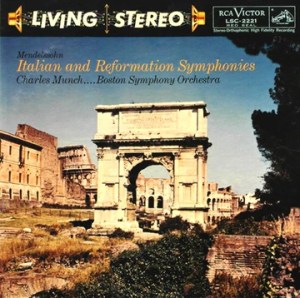
- Munch and the Boston Symphony Orchestra’s dynamic and lively performance, here with a KILLER Shootout Winning Triple Plus (A+++) side one mated to a solid Double Plus (A++) side two of this vintage Living Stereo reissue pressing
- It took us about a decade to finally realize that the Shaded Dog pressings, no matter what stampers they had, would simply never sound the way we wanted them to, and that the only way forward was to track down the right reissues, which I am happy to report we have now succeeded in doing
- These sides are doing practically everything right – they’re rich, clear, undistorted, open, spacious, and have depth and transparency to rival the best recordings you may have heard
- An abundance of energy, loads of rich detail and texture, and excellent clarity – the very definition of Demo Disc sound
- There are some bad marks (as is sometimes the nature of the beast with these vintage LPs) on the third movement of Symphony No. 4 (“Italian”), but once you hear just how incredible sounding this copy is, you might be inclined, as we were, to stop counting ticks and just be swept away by the music
This vintage pressing has the kind of Tubey Magical Midrange that modern records can barely BEGIN to reproduce. Folks, that sound is gone and it sure isn’t showing signs of coming back. If you love hearing INTO a recording, actually being able to “see” the performers, and feeling as if you are sitting in the studio with the band, this is the record for you. It’s what vintage all analog recordings are known for — this sound.
If you exclusively play modern repressings of vintage recordings, I can say without fear of contradiction that you have never heard this kind of sound on vinyl. Old records have it — not often, and certainly not always — but maybe one out of a hundred new records do, and those are some pretty long odds.
What The Best Sides Of Mendelssohn’s Symphonies No. 4 (“Italian”) and 5 (“Reformation”) Have To Offer Is Not Hard To Hear
- The biggest, most immediate staging in the largest acoustic space
- The most Tubey Magic, without which you have almost nothing. CDs give you clean and clear. Only the best vintage vinyl pressings offer the kind of Tubey Magic that was on the tapes in 1958
- Tight, note-like, rich, full-bodied bass, with the correct amount of weight down low
- Natural tonality in the midrange — with all the instruments having the correct timbre
- Transparency and resolution, critical to hearing into the three-dimensional studio space
No doubt there’s more but we hope that should do for now. Playing the record is the only way to hear all of the qualities we discuss above, and playing the best pressings against a pile of other copies under rigorously controlled conditions is the only way to find a pressing that sounds as good as this one does.
Copies with rich lower mids and nice extension up top did the best in our shootout, assuming they weren’t veiled or smeary of course. So many things can go wrong on a record. We know, we’ve heard them all.
Top end extension is critical to the sound of the best copies. Lots of old records (and new ones) have no real top end; consequently, the studio or stage will be missing much of its natural air and space, and instruments will lack their full complement of harmonic information.
Tube smear is common to most vintage pressings. The copies that tend to do the best in a shootout will have the least (or none), yet are full-bodied, tubey and rich.
Learning the Record
For our shootout, we had at our disposal a variety of pressings that had the potential for Hot Stamper sound. We cleaned them carefully, then unplugged everything in the house we could, warmed up the system, Talisman’d it, found the right VTA for our Triplanar arm (by ear of course) and proceeded to spend the next hour or so playing copy after copy on side one, after which we repeated the process for side two.
If you have five or more copies of a record and play them over and over against each other, the process itself teaches you what’s right and what’s wrong with the sound of the album. Once your ears are completely tuned to what the best pressings do well that the other pressings do not do as well, using a few carefully chosen passages of music, it quickly becomes obvious how well a given copy can reproduce those passages. You’ll hear what’s better and worse — right and wrong would be another way of putting it — about the sound.
This approach is simplicity itself. First, you go deep into the sound. There you find a critically important passage in the music, one which most copies struggle — or fail — to reproduce as well as the best. Now, with the hard-won knowledge of precisely what to listen for, you are perfectly positioned to critique any and all pressings that come your way.
It may be a lot of work but it sure ain’t rocket science, and we’ve never pretended otherwise. Just the opposite: from day one we’ve explained step by step precisely how to go about finding the Hot Stampers in your own collection. Not the good sounding pressings you happen to own — those may or may not have Hot Stampers — but the records you actually cleaned, shot out, and declared victorious.
What We’re Listening For On Symphonies No. 4 (“Italian”) and 5 (“Reformation”)
- Energy for starters. What could be more important than the life of the music?
- The Big Sound comes next — wall to wall, lots of depth, huge space, three-dimensionality, all that sort of thing.
- Then transient information — fast, clear, sharp attacks, not the smear and thickness so common to these LPs.
- Powerful bass — which ties in with good transient information, also the issue of frequency extension further down.
- Next: transparency — the quality that allows you to hear deep into the soundfield, showing you the space and air around all the instruments.
- Extend the top and bottom and voila, you have The Real Thing — an honest to goodness Hot Stamper.
Side One
Symphony No. 4 (“Italian”)
1° Mouvement: Allegro Vivace
2° Mouvement: Andante Con Moto
3° Mouvement: Con Moto Moderato
4° Mouvement: Saltarello – Presto
Side Two
Symphony No. 5 (“Reformation”)
1° Mouvement: Andante; Allegro Con Fuoco
2° Mouvement: Allegro Vivace
3° Mouvement: Andante – Andante con Moto
Choral: “Ein’ Feste Burg Ist Unser Gott”; Allegro Vivace
Symphony No. 4
The Symphony No. 4 in A major, Op. Posth. 90, MWV N 16, commonly known as the Italian, is an orchestral symphony written by German composer Felix Mendelssohn.
The work has its origins, as had the composer’s Scottish 3rd Symphony and The Hebrides overture, in the tour of Europe which occupied Mendelssohn from 1829 to 1831. Its inspiration is the colour and atmosphere of Italy, where Mendelssohn made sketches but left the work incomplete.
Mendelssohn completed the symphony in Berlin on 13 March 1833, in response to an invitation for a symphony from the London (now Royal) Philharmonic Society.
The joyful first movement, in sonata form, is followed by an impression in the subdominant minor of D minor of a religious procession the composer witnessed in Naples. The third movement is a minuet in which French horns are introduced in the trio, while the final movement (which is in the parallel minor key throughout) incorporates dance figurations from the Roman saltarello and the Neapolitan tarantella. It is among the first large multi-movement works to begin in a major key and end in the tonic minor, another example being Brahms’s first piano trio. Being an early romantic work, the symphony features greater use of individual melodies for woodwinds and a broad dynamic range.
Due to the beginning of the piece requiring specific articulation and dynamics while necessitating staying in tempo, many orchestral auditions, particularly for violinists, use an excerpt from the beginning of the 1st movement.
Symphony No. 5
The Symphony No. 5 in D major/minor, Op. 107, known as the Reformation, was composed by Felix Mendelssohn in 1830 in honor of the 300th anniversary of the Presentation of the Augsburg Confession. The Confession is a key document of Lutheranism and its Presentation to Emperor Charles V in June 1530 was a momentous event of the Protestant Reformation. This symphony was written for a full orchestra and was Mendelssohn’s second extended symphony. It was not published until 1868, 21 years after the composer’s death – hence its numbering as ‘5’. Although the symphony is not very frequently performed, it is better known today than when it was originally published. Mendelssohn’s sister, Fanny Hensel, chose the name Reformation Symphony.
The key of the symphony is stated as D major on the title page of Mendelssohn’s autograph score. However, only the slow introduction is written in D major, whereas the main theme and the cadence setting of the first movement are in D minor. The composer himself referred to the symphony on at least one occasion as in D minor. Nobody nowadays can agree whether it can be identified to be in either major or minor, if not both.
-Wikipedia