

More of the Music of Charles Mingus
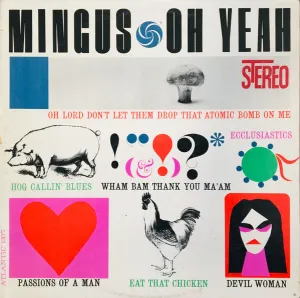

- Boasting two solid Double Plus (A++) sides, this vintage Stereo Atlantic Blue and Green Label pressing of Mingus’s brilliant Oh Yeah was doing just about everything right
- Tubey Magical, lively and clear, with three-dimensionality that will fill your listening room from wall to wall
- Phil Iehle and Tom Dowd made up the engineering team for these sessions, which explains why the better copies of the album sound so damn good
- A raucous (and rockin’) deviation from traditional jazz, this compilation incorporates R&B and soul influences – Mingus even lends his rich vocal stylings to a few songs
- Forget the later label pressings – we stopped buying them years ago
- 5 stars: “Oh Yeah is probably the most offbeat Mingus album ever, and that’s what makes it so vital.”
- It’s hard to imagine that any list of the Best Jazz Albums of 1962 would not have this record on it
This Atlantic Stereo pressing has the kind of Tubey Magical Midrange that modern records rarely even BEGIN to reproduce. Folks, that sound is gone and it sure isn’t showing signs of coming back. If you love hearing INTO a recording, actually being able to “see” the performers, and feeling as if you are sitting in the studio with the Mingus, this is the record for you. It’s what vintage all analog recordings are known for — this sound.
If you exclusively play modern repressings of vintage recordings, I can say without fear of contradiction that you have never heard this kind of sound on vinyl. Old records have it — not often, and certainly not always — but maybe one out of a hundred new records do, and those are some pretty long odds.
What The Best Sides Of Oh Yeah Have To Offer Is Not Hard To Hear
- The biggest, most immediate staging in the largest acoustic space
- The most Tubey Magic, without which you have almost nothing. CDs give you clean and clear. Only the best vintage vinyl pressings offer the kind of Tubey Magic that was on the tapes in 1962
- Tight, note-like, rich, full-bodied bass, with the correct amount of weight down low
- Natural tonality in the midrange — with all the instruments having the correct timbre
- Transparency and resolution, critical to hearing into the three-dimensional space of the studio
No doubt there’s more but we hope that should do for now. Playing the record is the only way to hear all of the qualities we discuss above, and playing the best pressings against a pile of other copies under rigorously controlled conditions is the only way to find a pressing that sounds as good as this one does.
What We’re Listening For On Oh Yeah
- Energy for starters. What could be more important than the life of the music?
- The Big Sound comes next — wall to wall, lots of depth, huge space, three-dimensionality, all that sort of thing.
- Then transient information — fast, clear, sharp attacks for the piano, horns and drums, not the smear and thickness common to most LPs.
- Tight, note-like bass with clear fingering — which ties in with good transient information, as well as the issue of frequency extension further down.
- Next: transparency — the quality that allows you to hear deep into the soundfield, showing you the space and air around all the players.
- Then: presence and immediacy. The musicians aren’t “back there” somewhere, way behind the speakers. They’re front and center where any recording engineer worth his salt — Phil Iehle and Tom Dowd in the case — would have put them.
- Extend the top and bottom and voila, you have The Real Thing — an honest to goodness Hot Stamper.
Engineering Excellence
The engineering duties were handled by Tom Dowd (whose work you surely know well) and Phil Iehle, who happens to be the man who recorded some of Coltrane’s most iconic albums for Atlantic: Giant Steps (1960) and Coltrane Jazz (1961).
Phil Iehle also helped engineer Buffalo Springfield’s Last Time Around, as well as albums by Mose Allison, Jerry Jeff Walker, Charles Mingus, the MJQ, Herbie Mann, Eddie Harris, Hank Crawford and dozens of others. Staff engineer at Atlantic? That’s my guess. But a supremely talented one nonetheless.
The Players
- Charles Mingus – piano and vocals
- Rahsaan Roland Kirk – flute, siren, tenor saxophone, manzello, and strich
- Booker Ervin – tenor saxophone
- Jimmy Knepper – trombone
- Doug Watkins – bass
- Dannie Richmond – drums
Side One
Hog Callin’ Blues
Devil Woman
Wham Bam Thank You Ma’am
Side Two
Ecclusiastics
Oh Lord Don’t Let Them Drop That Atomic Bomb On Me
Eat That Chicken
Passions Of A Man
AMG Review
After several sessions with Columbia and Candid, Charles Mingus briefly returned to Atlantic and cut the freewheeling Oh Yeah, which has to rank as the wildest of all his classic albums. Mingus plays no bass whatsoever, hiring Doug Watkins to fill in while he accompanies the group on piano and contributes bluesy vocals to several tracks (while shouting encouragement on nearly all of them).
Mingus had always had a bizarre sense of humor, as expressed in some of his song titles and arranging devices, but Oh Yeah often gets downright warped. That’s partly because Mingus is freed up to vocalize more often, but it’s also due to the presence of mad genius Roland Kirk. His chemistry with Mingus is fantastically explosive, which makes sense — both were encyclopedias of jazz tradition, but given over to oddball modernist experimentation.
…Oh Yeah is probably the most offbeat Mingus album ever, and that’s what makes it so vital. [Some reissues add three bonus tracks from the session, first released on Tonight at Noon.]