


Here is our description for the Super Hot (2+) copy that is currently on the site:
One of the most important records in my growth as an audiophile from 1971 to the present – my stereo was forced to evolve in order to play this kind of big production rock at the loud levels that the album needs in order to work its magic.
No matter how many times you play it, you will most likely hear – or at least gain more of an appreciation for – something new in the exceptionally dense, sophisticated soundfield Chris Kimsey creates for these songs.
And each time you make an improvement in the quality of your playback, this is the album that will show you exactly what you have just accomplished.
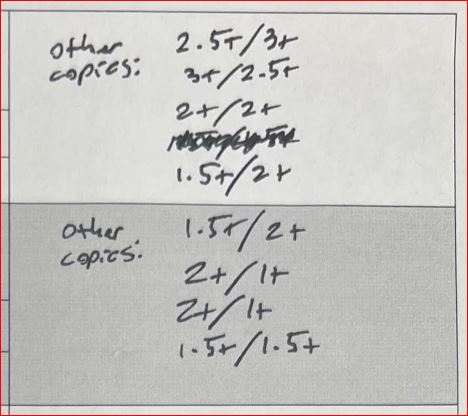

On the left is a portion of the breakdown, minus the actual stamper numbers that earned the highest grades (for obvious reasons.)
We had six UK pressings, all with the same stampers — the five you see graded and the one hidden to the left that actually won the shootout. (Three sides earned White Hot Stamper grades, an unusual outcome and a good one for the bottom line.)
Note that with the “right stampers” you could have ended up with an incredible Demo Disc (copy #1) or just a very good sounding copy on side two mated to a passable side one (copy #6).
Finding six clean UK pressings is, as you can well imagine, neither cheap nor easy. We probably bought close to twice that many to end up with six that we’re in something close to audiophile playing condition.
As you can see from the grades, two of them were clearly inferior to the other four. In the case of this title, a small sample size could have been very misleading. Fortunately for us, we spent the money and the time it takes to track down a good-sized batch of UK pressings in order to avoid that possibility.
Next come the better domestic pressings. There was a 2+/2+ that outscored all the other domestic pressings, and four others that came in behind it, all with the same stampers.
Of the five copies that had those stampers, two had side two’s that scored sub-Hot Stamper grades, which marked them as unsaleable. (Perhaps we will offer them as one-sided records since their side one’s are so good.)
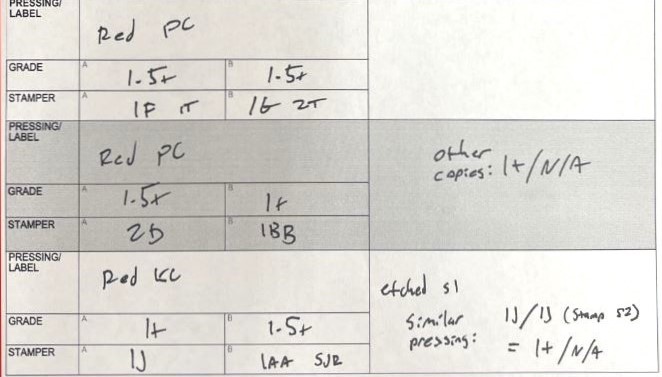

KC VS PC
We rarely have good luck with PC reissue copies when the originals come with the KC prefix, rarely meaning we find a PC winner maybe once out of every ten titles we play.
The stamper sheet above illustrates that there were two KC pressings that lost out to the best PC pressing.
Two more of the PC pressings were not very good.
This was a big shootout — 17 copies! Probably took three or four hours of very intense listening at loud levels, maybe with a lunch break before the best handful of pressings were pitted against each other in the final round.
What Did We Learn?
Based on what I could find on old stamper sheets, we hadn’t done this shootout since 2017, a lifetime in the world of Hot Stampers. In 2017 a number of KC pressings did well, with one earning a 3+ grade on side two, beating our best British pressing. Our playback quality has apparently come a long way since then as that would just not be in the cards these days.
- Stick with the Brits
The best domestics can do fine, but when two out of five are unsaleable due to a weak side two, and none of them are cheap to buy, they are clearly more trouble than they are worth.
- Don’t waste your time with the PC pressings. Your odds of finding a good one are just too slim.
This is also the case with the best sounding Red Label pressings of Kind of Blue. There are really good stampers for the 70s pressings, but they are so hard to find that we have all but given up looking for them.
When it comes to stampers, labels, mastering credits, country of origin and the like, we make a point of revealing little of such information on the site, for a number of reasons we discussed in a commentary we wrote many years ago, at the dawn of the Hot Stamper revolution. (Ahem.)
However, in 2024 we decided to reverse our previous policy. We now make available to our readers a great deal of that information, under these four headings:
Please to enjoy.
Some information has been left out, the specific stamper numbers for our Shootout Winners for example, and in the cases where we give out the stampers for the top copies, we do not identify the title of the record with those stampers.
As you can well imagine, our sizable investments in research and development over the course of decades make up a big part of the costs we must pass on to our customers.
We are more than happy to give out some tips — plenty of them in fact.
However, if you really want to find the best sounding pressing of any given title, you have to do the work we did, and that means buying, cleaning, playing and evaluating a big batch of pressings of the same album.
It may be expensive, it’s definitely a huge amount of work, but our experience tells us there is simply no other way to do it.