

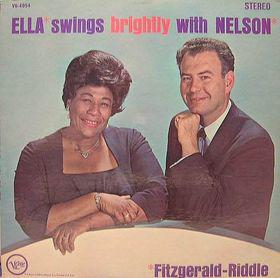
- A vintage Stereo Verve pressing (one of only a handful of copies to hit the site in almost two and a half years) with solid Double Plus (A++) grades from start to finish, and pressed on vinyl that’s about as quiet as we can ever hope to find it
- Remarkably lovely All Tube sound from 1961, with a huge, rich orchestra conducted by the legendary Nelson Riddle
- Fitzgerald’s performance on this album won her the Grammy Award for Best Vocal Performance, her 7th Grammy
- “The singer has rarely sounded better than during this period. Fitzgerald sticks mostly to familiar standards and is particularly memorable on ‘Don’t Be That Way,’ ‘What Am I Here For,’ ‘I’m Gonna Go Fishin,’ ‘ and ‘I Won’t Dance.'”
Take it from an Ella fan, you can’t go wrong with this one, assuming you can put up with some light crackle underneath the music. The record itself looks exceptionally clean and well-cared for, but it clearly does not play as quietly as we would have hoped.
The sound is rich and full-bodied in the best tradition of a classic vintage jazz vocal album. You could easily demonstrate your stereo with a record this good! The space is HUGE and the sound so rich.
Prodigious amounts of Tubey Magic as well, which is key to the best sounding copies. The sound needs weight, warmth and tubes or you might as well be playing a CD.
This early stereo pressing has the kind of Tubey Magical Midrange that modern records cannot even BEGIN to reproduce. Folks, that sound is gone and it sure isn’t showing signs of coming back. If you love hearing INTO a recording, actually being able to “see” the performers, and feeling as if you are sitting in the studio with the band, this is the record for you. It’s what vintage all analog recordings are known for — this sound.
If you exclusively play modern repressings of vintage recordings, I can say without fear of contradiction that you have never heard this kind of sound on vinyl. Old records have it — not often, and certainly not always — but maybe one out of a hundred new records do, and those are some pretty long odds.
What The Best Sides Of Ella Swings Brightly With Nelson Have To Offer Is Not Hard To Hear
- The biggest, most immediate staging in the largest acoustic space
- The most Tubey Magic, without which you have almost nothing. CDs give you clean and clear. Only the best vintage vinyl pressings offer the kind of Tubey Magic that was on the tapes in 1961
- Tight, note-like, rich, full-bodied bass, with the correct amount of weight down low
- Natural tonality in the midrange — with all the instruments having the correct timbre
- Transparency and resolution, critical to hearing into the three-dimensional studio space
No doubt there’s more but we hope that should do for now. Playing the record is the only way to hear all of the qualities we discuss above, and playing the best pressings against a pile of other copies under rigorously controlled conditions is the only way to find a pressing that sounds as good as this one does.
Copies with rich lower mids and nice extension up top (to keep Nelson’s string arrangements from becoming shrill) did the best in our shootout, assuming they weren’t veiled or smeary of course. So many things can go wrong on a record. We know, we’ve heard them all.
We’re glad to report this copy was doing more of what we wanted it to do than practically all others we played.
And we know a fair bit about Ella’s recordings at this point. As of today we’ve done commentaries for more than a dozen different Ella Fitzgerald albums.
What We’re Listening For On Ella Swings Brightly With Nelson
- Energy for starters. What could be more important than the life of the music?
- Then: presence and immediacy. The vocals aren’t “back there” somewhere, lost in the mix. They’re front and center where any recording engineer worth his salt would put them.
- The Big Sound comes next — wall to wall, lots of depth, huge space, three-dimensionality, all that sort of thing.
- Then transient information — fast, clear, sharp attacks, not the smear and thickness so common to these LPs.
- Tight note-like bass — which ties in with good transient information, also the issue of frequency extension further down.
- Next: transparency — the quality that allows you to hear deep into the soundfield, showing you the space and air around all the instruments.
- Extend the top and bottom and voila, you have The Real Thing — an honest to goodness Hot Stamper.
Hardness and Brashness
Want to know what we are on about with all this talk of hardness and brashness? Easy, just play the average copy. Unless you have been exceptionally fortunate to have chanced upon a properly mastered and pressed and cared for copy, you will hear plenty of both.
It’s one of the main reasons we have such a hard time doing shootouts for Ella’s 50s and 60s albums. The other of course is the poor condition most copies are in. Few pressings do not have marks that play or damaged grooves. The record players of the 50s and 60s, not to mention their owners, were ruinous on the albums of the day.
Which is simply another reason not to expect another top copy of this album to come to the site any time soon. Give us two or three years or so and we might be able to find another batch with which to do a shootout. In that time we will surely look at fifty copies, buy ten, and end up with five that are worth playing.
Obviously, we wouldn’t bother if the music and sound weren’t so good. When you are lucky enough to find a copy that sounds as good as this one, full of standards from the Great American Songbook, you cannot help but recognize that this era for Ella will never be equaled, by her or anyone else.
Side One
When Your Lover Has Gone
Don’t Be That Way
Love Me Or Leave Me
I Hear Music
What Am I Here For?
I’m Gonna Go Fishin’
Side Two
I Won’t Dance
I Only Have Eyes For You
The Gentleman Is A Dope
Mean To Me
Alone Together
Pick Yourself Up
AMG Review
Nelson Riddle, whose arrangements were an asset on some of Ella Fitzgerald’s Song Book projects, also made two albums with her during 1961: this one plus Ella Swings Gently with Nelson. The singer has rarely sounded better than during this period. For the Swings Brightly set (which gets a slight edge over the other one), Fitzgerald sticks mostly to familiar standards and is particularly memorable on “Don’t Be That Way,” “What Am I Here For,” “I’m Gonna Go Fishin’,” and “I Won’t Dance.”
