

More of the Music of Richard Strauss
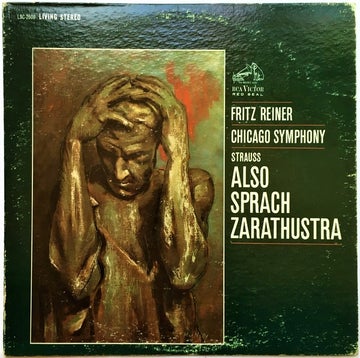
- An early Shaded Dog pressing of this wonderful classical Masterpiece with superb Double Plus (A++) sound from first note to last
- It’s also fairly quiet at Mint Minus Minus, a grade that even our most well-cared-for vintage classical titles have trouble playing at
- The vibrant colors of the orchestra are captured brilliantly in All Tube Analog by the RCA engineers, creating an immersive and engrossing listening experience for the work without equal in our experience
- There is plenty on offer for the discriminating audiophile, with the spaciousness, clarity, tonality and freedom from artificiality that are hallmarks of the best Living Stereo recordings
- “Reiner’s close familiarity with the score and personal relationship with Strauss himself add extra weight to the authority and importance of his interpretation of Also sprach Zarathustra.”
This vintage Living Stereo pressing has the kind of Tubey Magical Midrange that modern records can barely BEGIN to reproduce. Folks, that sound is gone and it sure isn’t showing signs of coming back. If you love hearing INTO a recording, actually being able to “see” the performers, and feeling as if you are sitting in the studio with the band, this is the record for you. It’s what vintage all analog recordings are known for — this sound.
If you exclusively play modern repressings of vintage recordings, I can say without fear of contradiction that you have never heard this kind of sound on vinyl. Old records have it — not often, and certainly not always — but maybe one out of a hundred new records do, and those are some pretty long odds.
What The Best Sides Of Also Sprach Zarathustra Have To Offer Is Not Hard To Hear
- The biggest, most immediate staging in the largest acoustic space
- The most Tubey Magic, without which you have almost nothing. CDs give you clean and clear. Only the best vintage vinyl pressings offer the kind of Tubey Magic that was on the tapes in 1962
- Tight, note-like, rich, full-bodied bass, with the correct amount of weight down low
- Natural tonality in the midrange — with all the instruments having the correct timbre
- Transparency and resolution, critical to hearing into the three-dimensional studio space
No doubt there’s more but we hope that should do for now. Playing the record is the only way to hear all of the qualities we discuss above, and playing the best pressings against a pile of other copies under rigorously controlled conditions is the only way to find a pressing that sounds as good as this one does.
Copies with rich lower mids and nice extension up top did the best in our shootout, assuming they weren’t veiled or smeary of course. So many things can go wrong on a record! We know, we’ve heard them all.
Top end extension is critical to the sound of the best copies. Lots of old records (and new ones) have no real top end; consequently, the studio or stage will be missing much of its natural air and space, and instruments will lack their full complement of harmonic information.
Tube smear is common to most vintage pressings. The copies that tend to do the best in a shootout will have the least (or none), yet are full-bodied, tubey and rich.
What We’re Listening For On This Classical Masterpiece
- Energy for starters. What could be more important than the life of the music?
- The Big Sound comes next — wall to wall, lots of depth, huge space, three-dimensionality, all that sort of thing.
- Then transient information — fast, clear, sharp attacks, not the smear and thickness so common to these LPs.
- Powerful bass — which ties in with good transient information, also the issue of frequency extension further down.
- Next: transparency — the quality that allows you to hear deep into the soundfield, showing you the space and air around all the instruments.
- Extend the top and bottom and voila, you have The Real Thing — an honest to goodness Hot Stamper.
A Word about the MoFi
Can you believe this bright and phony sounding piece of junk was once on the TAS Super Disc List? Sad, isn’t it? At least Harry had the good sense to delete it way back in the 80s, along with the rest of the awful MoFi’s that were on it at the time.
Hey, I sure liked a lot of my MoFi’s in the 80s too. Thank god I didn’t have my own Super Disc list at the time. It would be every bit as embarrassing as Harry’s list is these days, of that you can be sure.
A Must Own Classical Masterpiece
This Demo Disc Quality recording is a Masterpiece that should be part of any serious Classical Music Collection. Others that belong in that category can be found here.
Side One
Also Sprach Zarathustra, Op. 30, Part I
Side Two
Also Sprach Zarathustra, Op. 30 (Concluded)
Prime Phonic Review
In his 1954 recording with the Chicago Symphony Orchestra for RCA Victor, re-released on Living Stereo, Fritz Reiner’s close familiarity with the score and personal relationship with Strauss himself add extra weight to the authority and importance of his interpretation of Strauss’s celebrated tone poem.
Richard Strauss’s tone poem Also Sprach Zarathustra (“Thus Spoke Zarathustra”) was composed in 1896 and inspired by Friedrich Nietzsche’s book of the same name, which was published between 1883 and 1891. The work had its first performance on 27 November 1896 in Frankfurt with Strauss himself as the conductor and has remained popular ever since, having become an integral part of the orchestral repertoire…
Divided into nine sections named after selected chapters of Nietzsche’s book, the piece opens with a sustained low C on the double basses, contrabassoon and organ, aided by a bass drum roll, until the famous “dawn” motif is introduced with its three notes in intervals of a fifth and octave (C–G–C). Also known as the nature motif, it is central throughout the work’s structure, while its adaptation for the opening of Stanley Kubrick’s 1968 cinematic epic2001: A Space Odyssey has further boosted the work’s enduring popularity.
A special place in the long interpretative history of Also Sprach Zarathustra no doubt belongs to the performance of the piece by the Chicago Symphony Orchestra and Fritz Reiner, a particularly acclaimed interpreter of Strauss who had worked closely with the composer before moving to the United States in the early 1920s.
Reiner’s close familiarity with the score and personal relationship with Strauss himself add extra weight to the authority and importance of his interpretation of Also Sprach Zarathustra. His great attention to detail, dynamics, and motivic interrelationships, while never losing focus of the greater whole is evident is his 1954 recording of the piece with the Chicago SO for Living Stereo. Reiner does an exceptionally good job in bringing out the nuances and tonal relationships of the score that, in return, aspires to convert Nietzsche’s elaborate philosophy into musical elements through challenging conventional notions of harmony and tonality.
Its great musical value aside, Reiner’s landmark recording is also of significant historical importance. His interpretation of Strauss’s magnificent tone poem has had a considerable impact upon subsequent renditions, such as the 1970 performance of the piece by the New York Philharmonic and Leonard Bernstein, who had been a pupil of Reiner at the Curtis Institute of Music in Philadelphia.
By Mimis Chrysomallis