

More of the Music of Thelonious Monk
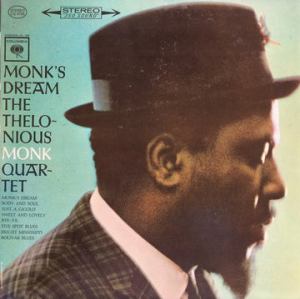

- Monk’s Dream returns to the site for only the second time in over two years, here with INCREDIBLE Shootout Winning Triple Plus (A+++) grades or close to them throughout this black print Stereo 360 pressing
- These are just a few of the things we had to say about this killer copy in our notes: “big and weighty”…”great size and detail and very full”…”breathy sax jumping out of the speakers”…”very big and full piano”
- Both of these sides are rich, spacious, big and Tubey Magical, with less smear on the piano, a problem that holds many copies back
- The sound found on these early Columbia 360 Label Stereo pressings is absolutely the right one for Monk’s music
- This is a lot of money for a somewhat noisy copy – “Body and Soul” is pretty much ruined here, alas – but the sound is so awesome and quiet pressings of the album so hard to come by that we hope someone will take a chance on it and get the thrill we did from hearing it sound so good
- 5 stars: “Although he would perform and record supported by various other musicians, the tight – almost telepathic – dimensions that these four shared has rarely been equalled in any genre… Monk’s Dream is recommended, with something for every degree of Monk enthusiast.”
A truly outstanding Monk album from 1963. Thanks to Columbia’s state of the art engineering, the recording really comes to life, or at least it does on a copy that sounds as good as this one does!
Charlie Rouse is particularly wonderful on sax on this album, and this copy features him on many of its tracks. The sax sound is full-bodied and natural with lots of breath and just the right amount of bite. Monk’s piano comes through with powerful dynamics and real weight to the keys.
So many copies just sound like an old jazz record, but this one lets you feel like you are right there in the studio, watching as the music is spontaneously created. What more could you ask for?
This vintage Columbia 360 Stereo pressing has the kind of Tubey Magical Midrange that modern records can barely BEGIN to reproduce. Folks, that sound is gone and it sure isn’t showing signs of coming back. If you love hearing INTO a recording, actually being able to “see” the performers, and feeling as if you are sitting in the studio with the band, this is the record for you. It’s what vintage all analog recordings are known for — this sound.
If you exclusively play modern repressings of vintage recordings, I can say without fear of contradiction that you have never heard this kind of sound on vinyl. Old records have it — not often, and certainly not always — but maybe one out of a hundred new records do, and those are some pretty long odds.
What The Best Sides Of Monk’s Dream Have To Offer Is Not Hard To Hear
- The biggest, most immediate staging in the largest acoustic space
- The most Tubey Magic, without which you have almost nothing. CDs give you clean and clear. Only the best vintage vinyl pressings offer the kind of Tubey Magic that was on the tapes in 1963
- Tight, note-like, rich, full-bodied bass, with the correct amount of weight down low
- Natural tonality in the midrange — with all the instruments having the correct timbre
- Transparency and resolution, critical to hearing into the three-dimensional studio space
No doubt there’s more but we hope that should do for now. Playing the record is the only way to hear all of the qualities we discuss above, and playing the best pressings against a pile of other copies under rigorously controlled conditions is the only way to find a pressing that sounds as good as this one does.
What We’re Listening For On Monk’s Dream
- Energy for starters. What could be more important than the life of the music?
- The Big Sound comes next — wall to wall, lots of depth, huge space, three-dimensionality, all that sort of thing.
- Then transient information — fast, clear, sharp attacks, not the smear and thickness so common to these LPs.
- Tight, full-bodied bass — which ties in with good transient information, also the issue of frequency extension further down.
- Next: transparency — the quality that allows you to hear deep into the soundfield, showing you the space and air around all the instruments.
- Then: presence and immediacy. The piano isn’t “back there” somewhere, lost in the mix. It’s front and center where any recording engineer worth his salt would put it.
- Extend the top and bottom and voila, you have The Real Thing — an honest to goodness Hot Stamper.
The Players
- Bass – John Ore
- Drums – Frankie Dunlop
- Piano – Thelonious Monk
- Tenor Saxophone – Charles Rouse
- Producer – Teo Macero
Side One
Monk’s Dream
Body and Soul
Bright Mississippi
Five Spot Blues
Side Two
Bolivar Blues
Just a Gigolo
Bye-Ya
Sweet and Lovely
AMG Review
Monk’s Dream is the Columbia Records debut release featuring the Thelonious Monk Quartet: Monk (piano), Charlie Rouse (tenor sax), John Ore (bass), and Frankie Dunlop (drums). Jazz scholars and enthusiasts alike also heralded this combo as the best Monk had been involved with for several years. Although he would perform and record supported by various other musicians, the tight — almost telepathic — dimensions that these four shared has rarely been equalled in any genre…
Most notable about Monk’s solo work is how much he retained the same extreme level of intuition throughout the nearly two decades that separate these recordings from his initial renderings in the late ’40s. Monk’s Dream is recommended, with something for every degree of Monk enthusiast.
Further Reading
- New to the Blog? Start here
- Important lessons we learned from record experiments
- Letters, reviews and commentaries for the music of Thelonious Monk